


 Back
Back





2023 Supreme(Raj) 1619
RAJASTHAN HIGH COURT
Rekha Borana, J.
Lrs of Manohar Lal & Ors. - Appellants
Versus
Prem Chand & Ors. - Respondents
S.B. Civil First Appeal No. 189 of 2012
Decided On : 02-05-2023
Mr. Prateek Surana, Advocate with Mr. Himanshu Bumb, Advocate, for the Appellant; Mr. Jitendra Ojha, Advocate, for the Respondent.
A right of pre-emption must be substantiated at the time of decree; absence of such right leads to dismissal of the claim.
Headnote:
Pre-emption - Right of Pre-emption - Rajasthan Pre-emption Act, 1966 - Sections 11, 15 - The court emphasized that a subsisting right of pre-emption must exist at the time of decree, which was not proven, leading to the dismissal of the appeal.
Fact of the Case:
The plaintiffs claimed a right of pre-emption over a property sold by the defendant, asserting common walls and access. The defendants contended that the property was demolished and no commonality existed.
Finding of the Court:
The court found that the plaintiffs failed to establish any common walls or access, and the property was merely a vacant plot, negating their claim to pre-emption.
Issues: The primary issue was whether the plaintiffs had a valid right of pre-emption over the disputed property.
Ratio Decidendi: The court held that a subsisting right of pre-emption must exist at the time of the decree, which was not the case here as the property had been demolished.
Result: The appeal was dismissed, affirming the lower court's judgment.
ORDER
1. The present regular appeal has been preferred against the judgment and decree dated 06.01.2012 passed in Civil Suit No.28/2011 by District Judge, Doongarpur whereby the suit for pre-emption as preferred by the plaintiffs under Section 11 of the Rajasthan Pre-emption Act, 1966 (hereinafter referred to as 'the Act of 1966') has been dismissed.
2. The case of the plaintiffs-appellants was that the defendant No.1-respondent No.1 who was the owner of the residential premise just adjoining to the houses of the plaintiffs sold out the same to defendant No.2 Mohammed Nijim on 11.04.2005 and the sale deed qua the same was also executed. The plaintiffs have two walls and the way in common with the house of the defendants and therefore, they have a right of pre-emption. It was further averred in the plaint that the notice as served by the plaintiffs was refused to be accepted by defendant No.1 and therefore, the present suit has been preferred.
3. Per contra, it was submitted by defendant No.1 that firstly, there was no house on site as alleged by the plaintiffs as of date. It was submitted that the house was in a deteriorated state and a notice was served on him by the Municipal Authorities for demolition of the house. After the property being sold out, complete three floors of the house had been demolished and as of date, there was only a vacant plot on the site. Therefore, it cannot be alleged that there were any common walls between the residential premises of the plaintiffs and defendant No.1 and they cannot claim any right of pre-emption.
4. Written statement was also filed by defendant No.2 and he specifically stated that after the premise been sold out to him, he got the same completely demolished and as of date no residential house existed on the site. It has further been submitted that neither there is common way as alleged by the plaintiffs nor were/ are there any common walls. On the basis of the pleadings, eight issues were framed by the learned Court below as under:
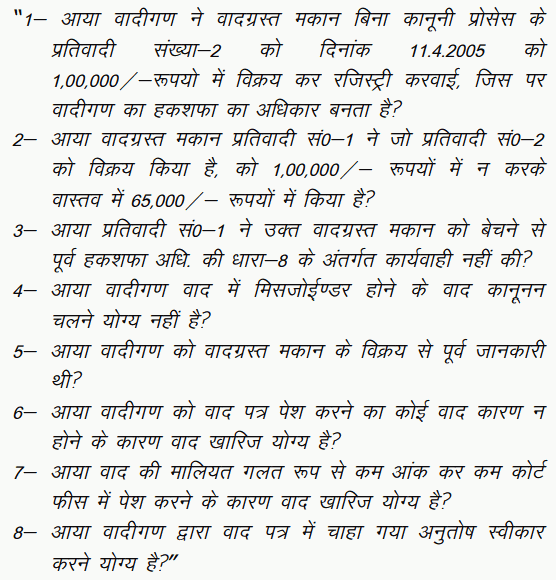
5. From a comprehension of the above facts, it is evident that the basic and foremost issue is whether the plaintiffs had a right of pre-emption in the disputed property as alleged by them? Meaning thereby, fate of issue no.1 as framed by the learned Court below would decide the fate of other issues.
6. While deciding issue no.1, the learned Court below specifically reached to a conclusion that admittedly, there was no house on site and it was only a vacant plot of land. Therefore, the averment of the plaintiffs that there were common walls between the houses of the plaintiffs and defendant falls flat on the face of it. Had there been any common walls, the demolition of the house by the defendants would definitely have affected the houses of the plaintiffs which is not the case of the plaintiffs. The learned Court below reached to the specific conclusion that the plaintiffs utterly failed to establish on record any common portion/wall between their houses and therefore, it cannot be held that the plaintiffs were entitled to any decree in their favour on the basis of right of pre-emption.
7. Section 15 of the Act of 1966 reads as under:
Provided that no voluntary transfer made in favour of the purchaser after the institution of a suit for pre-emption shall defeat any right which the plaintiff had at the date such institution."
8. Section 15 specifically provides that for a decree of preemption to be granted in favour of a party, a subsisting right of pre-emption at the time of passing of the decree oug














