
 Back
Back





IN THE HIGH COURT OF JUDICATURE FOR RAJASTHAN AT JODHPUR
SHREE CHANDRASHEKHAR, KULDEEP MATHUR, JJ.
Indraj - Petitioner
Versus
Union of India, through Secretary Ministry of Communication Dak Bhawan & Ors. - Respondents
D.B. Civil Writ Petition No. 10369 of 2024
Decided On : 02-09-2024
Disciplinary Action - Writ Petition - Indian Evidence Act, 1872 - Sections 17, 18-21 - The court emphasized the necessity of clear and unambiguous evidence for disciplinary actions, particularly regarding admissions, and highlighted the inadequacy of mere admissions without corroborative evidence in upholding punitive measures.
Fact of the Case:
The petitioner, a Branch Post Master, was charged with misappropriating funds based on irregularities found during an inspection. He denied the charges, claiming mistakes in entries and undue influence during his statement. The disciplinary authority removed him from service after an inquiry.
Finding of the Court:
The court found that the disciplinary authority's decision was based on insufficient evidence and that the Tribunal failed to consider the lack of corroborative evidence for the admissions made by the petitioner.
Issues: Whether the disciplinary action taken against the petitioner was justified based on the evidence presented during the inquiry.
Ratio Decidendi: The court held that admissions must be supported by clear evidence, and the absence of such evidence undermines the validity of disciplinary actions.
Result: The court quashed the disciplinary order and allowed the writ petition.
ORDER :
Shree Chandrashekhar, J.
This Writ Petition challenges the decision dated 23rd February 2023 passed by the Central Administrative Tribunal, Jodhpur Bench, Jodhpur in Original Application No.397 of 2015.
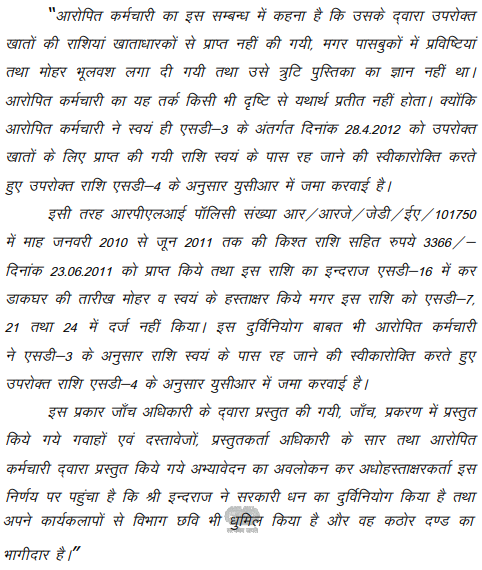
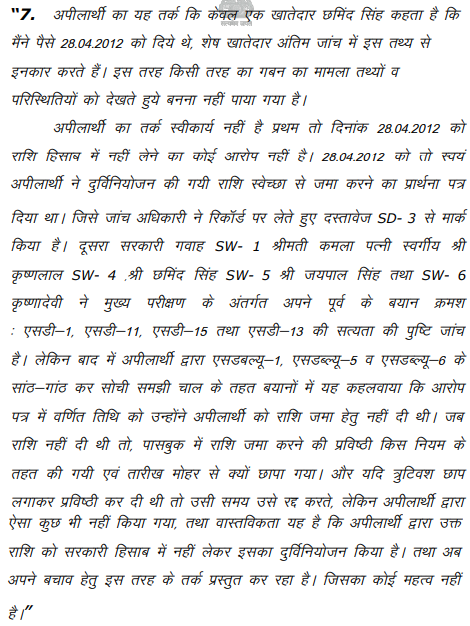
2. The petitioner was aggrieved by the punishment order dated 8th December 2014 which was approved by the Appellate Authority by an order dated 31st July 2015. The petitioner has pleaded that he was appointed as Branch Post Master in the post office Chak 1 KK Chunawadh on 12th January 1998 and discharged his duties with utmost devotion and sincerity. However, he was charged with misappropriating public fund in R.D. and Life Insurance Policy on the basis of certain irregularities detected in the Annual Inspection dated 16th June 2011. He was served a charge-memo on 17th December 2013 with two Articles of charge on imputations that (i) he received money from Smt. Kamla Devi, Chhaminder Singh and Krishna Devi for depositing in their Recurring account but the money received by him were not deposited in their accounts and entries in their passbook were made, and (ii) he received Rs.3366/- from Jaipal Singh on 23rd June 2011 against his Life Insurance Policy but this amount was also not deposited by him in the Government account. He denied the charges and claimed that he did not receive any amount from the aforesaid account holders and the entries made in the passbook of Smt. Kamla Devi was a mistake. About Chhaminder Singh, he offered an explanation that Rs.1400/- given by the said account-holder to the petitioner was deposited on the same day but mistakenly in unclassified account. He also denied the charge that Smt. Krishna Devi gave Rs.300/-to him on 31st July 2010. As regards the entry in the Life Insurance Policy of Jaipal Singh, he offered an explanation that the passbook was mistakenly stamped. The petitioner also denied the statement made by him to the Inspector of Post Office saying that his statement was procured under undue influence.
3. The Inspector of the Post Office at Suratgarh submitted a report to the Inquiry Officer indicating that the allegations made against the delinquent Government employee were found correct. The petitioner challenged the findings recorded in the inquiry by filing his reply on 13th October 2014. Thereafter, the Inquiry Officer submitted the final inquiry report on 11th November 2014 and the petitioner was offered an opportunity to reply to second show cause notice and, in compliance thereof, he filed his reply on 25th November 2014. However, the disciplinary authority by an order dated 8th December 2014 passed an order of removal from service and, as noticed above, the appeal preferred by him has been dismissed.
4. The Tribunal held that the departmental authorities rightly accepted the inquiry report and, that, not even an inquiry was required in the face of admission of guilt by the delinquent bank employee. The Tribunal referred to the decision in “Central Bank of India Vs. Karunamoy Banerjee”, AIR 1968 SC 266 where the Hon'ble Supreme Court observed that if the workman admits his guilt then it would be a mere empty formality to insist upon the Management to lead evidence in support of the charge framed against the delinquent Government employee. The Tribunal also referred to the decisions in “Channabasappa Basappa Happali, Vs. State of Mysore”, AIR 1972 SC 32 and “Manager Boisahabi tea Estate Vs. P.O. Labour Court”, 1981 Lab IC 557 on the above proposition.
5. The Tribunal further referred to the decisions in “State of Andhra Pradesh & Ors. Vs. S. Sree Rama Rao”, AIR 1963 SC 1723, “Andhra Pradesh & Ors. Vs. Chitra Venkata Rao” 1975 (2) SCC 557, “Union of India Vs. P. Gunasekaran” 2015 (4) SLR 244, “U.P. State Road Transport Corporation Vs. Suresh Chand Sharma”, (2010) 6 SCC 555 and held that no interference was required in the matter, not even with the punishment of removal from service on the ground of the same being disproportionate to the charge found proved against the delinquent ba
AI
Disciplinary actions require clear evidence beyond mere admissions; unsupported admissions cannot justify punitive measures.

In disciplinary proceedings for misappropriation, judicial review is limited; cannot re-appreciate evidence or substitute views if inquiry fair, findings based on some evidence, and punishment propor....

Disciplinary actions against employees for financial misappropriation must follow due process and can only be interfered with if proven unreasonable, arbitrary, or disproportionate to the misconduct.

Removal from service upheld for GDS Branch Postmaster's misappropriation despite repayment; courts refrain from interfering with punishment quantum unless shocking to conscience, emphasizing strict s....

The court upheld the dismissal of a government employee for embezzlement, affirming that disciplinary authority's findings are binding unless proven perverse.

Admission of guilt in disciplinary proceedings cannot be contested later; courts seldom interfere with the quantum of punishment unless shockingly disproportionate.

The court affirmed the necessity of stringent penalties for corruption within public service, emphasizing that admissions of guilt during inquiries mitigate claims of unjust treatment.

The court upheld the impugned punishment order as sustainable in the eyes of the law.



An indispensable Tool for Legal Professionals, Endorsed by Various High Court and Judicial Officers
Please visit our Training & Support
Center or Contact Us for assistance

Scan Me!
India’s Legal research and Law Firm App, Download now!


For Daily Legal Updates, Join us on :



 Back to top


