
 Back
Back





HIGH COURT OF RAJASTHAN (JODHPUR BENCH)
MR. JUSTICE KULDEEP MATHUR, J
VINOD KUMAR @ BILLA – Appellant
Versus
STATE OF RAJASTHAN – Respondent
CRLMB / 14056 / 2024
(A) Code of Criminal Procedure, 1973 - Section 439 - Bail application - The petitioner was arrested in connection with F.I.R. No.51/2023 for offences under NDPS Act - The petitioner was implicated solely based on statements from co-accused without direct evidence - The court found no other evidence indicating involvement of the petitioner in the alleged crime. (Paras 1, 2, 3, 8)
(B) Bail - Considerations for granting bail - The court noted that the petitioner is in judicial custody and the trial will take a long time, thus justifying the grant of bail. (Paras 4, 8)
Facts of the case:
The petitioner was arrested for possession of poppy husk/straw greater than commercial quantity, implicated based on co-accused statements without direct evidence against him.
Findings of Court:
The court found sufficient grounds to grant bail due to lack of direct evidence against the petitioner and the lengthy trial process.
Issues: The main issues were the sufficiency of evidence against the petitioner and the implications of being a habitual offender.
Ratio Decidendi: The court ruled that the absence of direct evidence against the petitioner warranted the granting of bail, emphasizing that implications based solely on co-accused statements are insufficient for denial of bail.
Result: Bail application allowed.
ORDER :
(FARJAND ALI, J.)
1. This second application for bail under Section 439 Cr.P.C. (483 BNSS) has been filed by the petitioner who has been arrested in connection with F.I.R. No.51/2023, registered at Police Station Ghamoodwali, District Sri Ganganagar, for offences under Sections 8/15 and 25 of NDPS Act.
2. Learned counsel for the petitioner submitted that the contraband (poppy husk/straw) greater than commercial quantity weighing 100 kgs. was recovered from the conscious possession of the co-accused persons namely Aslam and Vishnu. Learned counsel submitted that the petitioner has been implicated in the present case solely on the basis of the information supplied by the co-accused persons while they were in custody.
3. Drawing attention of the Court towards the challan papers and the statements of the Investigating Officer- Gopal Singh (PW.2), learned counsel submitted that apart from the information divulged by the co-accused persons while they were in custody, there is no other direct/circumstantial evidence is available on record indicating the involvement of the petitioner in commission of the alleged crime.
4. Lastly, learned counsel for the petitioner submitted that the petitioner is in judicial custody and the trial of the case will take sufficiently long time, therefore, the benefit of bail should be granted to the accused-petitioner.
5. Per contra, learned Public Prosecutor has vehemently opposed the bail application and submitted that the petitioner is a habitual offender and therefore, looking to the seriousness of the allegations levelled against the present petitioner, he does not deserve to be enlarged on bail. However, he was not in a position to refute the fact that the Investigating Officer- Gopal Singh (PW.2) during his cross-examination before the competent criminal Court has admitted the fact that apart from the statements of the co-accused persons, he had not collected any other evidence indicating the involvement of the petitioner in commission of the alleged crime.
6. Heard learned counsel for the parties at Bar. Perused the material available on record.
7. The relevant portion of the cross-examination of the Investigating Officer- Gopal Singh (PW.2) is reproduced below for ready reference:-
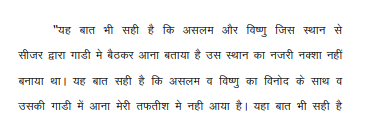
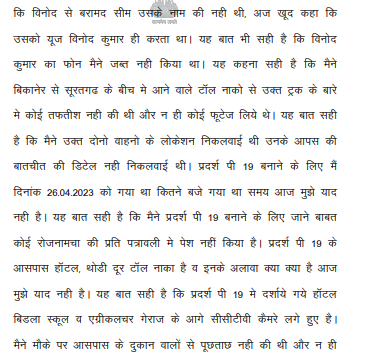
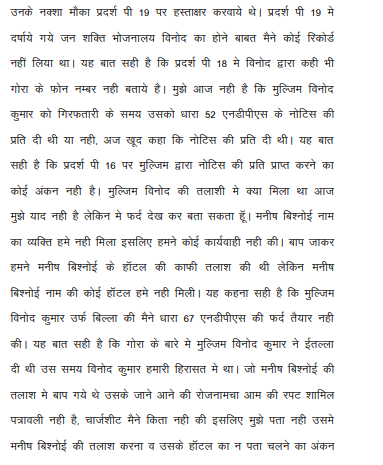
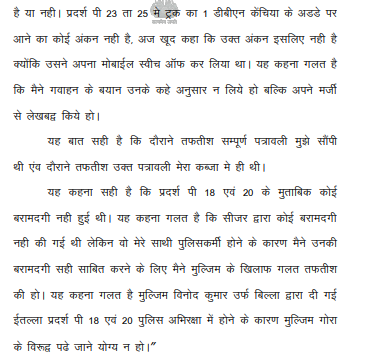
8. Having considered the rival submissions, facts and circumstances of the case, this Court prima facie finds sufficient force in the argument of learned senior counsel for the petitioner that the petitioner has been implicated in the present case solely on the basis of the information supplied by the co-accused persons while they were in custody. This Court prima facie does not find any other direct/circumstantial evidence available on record indicating the involvement of the petitioner in commission of the alleged crime. Thus, without expressing any opinion on merits/demerits of the case, this Court is inclined to enlarge the petitioner on bail.
9. Consequently, this second bail application under Section 439 Cr.P.C. (483 BNSS) is allowed. It is ordered that the accused- petitioner- Vinod Kumar @ Billa S/o Nihalchand, arrested in connection with F.I.R. No.51/2023, registered at Police Station Ghamoodwali, District Sri Ganganagar, shall be released on bail, if not wanted in any other case, provided he furnishes a personal bond of Rs.1,00,000/- and two sureties of Rs.50,000/- each, to the satisfaction of learned trial Court, for his appearance before that Court on each & every date of hearing and whenever called upon to do so till completion of the trial.
10. It is however, made clear that findings recorded/observations made above are for limited purposes of adjudication of bail application. The trial Court shall not get prejudiced by the same.
The absence of direct evidence against a petitioner, solely relying on co-accused statements, justifies the granting of bail under Section 439 Cr.P.C.

Bail should be granted when there is no direct or circumstantial evidence against the accused, despite initial implicating statements that have been retracted.

The court granted bail due to lack of direct evidence against the petitioner and absence of criminal antecedents, emphasizing the presumption of innocence.
The court granted bail to the petitioner, finding insufficient grounds for continued detention based on the nature of the charges and comparison with a co-accused already granted bail.
Bail may be granted when the petitioner is not in possession of contraband and co-accused have been released, considering judicial custody and absence of criminal antecedents.
The court granted bail due to lack of evidence against the petitioner and the lengthy trial duration, emphasizing the need for substantial grounds to question the prosecution's case.
The principle of parity in bail applications allows for the release of accused if co-accused in similar circumstances have been granted bail.
The court granted bail based on insufficient evidence against the petitioner and the principle of parity with a co-accused already released on bail.



An indispensable Tool for Legal Professionals, Endorsed by Various High Court and Judicial Officers
Please visit our Training & Support
Center or Contact Us for assistance

Scan Me!
India’s Legal research and Law Firm App, Download now!


For Daily Legal Updates, Join us on :



 Back to top


