
 Back
Back





HIGH COURT OF RAJASTHAN (JAIPUR BENCH)
PANKAJ BHANDARI, SHUBHA MEHTA, JJ
Nidhi Choudhary D/o Shri Rajendra Singh Bhamu - Appellant
Versus
The State of Rajasthan - Respondent
SAW / 407 / 2024
Decided On : 07-01-2025
(A) Right to Education Act, 2009 - Judicial review of examination processes - The court emphasized that the answer key should be assumed correct unless demonstrably erroneous, as established in Kanpur University and Ors. Vs. Samir Gupta and Ors. (1983 AIR (SC) 1230). (Paras 28, 29)
(B) Expert Committee - The court held that it cannot substitute its judgment for that of an expert committee unless the answers are palpably erroneous. (Paras 28, 31)
Facts of the case:
The appellants challenged the final answer key issued by the Rajasthan Staff Selection Board after 138 writ petitions were dismissed, arguing that certain answers were incorrect and should have been changed or deleted. (Paras 1, 2)
Findings of Court:
The court found no palpable error in the expert committee's final answer key and upheld the dismissal of the appeals. (Paras 31)
Issues: The main issues included whether the expert committee's answers were demonstrably erroneous and if the court could intervene in the expert committee's decisions. (Paras 28, 29)
Ratio Decidendi: The court ruled that the expert committee's decisions are to be respected unless there is clear evidence of error, reaffirming the principle that courts should not act as experts in such matters. (Paras 28, 31)
Result: Appeals dismissed.
JUDGMENT
Pankaj Bhandari, J
1. Appellants have preferred these Special Appeals (Writ) aggrieved by Order dated 31.05.2024, whereby 138 writ petitions were dismissed by a common order.
2. Succinctly stated the facts of the case are that the appellants herein and other petitioners who are aggrieved by the final answer key have preferred the writ petitions before the High Court challenging certain questions and the final answers approved by the Rajasthan Staff Selection Board (for short ‘RSSB’). Out of 138 petitions, 21 appeals have been preferred before this court. It is pertinent to note that after reviewing of the answer key, the matter was agitated before the High Court in writ jurisdiction and High Court has referred certain questions to the expert committee. The expert committee thereafter reviewed the answers and issued the final answer key and results were declared, aggrieved by which, the present appeals have been preferred.
3. It is contended by counsel for the appellants that certain questions ought to have been deleted, but the same have not been deleted. Certain questions where the answer was originally correct has been changed. It is contended that after declaration of the answer key, objections with regard to 22 questions were raised before the authorities and authorities after reviewing the answers, deleted five questions, changed three answers and 14 answers remain unchanged. It is contended that if the answers are palpably and demonstrably erroneous, the Courts can review the said answers. In the present case, the answers were palpably and demonstrably wrong and, therefore, learned Single Judge ought to have reviewed the answer key.
4. Our attention has been drawn to question No.19 which reads as under:-
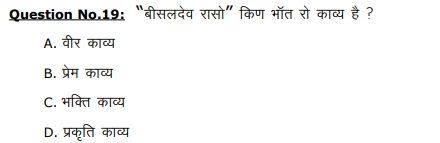
5. It is contended by counsel for the appellants that as per the text books, the correct answer is Option A and as per the experts committee Option B is the correct answer which is not the correct answer.
6. Per contra, learned counsel for the RSSB and learned AAG contends that this question was neither placed before the learned Single Judge nor was considered by the learned Single Judge and now at the stage of appeal, the same cannot be raised. It is contended that Bisaldev Raso had nothing to do with “Vir Kavya” and the experts committee had rightly changed the answer to Prem Kavya.
7. Our attention has also been drawn to Question No.55 which reads as under:-
Question No.55: Children who belonging to Scheduled Caste, Scheduled Tribe or Socially and Educationally Backward Class are defined as-
A. Weaker Section.
B. Special Backward Class.
C. Below Poverty Line.
D. Disadvantaged Group.
In the preliminary answer key, the answer was Option D and after receiving the objections, the expert committee deleted the question. After the interim order order passed by the Court dated 12.09.2023, there was re-verification by the experts and the question was deleted.
8. It is contended by counsel for the appellants that the answer in this case should have been Option D which was the original answer in the preliminary answer key, as the children belonging to Scheduled Caste, Scheduled Tribe or socially and educationally backward class are defined as disadvantaged group.
9. Per contra, Counsel for the RSSB and learned AAG contends that the definition of disadvantaged groups includes within its ambit those children who are disadvantaged on account of cultural, economic, geographical, linguistic or gender relating factors and thus, the expert committee deleted the question. The expert committee thereafter constituted in pursuance of the interim order passed by the High Court dated 12.09.2023 has also deleted the question. It is contended that the rationale adopted by the expert committee for affirming the answer noted in the final answer key was that as per the definition clause of the Right to Education Act, 2009, the definition of ‘disadvantaged group’ is broader, which also includes within its ambit those children who are disadvantaged on acc
The court affirmed that an answer key is presumed correct unless proven demonstrably erroneous, emphasizing respect for expert committee decisions in educational assessments.
Judicial review of examination answer keys is limited; courts cannot substitute expert judgment unless answers are demonstrably erroneous.

Judicial review of answer keys is limited; courts should not substitute their judgment for that of experts unless errors are clearly demonstrable.
Point of Law : Law that compassion sympathy or claim on basis of assessment cannot be permitted as entire examination process is derailed because some candidates are disappointed or dissatisfied or p....


Judicial review of examination answer keys is permissible only in exceptional cases where the key is demonstrably wrong, and the burden of proof lies with the candidates to show such error without in....



An indispensable Tool for Legal Professionals, Endorsed by Various High Court and Judicial Officers
Please visit our Training & Support
Center or Contact Us for assistance

Scan Me!
India’s Legal research and Law Firm App, Download now!


For Daily Legal Updates, Join us on :



 Back to top


