
 Back
Back





HIGH COURT OF JUDICATURE FOR RAJASTHAN, BENCH AT JAIPUR
SANJEEV PRAKASH SHARMA, ACJ., SANJEET PUROHIT, J.
Sheela Kumari, W/o. Shri Ram Narayan Sharma – Petitioner
Versus
State Of Rajasthan, Through Secretary, Rural Development And Panchayati Raj Department – Respondent
D.B. Civil Writ Petition No. 7718 of 2025 Connected With D.B. Civil Writ Petition No. 2338 of 2020
Decided On : 14-11-2025
The judgment addresses a large number of writ petitions and special appeals challenging the delimitation of Panchayati Raj Institutions and Municipalities in Rajasthan, including inclusions/exclusions of areas, ward boundaries, and related electoral processes under the Rajasthan Panchayati Raj Act, 1994, and the Rajasthan Municipalities Act, 2009 (!) .
Local self-governance in India involves three tiers: Union, State, and Local Bodies, with Panchayats for rural areas (Part IX, Articles 243-243O, Eleventh Schedule) and Municipalities for urban areas (Part IX-A, Twelfth Schedule), emphasizing democratic participation and accountability (!) (!) .
The Rajasthan Panchayati Raj Act, 1994, and Rajasthan Municipalities Act, 2009, implement constitutional mandates for local bodies, with delimitation powers vested in the State Government for territorial adjustments and elections (!) (!) .
The litigation arises from state-wide delimitation efforts initiated in 2024-2025, affecting Panchayats and Municipalities due to district reorganizations, COVID-19 disruptions, and a policy for unified elections, leading to challenges on grounds like procedural irregularities and arbitrary actions (!) (!) .
Key issues include: maintainability of challenges to final delimitation notifications; scope of judicial review under Article 226; statutory nature of guidelines; locus standi of petitioners; compliance with natural justice principles; and constitutional obligations for timely elections (!) (!) .
Petitioners argue notifications violate Article 243E (five-year term for local bodies) and Article 243U (timely elections), lack prior consultation with State Election Commission, and ignore guidelines on population, distance, and facilities (!) (!) (!) (!) (!) (!) (!) (!) (!) (!) (!) (!) (!) (!) (!) (!) (!) (!) (!) .
Respondents contend that delimitation notifications are conditional legislation, immune from judicial interference except in cases of manifest arbitrariness; guidelines are administrative, not statutory; and elections are postponed bona fide due to reorganization for efficiency and financial viability (!) (!) (!) (!) (!) (!) (!) (!) (!) (!) (!) (!) (!) (!) (!) (!) (!) (!) (!) (!) .
Article 243O(a) and 243ZG(a) bar courts from questioning delimitation laws or seat allotments made under Articles 243K and 243ZA; Section 117 of the 1994 Act and Section 30 of the 2009 Act similarly prohibit interference in delimitation or electoral matters (!) (!) (!) (!) (!) (!) (!) (!) (!) (!) (!) (!) (!) (!) .
Judicial review under Article 226 is limited to procedural irregularities, perversity, or arbitrariness in decision-making, not merits; delimitation notifications are legislative acts not open to challenge except in rare cases of constitutional violation (!) (!) (!) (!) (!) (!) (!) (!) (!) (!) (!) (!) (!) (!) (!) (!) .
Guidelines for delimitation (e.g., population 3000-5500, 6 km distance, facilities) are administrative instructions, not statutory rules under Section 102 of the 1994 Act or equivalent provisions, and deviations do not vitiate notifications (!) (!) (!) (!) (!) (!) (!) (!) .
Petitioners have locus standi to challenge delimitation if rights are affected, as notices under Section 101(1) of the 1994 Act invite public input; mere administrative guidelines do not bar writs (!) (!) (!) (!) (!) (!) (!) (!) .
No statutory mandate requires hearing or reasoned orders on objections under Section 101; process is legislative, not quasi-judicial, so natural justice principles like audi alteram partem do not apply (!) (!) (!) (!) (!) (!) (!) (!) (!) (!) (!) (!) .
Challenges to final notifications on grounds like population/distance deviations, political motivation, or non-consultation with State Election Commission fail, as decisions involve subjective satisfaction and holistic factors (!) (!) (!) (!) (!) (!) (!) (!) (!) (!) (!) (!) (!) (!) (!) (!) (!) (!) (!) (!) (!) (!) (!) (!) (!) (!) (!) (!) (!) (!) .
Direct inclusion of rural areas into municipalities under Section 3 of the 2009 Act does not require prior transitional area declaration under Article 243Q(2); overriding provisions apply (!) (!) (!) (!) (!) (!) (!) (!) (!) (!) (!) (!) (!) (!) (!) .
Petitions challenging ongoing delimitation process (pre-final notification) are premature; no interference until final notification (!) (!) (!) (!) (!) (!) (!) (!) (!) (!) .
Interim order dated 23.05.2025 directing High-Level Committee to adjudicate objections is set aside; proposals must be considered objectively, but no judicial oversight required (!) (!) (!) (!) (!) (!) .
Delimitation of municipal wards without census change or boundary alteration is invalid under Sections 6, 9, 10 of the 2009 Act (!) (!) (!) (!) (!) (!) (!) (!) (!) (!) (!) (!) (!) (!) (!) (!) .
Pradhan vacates office upon ward exclusion from Panchayat Samiti under Section 101(5A) of 1994 Act and Section 3(8) of 2009 Act; no continuation despite representing broader area (!) (!) (!) (!) (!) (!) (!) (!) (!) (!) (!) (!) (!) (!) (!) (!) (!) (!) (!) (!) (!) (!) (!) (!) (!) (!) (!) (!) (!) .
Administrator appointments under Section 95(1)(b) of 1994 Act and Section 322(3)(b) of 2009 Act are valid; outgoing Sarpanch can serve as Administrator, distinct from urban bodies (!) (!) (!) (!) (!) (!) (!) (!) (!) (!) (!) (!) (!) (!) (!) (!) (!) (!) (!) (!) (!) (!) (!) (!) (!) (!) .
Village headquarters selection is administrative; guidelines for facilities/distance are non-statutory, not judicially reviewable (!) (!) (!) (!) (!) (!) .
Elections must follow constitutional mandate (Articles 243E, 243U); postponement justified by bona fide reorganization, but must be held post-delimitation by 15.04.2026 (!) (!) (!) (!) (!) (!) (!) (!) (!) (!) (!) (!) (!) (!) (!) (!) (!) (!) (!) (!) (!) (!) (!) (!) (!) (!) (!) (!) (!) (!) (!) (!) (!) (!) (!) (!) (!) (!) (!) (!) (!) (!) (!) (!) .
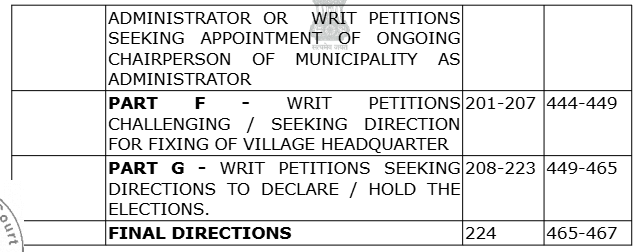
Final directions: dismiss challenges to final notifications; no interference in ongoing processes; prohibit ward boundary changes without census/boundary alteration; complete delimitation by 31.12.2025; hold elections by 15.04.2026 (!) (!) (!) (!) (!) (!) (!) (!) (!) (!) (!) (!) (!) (!) (!) .
JUDGMENT :
PART I - PREFACE
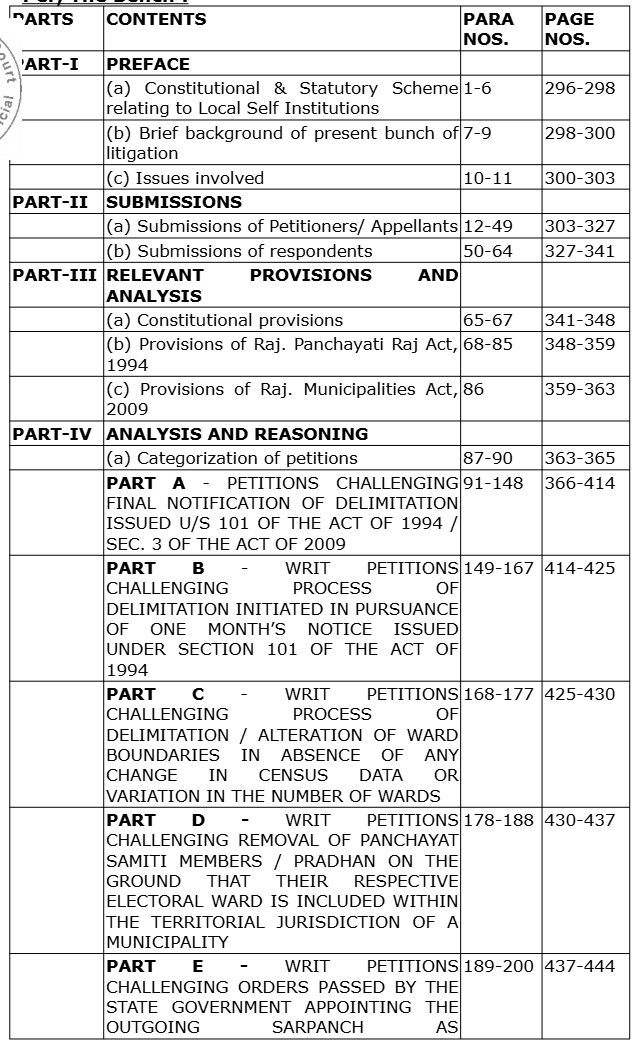
(a) CONSTITUTIONAL & STATUTORY SCHEME RELATING TO LOCAL SELF INSTITUTIONS
1. The governance mechanism in India was largely with the Union of India and the States and Union Territories, under the Constitution. However, urban local self governance and organisation of Village Panchayats was an aspiration as envisaged under Article 40 of the Constitution wherein it was provided that the State shall take steps to organise village panchayats and endow them with such powers and authority as may be necessary to enable them to function as units of self-government.
2. The concept of self governance was initially regulated and controlled by the executive of the States. The Parliament while bringing out amendment in the Constitution inserting Part-IXA, under its objects and reasons, recognized that the system as was being followed, was pleased with many vices and could not acquire the status and dignity of responsible people bodies.
3. Accordingly, Part-IX introduce a three tier system of Panchayat Raj Institutions at Village, intermediate and district levels, while Part-IXA introduce a system of three types of municipalities based on the size of urban areas, the lowest being an area of transition from rural area to an urban area. Articles243B and 243Q mandated institutions of local governance in the States based on ratio between population and territorial areas and number of cities. It also provided for reservation for different sections of society which deserve representation as per population. With the amendment, the governance stands distributed in between Union, States and Local Self Governance with a separate sphere of functioning as per the schedules to the Constitution.
4. While the three governance have to act in tandem with each other, the Indian federalism puts more stress on overall governance to the Union, followed by the State Government and then the local governance amongst the local bodies which, of course, has to be under the supervision of the States. The functions of the third limb of governance, namely local self governance, have been clearly outlined under Articles 243G, 243H, 243W and 243X, and Eleventh and Twelfth Schedules of the Constitution.
5. Local self governance, thus, treats a District to be a third territorial unit after the Central and the States, and local self governance for various levels under the District comprising of rural and urban areas forms the source of self governance, as envisaged in the Constitution. The essence of democracy, thus, lies in the manner the local authorities function and, therefore, periodical elections at grassroot level become a necessary ingredient. The scope and functional structure of Panchayati Raj and municipal institutions form the basis for conducting such elections. Delimitation of territory, therefore, has an important role in identifying participation of the people at large in a particular territory in representation at Panchayats and municipalities. The State legislature has been empowered to enact laws for all the purposes as envisaged under Part-IXA of the Constitution.
6. Accordingly, the State of Rajasthan legislature enacted Rajasthan Panchayati Raj Act, 1994 and Rajasthan Municipalities Act, 2009, to which we may refer at appropriate stage of this judgment. The Rajasthan Panchayati Raj Act, 1953 and the Rajasthan Panchayat Samiti & Zila Parishad Act, 1959 were repealed and the Rajasthan Panchayati Raj Act, 1994 was brought into force w.e.f. 23.4.1994 vide gazette notification. From time to time there have been certain amendments made. Similarly, Rajasthan Municipalities Act, 1959, wherein amendments had been made from time to time by the legislature in consonance with the provisions incorporated in Part IXA of the Constitution, was repealed and the Rajasthan Municipalities Act, 2009, was enacted by the State legislature vide notification dated 11.9.2009 w.e.f. 15.9.2009, which comprehensively deal with all the aspects relating to local sel
The court held that notifications for delimitation of Gram Panchayats are administrative acts not subject to judicial review unless proven arbitrary, and non-adherence to internal guidelines does not....

Delimitation after panchayat reorganization mandates strict adherence to 7-day objection and appeal timelines; curtailment to 3 days and rushed processes invalid; conduct elections using prior valid ....

Delimitation orders issued under constitutional provisions are immune from judicial review barring exceptional circumstances; challenges to their validity cannot be entertained under Article 226 of t....

Delimitation exercises must adhere strictly to statutory provisions to ensure free and fair elections; failing to do so constitutes a colorable exercise of power.

The court affirmed that without new census data or changes in municipal boundaries, the delimitation of wards is unauthorized as per the Rajasthan Municipalities Act, 2009.

Limited scope of judicial review in administrative actions and impermissibility of interference in electoral matters after the commencement of the election process
The main legal point established in the judgment is the interpretation of legal provisions related to the term of the Municipal Corporation, the constitution of the Delimitation Board, and the scope ....

Election - Delimitation notification - Both Zilla Panchayat and Taluk Panchayat, only rider is in terms of proviso appended to Sections 161 and 122 which bar Election Commission to bring into force d....



An indispensable Tool for Legal Professionals, Endorsed by Various High Court and Judicial Officers
Please visit our Training & Support
Center or Contact Us for assistance

Scan Me!
India’s Legal research and Law Firm App, Download now!


For Daily Legal Updates, Join us on :



 Back to top


