
 Back
Back





IN THE HIGH COURT OF HIMACHAL PRADESH AT SHIMLA
JYOTSNA REWAL DUA, J.
The State H.R.T.C Conductor Union, Himachal Pradesh - Petitioner
Versus
State of H.P. & Anr. - Respondents
CWP No. 4956 of 2021
Decided On : 21-11-2025
| Table of Content |
|---|
| 1. historical pay parity between conductor and clerk disrupted temporarily in 2012 (Para 1 , 2 , 3 , 4) |
| 2. pay parity requires equivalence in duties, qualifications, responsibilities (Para 5) |
Judgment :
Jyotsna Rewal Dua, J.
Petitioner is a Union registered under the Trade Unions Act, 1926 before the Registrar Trade Unions, Himachal Pradesh. It is seeking to espouse the cause of its members-the Conductors working in Himachal Road Transport Corporation (HRTC)-respondent No.2, concerning anomaly in their pay-scale.
2. The case
Following facts are not in dispute:-
2(i) Respondent-HRTC came into existence on 02.10.1974. It framed Recruitment & Promotions Rules for its employees in the year 1976 and carried out amendments thereto from time to time in accordance with law. Post of Conductor in the respondent No.2-Corporation was in the pay-scale of Rs.110-200 prior to 01.01.1978 and in pay-scale of Rs. 400-600 as on 01.01.1978. The same was the pay- scale for the post of Clerk in the respondent No.2- Corporation. During third general revision of pay-scales, post of Conductor in respondent No.2-Corporation was assigned pay-scale of Rs.950-1800 with initial start of Rs.1000/- w.e.f. 01.01.1986. Post of Clerk in the respondent No.2- Corporation was also allocated the same pay scale. In the next general revision of pay-scales (4th), Rs.3120-5160 was the pay-scale for the post of Conductor in the HRTC. The same pay scale was given to the post of Clerk. In the 5th general revision of pay-scales, effective from 01.01.2006, the post of Conductor and that of Clerk in the respondent No.2- Corporation again had the same pay scale of Rs.5910-20200 + 1900 (GP). The above position is tabulated as under (provided by the respondent in office letter dated 29.10.2025):-
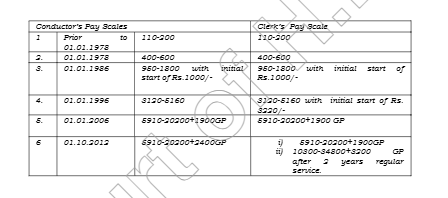
2(ii) The above table makes it evident that right from the first revision of pay-scale till the 4th revision, post of Conductor and Clerk in the respondent No.2-Corporation enjoyed the same pay-scale. Problem arose w.e.f. 01.10.2012. The genesis of the problem lay in a notification issued by the respondent No.1-State Government on 27.09.2012. This notification was issued in exercise of powers conferred by Rules 3 & 9 of the Himachal Pradesh Civil Services (Category/Post wise Revised Pay) Rules 2012. The notification gave benefit of revised Pay Band and Grade Pay to 26 categories of posts in the State. The category of Clerk figured at Sr. No.15 of the notification. The revised Pay Band and Grade Pay given to this category under the aforesaid notification dated 27.09.2012 was as under: -
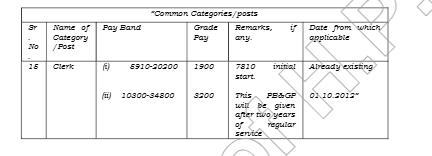
The post of Clerk, which was in the pay-scale of Rs.5910-20200 +1900 (GP) with initial start of Rs.7810 was to get pay-scale of Rs.10300-34800 + 3200 (GP) after two years of regular service w.e.f. 01.10.2012. The post of Conductor which admittedly did not exist in the respondent- State Government, was not included in the State notification dated 27.09.2012.
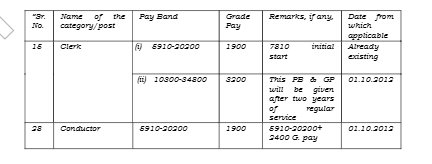
2(iii) Based upon the State Government notification dated 27.09.2012, respondent No.2-Corporation issued its office order on 24.10.2013 allowing its employees the same pay-scales as allowed by the State Government in the notification dated 27.09.2012 for the posts included in the said notification. Accordingly, the post of Clerk in the respondent No.2-Corporation, which was enjoying the pay- scale of Rs.5910-20200 +1900 (GP) was to have the pay- scale of Rs.10300-34800+3200 (GP) after two years of regular service w.e.f. 01.10.2012. The arrears for the period 01.10.2012 to 30.09.2013 were ordered to be credited in the Provident Fund Accounts of the concerned individuals and were to be paid in cash w.e.f. 01.10.2013.
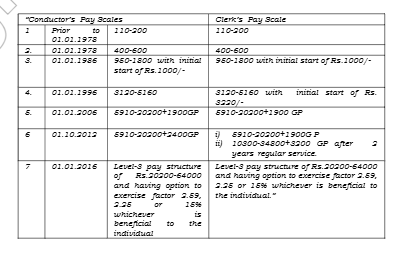
The pay-scale of the Conductor in the respondent No.2-Corporation did not undergo any revision save and except enhancement of Grade Pay from Rs.1900/- to Rs.2400/-. For better comprehension, the revision carried out by respondent No.2-Corporation in the pay scales for the post of Clerk and Conductor under office order dated 24.10.2013
AI
Courts may rectify pay scale anomaly between historically equivalent posts arising from irrational partial adoption of revision notifications, without job evaluation or equating duties.
State's selective deviation from followed pay pattern without objective justification, failing to reflect grade pay enhancement in basic pay and initial start, creates anomaly violating Articles 14 a....

The determination of pay scales is the exclusive domain of the state, and courts should only intervene in cases of constitutional violations.
The State of Himachal Pradesh is not mandated to follow pay scales set by another State; employer discretion in service conditions is reaffirmed.

The main legal point established in the judgment is the requirement for establishing parity in pay scales based on comparative job evaluation and equation of posts, and the burden of proof on the pet....
Arbitrariness is an anti-thesis of doctrine of equality envisaged under Article 14 of Constitution of India.

The principle of equal pay for equal work under Articles 14 and 39(d) of the Constitution mandates that employees performing similar duties be compensated equally, regardless of title discrepancies.

Tribunal cannot grant higher promotional pay scale to one cadre's employees matching another distinct cadre's juniors by one-time parity, as it exceeds jurisdiction absent Article 14 violation from r....

Direct appointees entitled to pay parity with transferred employees and departmental counterparts performing identical duties, as unequal pay scales violate Articles 14/16; courts rectify arbitrary a....



An indispensable Tool for Legal Professionals, Endorsed by Various High Court and Judicial Officers
Please visit our Training & Support
Center or Contact Us for assistance

Scan Me!
India’s Legal research and Law Firm App, Download now!


For Daily Legal Updates, Join us on :



 Back to top


