
 Back
Back





IN THE HIGH COURT OF JHARKHAND AT RANCHI
HON'BLE THE ACTING CHIEF JUSTICE SHREE CHANDRASHEKHAR, HON'BLE MRS. JUSTICE ANUBHA RAWAT CHOUDHARY
M/s. G.P.T. Infraprojects Limited – Appellant
Versus
State of Jharkhand - Respondent
LPA No. 186 of 2016
Decided on : 29-01-2024
[ARBITRATION] - [Micro, Small and Medium Enterprises Development Act, 2006 and Arbitration and Conciliation Act, 1996] - [Sections 18, 21, 34 of the Arbitration and Conciliation Act, 1996; Sections 17, 18 of the Micro, Small and Medium Enterprises Development Act, 2006] - The court analyzed the jurisdictional issues surrounding the award passed by the Jharkhand Facilitation Council under the MSMED Act, emphasizing that the council must follow the procedural requirements of both the MSMED Act and the Arbitration Act. The court highlighted that the Facilitation Council failed to properly initiate arbitration proceedings after conciliation efforts, rendering the award a nullity. The court concluded that the buyer's challenge to the award should not have been dismissed on the grounds of alternative remedies under Section 34 of the Arbitration Act, as the award was not validly constituted in the first place, thus allowing the appeal and remitting the matter back to the Facilitation Council for proper proceedings.
Fact of the Case:
The buyer, M/s. G.P.T. Infraprojects Limited, challenged an award passed by the Jharkhand Micro and Small Enterprises Facilitation Council, which was communicated on 12.12.2013. The buyer contended that the council's composition violated Section 21 of the MSMED Act and that the award lacked proper procedural adherence, as it was issued without a formal termination of conciliation proceedings. The buyer sought to quash the award through a writ petition under Article 226 of the Constitution, which was dismissed by the learned writ court, prompting the appeal.
Finding of the Court:
The court found that the Facilitation Council did not follow the necessary procedures outlined in the MSMED Act and the Arbitration Act, particularly failing to record the failure of conciliation before proceeding to issue an award. The court determined that the award was a nullity and that the learned writ court erred in dismissing the writ petition on the basis that the buyer had an alternative remedy under Section 34 of the Arbitration Act.
Issues: 1. Whether the award passed by the Facilitation Council was valid and could be challenged under Section 34 of the Arbitration Act? 2. Whether the learned writ court was justified in dismissing the writ petition on the grounds of alternative remedies?
Ratio Decidendi: The court held that the award was not valid as the Facilitation Council failed to properly initiate arbitration proceedings after conciliation. The court emphasized that the procedural requirements of both the MSMED Act and the Arbitration Act must be adhered to, and the absence of such adherence rendered the award a nullity, thus allowing the appeal.
Final Decision: The appeal was allowed, the award passed by the Facilitation Council and the order of the learned writ court were quashed and set aside. The matter was remitted to the Facilitation Council for fresh proceedings in accordance with the law.
JUDGMENT :
Anubha Rawat Choudhary, J.
This Letters Patent Appeal has been filed against the judgment dated 03.03.2016 passed in W.P.(C) No. 6 of 2014 dismissing the writ petition holding that the challenge to the award passed by Jharkhand Micro and Small Enterprises Facilitation Council (hereinafter referred to as “Facilitation Council”) communicated through memo no. 3342 dated 12.12.2013 should not be entertained in a proceeding under Article 226 of the Constitution of India. However, a liberty has been reserved with the appellant no.1 namely M/s. G.P.T. Infraprojects Limited (hereinafter referred to as “the buyer”) to avail the statutory remedy available under law. While dismissing the writ petition, the learned writ Court has also observed that the buyer is also under an obligation to make deposit of 75% of the awarded amount before his application under section 34 of the Arbitration and Conciliation Act, 1996 (hereinafter referred to as “the Act of 1996”) is entertained by the concerned Court.
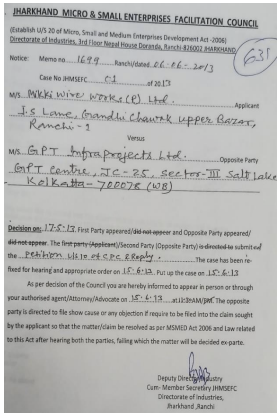
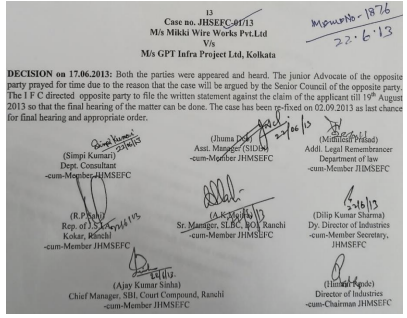
2. The writ petition was filed for quashing of the impugned order/award dated 12.12.2013 passed by the Facilitation Council under the provisions of the Micro, Small and Medium Enterprises Development Act, 2006 (hereinafter referred to as “the Act of 2006”) in Case No. JHMSEFC No. 01 of 2013 on a reference made by Messrs Miki Wires (P) Limited (hereinafter referred to as “the supplier”).
3. The buyer had challenged the award, inter alia, on the ground of composition of the Tribunal by stating that the same was not in accordance with the provisions of section 21 of the Act of 2006 as there were more than five members. The challenge was also based on the ground that Facilitation Council had without evolving any procedure, proceeded to decide the claim by a cryptic order which did not contain any reason as to admissibility of the amount claimed by way of adequate proof. It was asserted that though the provisions of Code of Civil Procedure (hereinafter referred to as “CPC”) and Evidence Act were not applicable, but the claim was required to be established. It was also asserted that the State Government had failed to frame any Rules laying down procedure to be followed by the Facilitation Council in entertaining such reference to adjudicate claims in terms of section 30 of the Act of 2006. It was asserted that the award impugned in the writ proceedings suffered from jurisdictional irregularity which required interference under Article 226 of the Constitution of India.
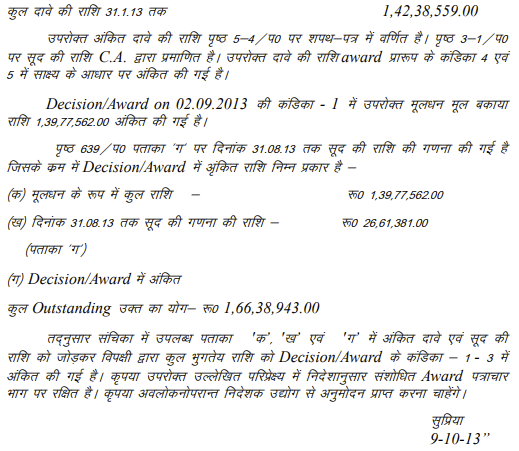
4. A counter-affidavit was filed by the supplier before the learned writ Court. It was argued by the learned Senior counsel appearing on behalf of the supplier that the writ petitioners, after surrendering to the jurisdiction of the Facilitation Council and after having failed to obtain any stay in respect of the proceedings from Hon’ble Calcutta High Court, had chosen to challenge the award on untenable grounds relating to composition of Tribunal or the procedure followed by the Tribunal. It was also asserted that the provisions of the Act of 1996 were to be followed in terms of section 18(3) by the Facilitation Council while deciding the dispute on reference in the manner of an arbitration proceeding and the Tribunal had the jurisdiction to follow the Rules of procedures which the parties agreed or on failure thereof, to conduct the proceedings in a manner it considers appropriate. It was asserted that the writ petitioners had the alternative remedy under section 34 of the Act of 1996 to challenge the award, but the writ petition was filed only to escape the liability to deposit 75% of the awarded amount in terms of the provisions of the Act of 2006. It was submitted on merits that when the claim of the applicant/supplier was not resisted by any written statement, the Facilitation Council was fully justified in declaring the award after considering materials available on rec
The Facilitation Council must adhere to the procedural requirements of both the MSMED Act and the Arbitration Act, and failure to do so renders any award issued a nullity, which can be challenged out....

The High Court cannot entertain writ petitions challenging awards of the Micro and Small Enterprises Facilitation Council without the mandatory deposit of 75% of the awarded amount as per Section 19 ....

The mandatory pre-deposit requirement under Section 19 of the MSMED Act, 2006 for challenging an award and the overriding effect of the MSMED Act, 2006 over the Arbitration Act, 1996 in specific disp....


Section 34 of the Arbitration Act arises as is evident from sub Section (6) of Section 16 of the Arbitration Act, which inter alia provides that the parties aggrieved by such an arbitral award may ma....

The main legal point established in the judgment is that the Facilitation Council has the jurisdiction to act as an Arbitrator after the failure of conciliation proceedings under the MSME Act. The ri....

Important Point : The court established that statutory remedies must be exhausted before invoking writ jurisdiction against awards under the MSMED Act.

Point of Law : Court are of the unhesitant view that learned Single Judge fell in error in not only entertaining the writ petition but also in allowing the same by setting aside the award dated 28.10....
The judicial principle of constructive res judicata applies where claims could have been previously raised, emphasizing the finality of judicial determinations.



An indispensable Tool for Legal Professionals, Endorsed by Various High Court and Judicial Officers
Please visit our Training & Support
Center or Contact Us for assistance

Scan Me!
India’s Legal research and Law Firm App, Download now!


For Daily Legal Updates, Join us on :



 Back to top


