
 Back
Back





IN THE HIGH COURT OF JHARKHAND AT RANCHI
Gautam Kumar Choudhary, J.
Tulsi Mahto and ors. - Appellants
Versus
Sulochna Devi and ors. - Respondents
Second Appeal No. 506 of 2003
Decided On : 19-07-2024
| Table of Content |
|---|
| 1. factual background of the case. (Para 1 , 2 , 3 , 4 , 5 , 6 , 7) |
| 2. defendant's claim and their objections. (Para 8 , 9 , 10 , 11 , 12 , 13) |
| 3. issues framed and trial court's findings. (Para 15 , 16 , 17 , 18 , 19) |
| 4. arguments presented by appellants. (Para 21 , 22 , 23 , 24 , 25 , 26) |
| 5. court's analysis on inheritance and property rights. (Para 28 , 29 , 30 , 31 , 32 , 33 , 34 , 35 , 36 , 37) |
JUDGMENT :
Gautam Kumar Choudhary, J.
1. This is plaintiff’s second appeal against judgment of reversal in Title Appeal No. 21/1990 thereby reversing the judgment and decree passed in in Partition Suit No. 21 of 1987/19 of 1989.
2. Parties for convenience shall be referred to by their original placement in the suit and shall include their heirs and legal representatives at different stages.
CASE OF PLAINTIFF
3. Plaintiffs/Appellants filed suit for partition with respect to the property detailed in Schedule A.
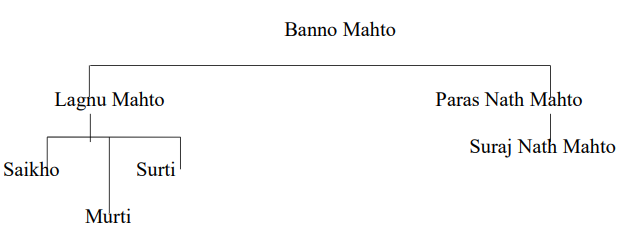
4. Plaintiffs and defendants are the heirs and descendants of common ancestors Banno Mahto, a recorded tenant who died in the year 1935 leaving behind two sons Lagnu Mahto and Paras Nath Mahto. Both inherited and came in joint possession over the land of their father. Lagnu Mahto died in the year 1957 leaving behind three daughters Salkho, Murti and Surti whereas Paras Nath Mahto died leaving behind his only son Suraj Nath Mahto. Both the parties remained in joint possession over the suit land.
5. After death of Laganu Mahto, his daughter viz Murti remained in Naihar and came in possession over the land left by her father and by paying rent to the State are in continuous possession of the land in question.
6. Most Murti filed one Partition Suit No.59/65 which was dismissed for default and the matter was amicably settled between the parties. Murti transferred 3.20 acres of land in Khata No. 8 by registered sale deed dated 28.12.1972 to her sons who are plaintiffs nos.1 to 4.
7. Plaintiff have half share in the Schedule A land for which the suit was filed.
CASE OF DEFENDANT
8. The case of the defendant nos. 1 and 3 who have filed joint written statement is that admittedly Banno Mahto was common ancestor in whose name the suit land was recorded. The said land was acquired before the last cadastral survey.
9. Lagnu Mahto and Paras Nath Mahto both pre-deceased their father Banno Mahto. Lagnu Mahto died first prior to the last cadastral survey. Parasnath Mahto died leaving behind two sons namely Defendant no.1 and another son Radhanath Mahto some times in the year 1912-13 and Banno Mahto died in the early 1920.
10. Banno Mahto being grand father married daughters of Lagnu, in his own life time and they settled in their respective matrimonial homes.
11. The two sons of Banno Mahto, lagnu Mahto and Parasnath Mahto never came in joint possession of the suit property after his death and that Lagnu Mahto did not die after 1957.
12. Daughters of Lagnu Mahto never came in possession of the suit land as after their marriage they settled in their sasural.
13. Defendants were unaware about the sale deed executed on 26.12.72 by Murti Devi in favour of her sons plaintiffs no. 1 to 4 with respect to some lands under khata no.8. With regard to mutation pursuant to the sale it is pleaded that Plaintiffs in collusion with the Anchal Staffs and without order of competent authority obtained some rent receipts in their own name.
14. Suit land was not in joint, but in exclusive possession of the plaintiffs.
15. On the basis of the pleadings of the parties, the following main issues were framed: -
VI. Whether the plaintiffs had acquired title and possession over the suit land?
VII. Whether the Lagnu Mahto died in the year 1957 or not?
16. Learned trial Court noted that issue of inheritance claimed by the Plaintiffs turned on the question whether Lagnu Mahto died before or after 1956. If he died after coming into force of the 1956 Act, his interest devolved by inheritance on his daughters who were class I heirs in terms of Section 8 of the Act.
17. In the absence
AI
Daughters cannot inherit if the father died before the Hindu Succession Act, 1956, as rights devolved by survivorship in joint family property.
The court affirmed that under the Hindu Succession Act, daughters do not inherit coparcenary property prior to the 2005 amendment, and the plaintiff's title was upheld against the defendant's claims.


Hindu female heirs cannot inherit property from a male relative if the male died before the Hindu Succession Act, 1956, making their claims void in this context.


Daughters are ineligible to inherit under Mitakshara Law prior to 1956, affirming that property succession is limited to male heirs in such cases.



An indispensable Tool for Legal Professionals, Endorsed by Various High Court and Judicial Officers
Please visit our Training & Support
Center or Contact Us for assistance

Scan Me!
India’s Legal research and Law Firm App, Download now!


For Daily Legal Updates, Join us on :



 Back to top


