
 Back
Back





IN THE HIGH COURT OF JHARKHAND AT RANCHI
M.S. SONAK, CJ, RAJESH SHANKAR, J.
Vivek Gaurav S/o Late Rajendra Kumar – Appellant
Versus
The State of Jharkhand – Respondent
W.P. (C) No. 456 of 2026
Decided On : 19-03-2026
| Table of Content |
|---|
| 1. jurisdiction and nature of the writ petition (Para 1 , 2 , 3 , 4 , 5) |
| 2. argument against discriminatory court fee provisions (Para 6 , 8 , 9 , 10) |
| 3. court's consideration of the court fees act amendments (Para 11 , 12 , 14 , 17) |
| 4. analysis of discrimination claims under article 14 (Para 15 , 16 , 18 , 19 , 20 , 21) |
| 5. burden of proof on state for justification (Para 22 , 23 , 24) |
| 6. hostile discrimination in probate suits (Para 25 , 26 , 27 , 28) |
| 7. precedent supporting petitioner's argument (Para 29 , 30 , 31 , 32 , 33) |
| 8. final ruling on the unconstitutionality of court fees (Para 34 , 35) |
JUDGMENT :
RAJESH SHANKAR, J.
1. Heard learned counsel for the parties.
2. Admit.
3. It was pointed out that the respondent Nos. 3 to 11 are proforma parties and they would not be affected, if the impugned provision relating to court fees is struck down.
4. With the consent of and at the request of learned counsel for the parties, we proceed to dispose of this writ petition finally.
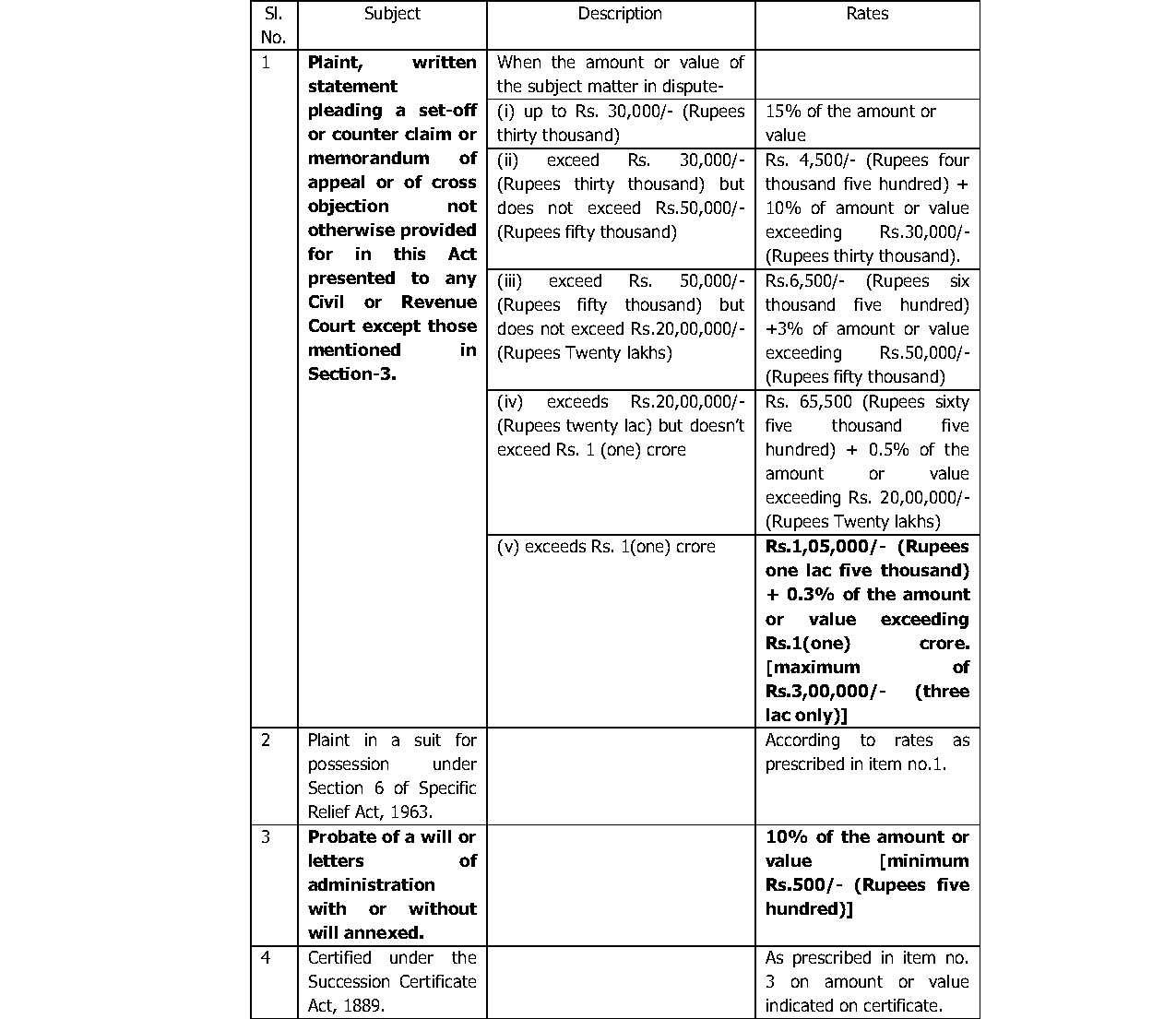
5. The challenge in this writ petition is to the Constitutional validity of a portion of a Court Fees (Jharkhand Amendment) Act, 2022 to the extent that it provides for no upper ceiling or a maximum limit on the court fees payable on a suit seeking “probate of a will or letters of administration with or without the will annexed.”
6. The primary argument is that singling out such proceedings by not providing an upper ceiling or maximum court fees, even though a ceiling or maximum of Rs. 3 Lakhs is provided for all other types of suits, amounts to practising hostile discrimination, which is abhorred by Article 14 of the Constitution of India.
7. Mr. Pratyush Kumar, learned counsel for the petitioner, clarifies that the challenge in this writ petition is restricted to the discrimination on account of non-providing an upper ceiling or a maximum limit for actions seeking a probate of a will or letters of administration with or without a will annexed and that no other point is being pressed in this writ petition, even though several other points may have been raised in the writ petition.
8. Mr Pratyush Kumar submits that there is no distinction between actions seeking probate of a will or letters of administration with or without a will annexed and the suits, even though a ceiling or maximum of Rs. 3 Lakhs in court fees is provided for suits and actions other than those seeking probate or letters of administration. He argues that this clearly results in equal being treated unequally, thus constituting a blatant violation of the principle of equality enshrined in Article 14 of the Constitution. He contends that on this simple ground, the impugned provision ought to be struck down and equality restored.
9. Mr Pratyush Kumar submits that the issue he now raises is no longer res integra. He relied onP.M. Ashwathanarayana Setty & Ors. v. State of Karnataka & Ors. 1989 Supp (1) SCC 696; Jyoti Nikul Jariwala & Anr. v. State of Maharashtra & Anr. 1988 Mh. L.J. 96; Prafulla Govinda Baruah v. The State of Assam & Anr. 2024 Supreme (Gau) 708 ; Subrata Das v. The Collector of 24 Parganas (South) & Others, 1992 Supreme Court (Calcutta) 10 and Kishore Kumar Kataruka v. State of Bihar & Ors. 1990 Supreme (Pat) 244 to support his contention. In particular, he stressed the decision of the Bombay High Court in the case ofJyoti Nikul Jariwala (supra) and its explicit approval by the Hon’ble Supreme Court in the case ofP.M. Ashwathanarayana Setty (supra).
10. Mr Jai Prakash, learned A.A.G-IA, who appears along with Mr Yogesh Modi on behalf of the State, defended the impugned provision on the basis of the reasoning reflected in the State's counter-affidavit. In addition, he submitted that “will” constitutes an exception to the general law of succession and therefore any proceedings to obtain probate of a will or letters of administration can never be compared with ordinary suits seeking to enforce the general law of succession. He submits that on account of this fundamental distinctio
AI
Equal treatment under law is mandated by Article 14; provisions imposing no ceiling on probate court fees violate this principle as they constitute hostile discrimination.


The court ruled that legislative revisions to court fees under the Kerala Finance Act, 2025, are constitutionally valid, reflecting economic necessity and not infringing citizens' right to access jus....

Section 55 of Court Fees Act mandates that every application for probate or letters of administration is to be accompanied by a valuation of estate in the form set forth in Part-1 of schedule III of ....

Court fee on applications for probate and letters of administration must comply strictly with statutory provisions, and deficiencies must be rectified prior to proceeding with appeals.


Damage suit – Valuation for the purposes of jurisdiction and relief has to be same in money suits falling under category 7(i).

The right to appeal is substantive and determined by the law in effect at the original proceeding's initiation, not subject to retrospective fee increases.

Proceedings under Sections 18 and 20 of Hindu Adoptions and Maintenance Act are not Suits and ad valorem court fee is not liable to be paid.



An indispensable Tool for Legal Professionals, Endorsed by Various High Court and Judicial Officers
Please visit our Training & Support
Center or Contact Us for assistance

Scan Me!
India’s Legal research and Law Firm App, Download now!


For Daily Legal Updates, Join us on :



 Back to top


