
 Back
Back





IN THE HIGH COURT OF JHARKHAND AT RANCHI
ANUBHA RAWAT CHOUDHARY, J.
Sanjay Kakkar, son of late Kamal Kumar Kakkar – Appellant
Versus
Vivek Kakkar, son of late Kamal Kumar Kakkar – Respondent
F.A. No. 175 of 2024
Decided On : 09-03-2026
| Table of Content |
|---|
| 1. trial court dismissed suit lacking joint property unity. (Para 2 , 4 , 5) |
| 2. rejected additional evidence; proceeded to hearing. (Para 6 , 7) |
| 3. joint fund from firm; lease proves possession unity. (Para 8) |
| 4. self-acquired properties; no joint nucleus proof. (Para 9) |
| 5. framed issues on title unity, non-joinder, share entitlement. (Para 10 , 11 , 12) |
| 6. witnesses failed to establish joint family source. (Para 13 , 14 , 15 , 16 , 17 , 18 , 19 , 20 , 21 , 22 , 23) |
| 7. non-joinder of sisters renders suit defective. (Para 24 , 25 , 26 , 27) |
| 8. claimant must prove nucleus for joint property presumption. (Para 28 , 29 , 30 , 31 , 32 , 33 , 34 , 35 , 36 , 37 , 38 , 39 , 40 , 41) |
| 9. joint lease insufficient to prove ownership unity. (Para 42 , 43 , 44 , 45 , 46 , 47 , 48) |
| 10. no unity of title; appeal dismissed upholding trial court. (Para 49 , 50 , 51 , 52 , 53 , 54 , 55 , 56 , 57) |
JUDGMENT :
ANUBHA RAWAT CHOUDHARY, J.
This appeal has been filed against the judgement and decree dated 28.06.2024 (decree signed on 05.07.2024) in Original (Partition) Suit No.58/2022 by learned Civil Judge (Sr. Division) – I, Bokaro whereby the suit filed by the plaintiffs has been dismissed on contest.
2. The suit was filed by Sanjay Kakkar, son of late Kamal Kumar Kakkar, and his wife Sonia Kakkar and defendants are Vivek Kakkar, son of late Kamal Kumar Kakkar and his wife Binney Kakkar. The suit was filed seeking preliminary decree for partition of half share of the plaintiffs over the suit property mentioned in Schedule A of the plaint. The Schedule A of the plaint is quoted as under:
Schedule A
The lands and commercial building situated at Mouza – Chas, P.S. No – 30, P.S. Chas, District Bokaro, Jharkhand, Khata number, plot number, area and boundary are as under:
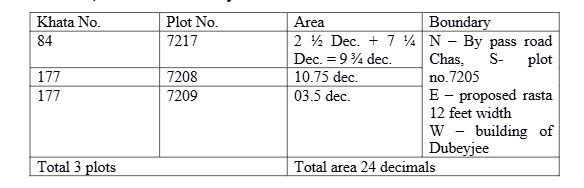
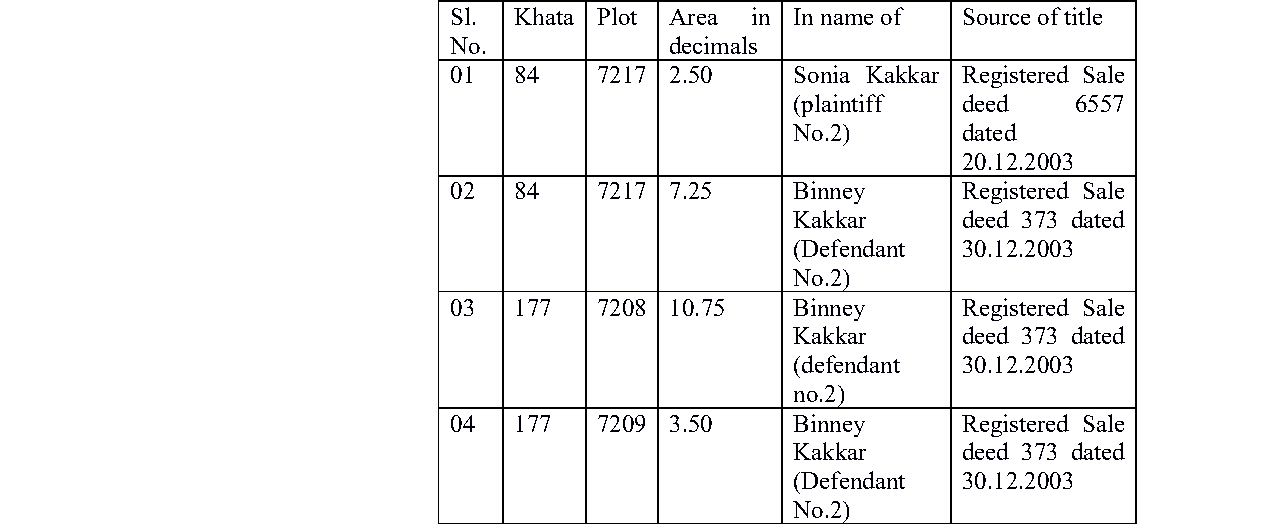
3. 2.50 decimal in plot no. 7217 is standing in the name of the plaintiff no.2 and the remaining 21.50 decimals aforesaid property is standing in the name of defendant no.2. The plaintiffs claimed that the entire suit property is joint family property and claimed ½ share and the defendant claimed that the property standing in the name of the defendant no.2 was their self-acquired property and claimed that partition suit was not maintainable. Admittedly, a portion of the suit property was jointly leased out by plaintiff no.2 and defendant no.2 to ICICI Bank.
4. The learned trial court framed the following issues for consideration:
i. Whether the suit is maintainable in its present form?
ii. Whether the suit is property valued?
iii. Whether there is a valid cause of action to bring the present suit?
iv. Whether the suit is barred by law of limitation, waiver, estoppel and acquiescence?
v. Whether plaintiff is entitled for ½ share in the suit property?
vi. Whether there is unity of title and possession amongst the parties to the instant schedule property?
vii. Whether plaintiff is entitled to get relief as claim in the plaint?
5. The learned trial court held that the suit was not maintainable, there was no valid cause of action to file the suit, the plaintiffs were not entitled to ½ share in the suit property and there was no unity of title and possession amongst the parties to the scheduled property and consequently the plaintiffs are not entitled to any claim partition as prayed for in the plaint and ultimately the suit was dismissed. The findings of the learned trial court with respect to issue nos.5 and 6 are quoted as under:
“It is evident from the oral as well as documentary evidence that Ext. 1 which is a sale deed no. 6567 was executed in the name of Sonia Kakkar and regarding which Sonia Kakkar had made a payment of the consideration amount to the executant of the sale deed. Similarly, Ext. 2 i.e. sale deed no. 373 in the name of Binny Kakkar wife of Vivek Kakkar defendant no. 2 and the consideration amount for the said sale deed of Rs. 4,05,000/- was paid through bank draft by Binny Kakkar and this factum has been very well mentioned in Ext. 2. It appears from Ext. 1 and 2 which is two diff
AI
No presumption of joint family property from family existence; claimant must prove acquisition from joint nucleus fund, especially for properties in daughters-in-law names via separate sale deeds wit....


Joint family properties must show evidence of shared ownership; individual earnings negate claims to partition.

The burden of proof to establish property as self-acquired rests on the party asserting so, once a joint family nucleus is established, underscoring the necessity of evidence to support claims.

A joint Hindu family property remains joint unless proven otherwise; the burden of proof lies on the party claiming separate ownership, requiring credible evidence.
The court established that without evidence proving properties as joint family assets, claims to them by family members fail, reaffirming the burden of proof lies with those asserting joint status.

In a partition suit, properties individually acquired cannot be presumed as joint family properties unless evidence proves acquisition occurred through joint family funds, emphasizing the necessity o....

The plaintiff must prove the existence of a joint family nucleus to establish claims over joint family properties; mere relation does not imply entitlement.



An indispensable Tool for Legal Professionals, Endorsed by Various High Court and Judicial Officers
Please visit our Training & Support
Center or Contact Us for assistance

Scan Me!
India’s Legal research and Law Firm App, Download now!


For Daily Legal Updates, Join us on :



 Back to top


