
 Back
Back





IN THE HIGH COURT OF JUDICATURE AT MADRAS
THE HONOURABLE MR. JUSTICE C. KUMARAPPAN, J.
Subbarayan (Died) & Ors. - Appellants
Versus
Arulmighu Arunachalasewarar Devasthanam Rep. by Executive Officer(Temporary)/ Assistant Commissioner & Ors. - Respondents
S.A. No. 999 of 2006 and C.M.P. No. 3 of 2006 and C.M.P. No. 836 of 2020
Decided On : 07-02-2024
TRUST - RELIGIOUS ENDOWMENT - Indian Trust Act, 1882; Tamil Nadu Hindu Religious and Charitable Endowments Act, 1959; Limitation Act - The court interpreted the provisions of the Indian Trust Act, particularly Sections 5 and 6, to determine the nature of the endowment made in the partition deed. It concluded that the dedication of property for religious purposes did not require formal documentation under the Trust Act, and that the intent of the settlor was clear in divesting ownership for charitable purposes. The Tamil Nadu HR&CE Act was also referenced to establish the nature of the endowment as a public religious charity, which influenced the court's decision to uphold the lower courts' findings regarding the temple's ownership of the property.
Fact of the Case:
The plaintiff, a temple, claimed ownership of a property dedicated for lighting lamps as per a partition deed from 1901. The first defendant, a descendant of the settlor, contested this, asserting the property was privately owned and not dedicated to the temple. The trial court ruled in favor of the temple, leading to appeals by the defendants.
Finding of the Court:
The court upheld the lower courts' findings that the property was trust property dedicated to the temple, based on the partition deed's stipulations. It found that the defendants could not claim ownership through adverse possession due to the nature of the endowment.
Issues: 1. Whether the property was trust property under the Indian Trust Act. 2. Whether the temple was the rightful trustee. 3. Whether the endowment was extinguished.
Ratio Decidendi: The court determined that the partition deed constituted an absolute dedication of the property to the temple, thus creating a public religious charity. The absence of formal trust documentation did not negate the existence of a trust, as the intent of the settlor was clear in divesting ownership for religious purposes.
Final Decision: The second appeal was dismissed, affirming the lower courts' decisions that the temple held rightful ownership of the property as a result of the endowment.
JUDGMENT :
C. Kumarappan, J.
[PRAYER: Second Appeal is filed under Section 100 of the Code of Civil Procedure, against the judgment and decree dated 27.10.2005 made in A.S.No.3 of 1993 on the file of the District Court, Thiruvannamalai, in confirming the judgment and decree, dated 23.11.1990 made in O.S.No.16 of 1993 on the file of the Sub-Court, Thiruvannamalai.]
The instant second appeal has been filed at the instance of the first defendant. The first respondent herein is the plaintiff before the trial Court and the respondents 2 to 6 are the defendants 2 to 6 before the trial Court.
2. For the sake of convenience, the parties will be referred to according to their litigative status before the trial Court.
3. The brief facts which give rise to the instant Second Appeal are as follows:
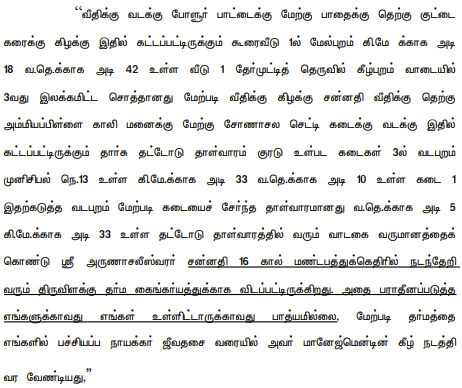
The plaintiff is a renowned ancient temple which is the abode of Lord Arulmigu Arunachaleswarar. According to the plaintiff, the suit property was endowed to the plaintiff temple for the service of lighting of lamp on the pillar standing in front of Arunachaleswarar Sannathi. The said endowment was made by one Chekkadi Muthiah. The first defendant is one of the descendant of Chekkadi Muthiah Naicker. According to the plaintiff, the endowment was made through the partition deed, dated 13.07.1901. By virtue of absolute dedication, the suit property became the absolute property of the temple. However, the first defendant obtained Municipal assessment in his favour and has also leased out a portion of the property to the second defendant and he has been enjoying other portion through his sons. Similarly, the third defendant has also transferred the Municipal assessment in his name and he has been enjoying the suit property as his absolute property, which is contrary to law. He further submits that the suit is not barred by limitation, by virtue of Section 10 of the Limitation Act and also by virtue of Section 109 of Tamil Nadu Hindu Religious and Charitable Endowments Act, 1959 (hereinafter referred to HR&CE Act). Therefore, the plaintiff submits that the defendants cannot perfect title by way of adverse possession. It is the further submission of the plaintiff that since the present trustees have failed to perform the services to the temple, the plaintiff was constrained to come forward to file a suit with the relief of declaration and for recovery of possession. However, the relief sought in respect of the declaration was given up subsequently.
4. The said suit was resisted by the first defendant by contending that, the first defendant's ancestors lit the lights on the stone pillars which was situated in front of 16 pillars mandapam till the removal of the said stone pillars. Further, with the advent of electricity and sophisticated illuminations, the practice of lighting lamps has become redundant. It is the specific case of the first defendant that the endowment made in the partition deed is only a private family trust and there was no dedication to the Devasthanam. It was further contended that the property never be a trust property and even if there was a trust, it was extinguished. Since the defendants were not permitted to light lamp, the question of existence of Trust will not arise. It was further contended that the suit is barred by limitation, and that they also perfected the title to the suit property by adverse possession.
5. The first defendant has also filed an additional written statement wherein he has specifically pleaded that the right of the plaintiff has been ousted, and that the very filing of the suit by the Executive Officer is not maintainable, as he has no locus standi to file this suit. He further submitted that the property was not vested with the plaintiff Temple, and there is no such recital in the partition deed. Hence, the first defendant prays to dismiss the suit.
Evidence and Documents:
6. Before the trial Court, on the side of the plaintiff, 10 documents were marked as Ex.A.1 to Ex.A.10 and two witnesses were examined as P
AI
A dedication of property for religious purposes can be established through intent and conduct, even in the absence of formal documentation, and such dedication constitutes a public religious charity ....

The main legal point established in the judgment is that under the Tamil Nadu Hindu Religious and Charitable Endowments Act, a property dedicated for charitable activities cannot be alienated, and an....
The suit properties were specifically endowed for doing charity services to the temple. The Court held that the suit properties have been completely endowed to the Temple for the purpose of performin....

The main legal point established in the judgment is that the dedication of the properties for the performance of Naivedyam service to the temple constituted a specific endowment, and the application ....
The definition of 'specific endowment' is consistent across the 1951 and 1959 Acts, and prior judicial determinations regarding the Trust's character are binding, preventing re-litigation.
The distinction between complete and partial dedication of property to religious purposes is critical in determining ownership rights, with complete dedication resulting in the property being held in....



An indispensable Tool for Legal Professionals, Endorsed by Various High Court and Judicial Officers
Please visit our Training & Support
Center or Contact Us for assistance

Scan Me!
India’s Legal research and Law Firm App, Download now!


For Daily Legal Updates, Join us on :



 Back to top


