
 Back
Back





THE MADURAI BENCH OF MADRAS HIGH COURT
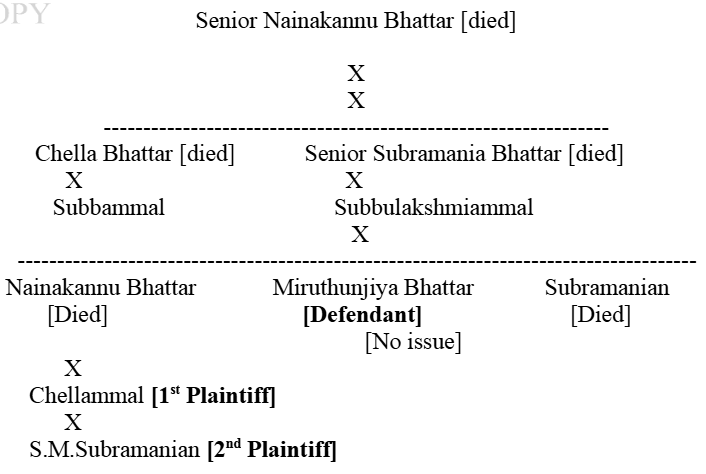
N. MALA, J.
Mirthinjiya Bhattar, [Died] – Appellant
Versus
S.N. Subramanian, S/o. Late Nainakannu Bhattar - Respondent
S.A.(MD).No.60/2008 and Cros.Objn.(MD).No.54/2012
Decided On : 01-06-2026
JUDGMENT :
N. MALA, J.
(1) The unsuccessful defendant is the appellant in the Second Appeal. The Second Appeal arises out of the judgment and decree dated 13.11.2006, passed in AS.No.194/2006, by the learned II Additional District Judge, Madurai, modifying the judgment and decree of the Trial Court dated 29.04.2003, made in OS.No.267/1992, by the learned II Additional Subordinate Judge, Madurai.
(2) For the sake of convenience, the parties are referred to, as per their ranking before the Trial Court.
Facts in brief:-
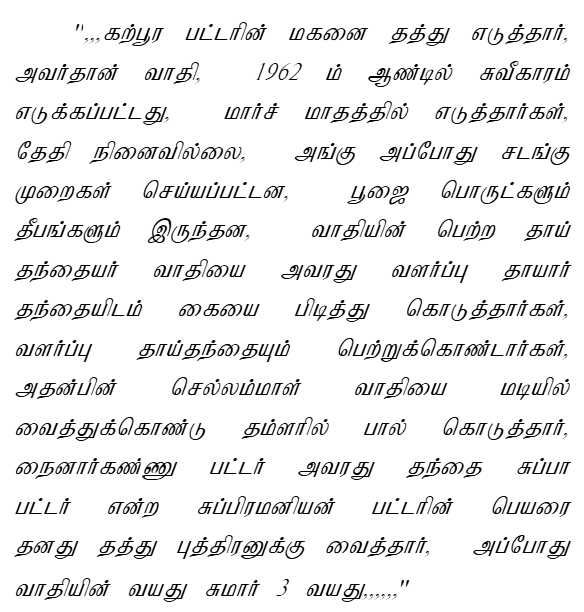
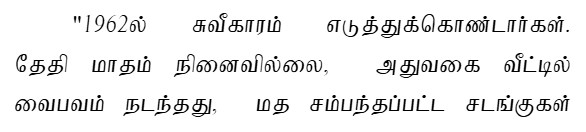
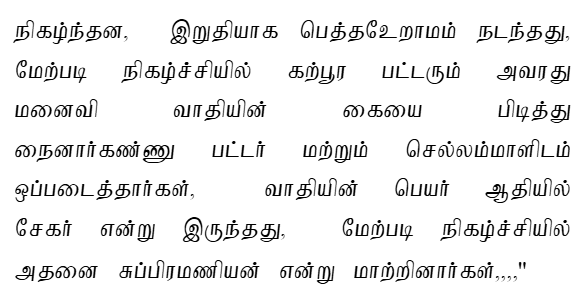
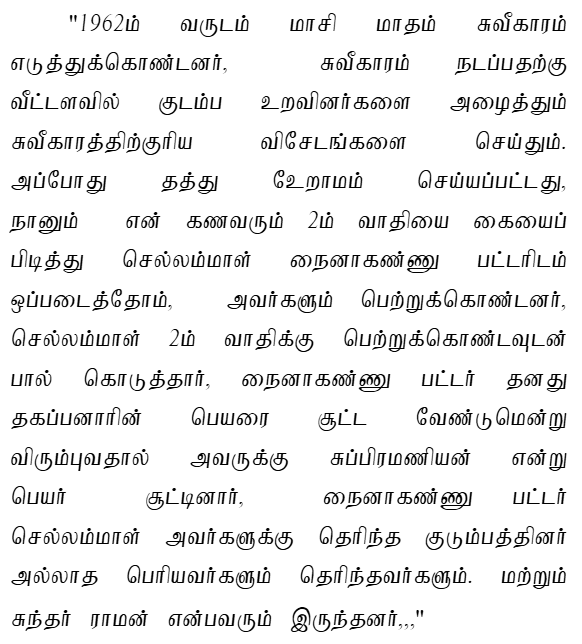
(3) The plaintiffs filed the suit in OS.No.267/1992, for partition and separate possession and for rendition of accounts. The suit properties are situate in Tirupparankundram Village. The plaintiffs contend that the suit properties along with the other properties, originally belonged to one Nainakannu Bhattar [Senior]. On the death of Nainakannu Bhattar [Senior], his two sons, namely, Chella Bhattar and Subramania Bhattar [Senior], inherited his properties as his legal heirs. On the death of Chella Bhattar, his wife Subbammal, filed a suit in OS.No. 540/1971, on the file of the Sub Court, Madurai, for partition of her share in the suit properties. In the said suit for partition, Subramania Bhattar's [Senior] wife, namely Subbulakshmi Ammal, was arrayed as the 4th defendant and the three sons of Subramania Bhattar [Senior], namely, Nainakannu Bhattar [Junior], Mirthunjiya Bhattar and Subramania Bhattar, were arrayed as defendants 1 to 3. The said suit ended in a compromise on 01.08.1974. According to the plaintiffs, as per the Compromise Decree, which is binding on all parties, the suit properties were allotted to the share of the three sons of Subramania Bhattar [Senior], namely, Nainakannu Bhattar [Junior], Mirthunjiya Bhattar and Subramania Bhattar. While so, Nainakannu Bhattar [Junior], died leaving behind him the plaintiffs as his legal heirs and Subramania Bhattar [Junior] died without any heirs. The plaintiffs contend that as the legal heirs of the deceased Nainakannu Bhattar [Junior], they along with Mirthinjiya Bhattar, the defendant herein, became entitled to the suit properties in equal shares. The plaintiffs further contend that the 2nd plaintiff was adopted by the first plaintiff and Nainakannu Bhattar [Junior] and therefore, both the plaintiffs were entitled to half share in the suit properties. The plaintiffs contend that the defendant herein was in management of the suit properties on behalf of all the sharers and since the plaintiffs did not want to keep the property undivided, they filed the suit for partition and rendition of accounts.
(4) The defendant in his written statement, admitted that the suit property originally belonged to Nainakannu Bhattar [Senior]. The defendant did not deny the genealogy mentioned in the plaint and the relationship of the parties. The defendant denied adoption of the 2nd plaintiff by Nainakannu Bhattar [Jr] and stated that the said Nainakannu Bhattar [Jr] died leaving behind the 1st plaintiff alone as his sole legal heir. The defendant denied the plaintiff's contention that Subramania Bhattar [Jr] died without leaving any legal heir. According to the defendant, at the time of Subramania Bhattar's [Jr] death, his mother Subbulakshmi Ammal, was alive and therefore, the share of Subramania Bhattar devolved on her. The defendant contended that the 2nd plaintiff is the son of one Karpoora Bhattar and his name was only Sekar @ Raja. The defendant further contended that in the earlier suit in OS.No.540/1971, the plaintiff therein was allotted the southern portion of the present suit properties in items No. 1, 2 and 3 and only the northern portion in the said items were allotted to the defendants therein. The defendant also contended that out of 4 acres 98 cents in suit item No.4, 2 acres and 42 cents in the western portion alone was allotted to defendants 1 to 3 therein. The defendant denied that the entire extent in items No.8, 9 and 10 belonged to the family of Nainakannu Bhat
A registered adoption deed provides only a rebuttable presumption of validity under the statute. The burden to prove the actual ceremony remains on the propounder, and the claim fails if evidence is ....

The main legal point established in the judgment is the validity of the adoption deed and the plaintiff's lack of locus standi to question the adoption.

Adoption – Ceremony of adoption may vary depending upon circumstances of each case, but for a valid adoption there has to be ceremony of giving and taking of child in adoption.

A valid adoption under the Hindu Adoptions and Maintenance Act cannot be cancelled, and a registered adoption deed carries a presumption of validity unless disproven. Additionally, the burden of proo....


The central legal point established in the judgment is the requirement to prove adoption strictly in accordance with the provisions of the Hindu Adoptions and Maintenance Act, 1956, including the con....

For a valid adoption under the Hindu Adoption and Maintenance Act, the biological parents must give the child in adoption, and the adoptive parents must take the child, which was not proven in this c....

The court established that valid adoption requires proof of giving and taking by biological and adoptive parents, which was not demonstrated, leading to equal shares among heirs.
Point of law: A perfectly valid adoption deed can be made without an adoption deed and any status which the adopted son gets by virtue of adoption is due to the proper ceremonies being performed and ....



An indispensable Tool for Legal Professionals, Endorsed by Various High Court and Judicial Officers
Please visit our Training & Support
Center or Contact Us for assistance

Scan Me!
India’s Legal research and Law Firm App, Download now!


For Daily Legal Updates, Join us on :



 Back to top


