
 Back
Back





IN THE HIGH COURT OF JUDICATURE AT MADRAS
SENTHILKUMAR RAMAMOORTHY, J.
Bristol Myers Squibb Company, represented by its constituted attorney/authorised signatory, Vivek Ratudi - Appellant
Versus
Deputy Controller of Patents, Patent Office, Intellectual Property Building, G.S.T. Road, Guindy, Chennai – 600032 and Anr. - Respondents
CMA (PT) No.2 of 2023
Decided On : 10-07-2024
Patent - Patent Application - Patents Act, 1970 - Sections 3(d), 8, 25(1)(b), 25(1)(e) - The court analyzed the rejection of a patent application based on enhanced bioavailability and therapeutic efficacy, emphasizing the need for substantial data to support claims of enhanced efficacy under Section 3(d).
Fact of the Case:
The appellant challenged the rejection of their patent application for a hemisulphate salt of a known compound, arguing that the invention demonstrated enhanced bioavailability and therapeutic efficacy, contrary to the objections raised by the patent office.
Finding of the Court:
The court found that while the application showed increased bioavailability, it did not sufficiently establish that this led to enhanced therapeutic efficacy, as required by Section 3(d) of the Patents Act.
Issues: Whether the claimed invention meets the requirements of patentability under Section 3(d) of the Patents Act, particularly regarding enhanced therapeutic efficacy based on increased bioavailability.
Ratio Decidendi: The court held that increased bioavailability alone does not equate to enhanced therapeutic efficacy, and the applicant must provide substantial data to support claims of enhanced efficacy.
Result: The court set aside the rejection order and remanded the matter for reconsideration.
JUDGMENT :
(Senthilkumar Ramamoorthy, J.) :
(Prayer: This Civil Miscellaneous Appeal is filed under Section 117- A of the Patents Act, 1970, to pass an order setting aside the orders dated 30 March 2023 passed by the 1st respondent in Indian Patent Application No.5948/CHENP/2014 and pass any other order and/or direction that this Hon'ble Court deems fit and proper in the facts and circumstances of the case.)
Background
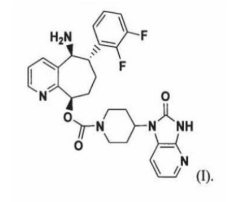
The appellant assails an order dated 30 March 2023 by which Patent Application No.5948/CHENP/2014 was rejected by the Indian Patent Office. The said application was the national phase application derived from PCT Application No. PCT/US2013/027648. The claimed invention is titled “N (5S 6S 9R) 5 AMINO 6 (2 3 DIFLUOROPHENYL) 6 7 8 9 TETRAHYDRO 5H CYCLOHEPTA [B] PYRIDIN 9 YL 4 (2 OXO 2 3 DIHYDRO 1H IMIDAZO [4 5 B] PYRIDIN 1 YL) PIPERIDINE 1 CARBOXYLATE HEMISULPHATE SALT”. The base compound is referred to throughout this order as Compound (I) and the claimed invention as the hemisulphate salt of Compound (I). Upon such application being presented before the Indian Patent Office (the IPO) on 04 August 2014 claiming priority from US Application Serial No. 61/603, 598 dated 27 February 2012, the First Examination Report (FER) was issued on 17 July 2018. The appellant responded to the FER on 16 January 2019. A hearing was held on 13 November 2019 and the appellant filed written submissions on 27 November 2019.
2. Upon the appellant requesting for an update in 2020, the appellant was notified of the pre-grant opposition of the second respondent on 17 December 2020. The opposition was filed on the grounds that: claims 1-6 lack novelty in view of anticipation in prior art D1; claims 1-6 lack inventive step over prior art documents D1- D4; claims 1-5 are excluded from patent protection under Section 3(d) of the Patents Act, 1970 (the Patents Act); claim 6 is excluded from patent protection under Section 3(e) of the Patents Act; and that there was non-compliance with the requirements of Section 8 of the Patents Act. The appellant filed a reply thereto on 15 March 2021 and a hearing was fixed on 4 January 2023. After the hearing, the appellant filed written submissions on 18 February 2023 and revised submissions on 20 February 2023. The impugned order was issued on 30 March 2023, and the present appeal arises in the said facts and circumstances.
Counsel and their contentions
3. Oral arguments on behalf of the appellant were addressed by Ms.Archana Shanker, learned counsel, assisted by Mr.Prem Chander and Mr.Vishal, learned counsel; on behalf of the first respondent by Mr.A.R.Sakthivel, learned SPC. The second respondent remained unrepresented in spite of private notice being served on 21 July 2023 as specified in affidavit of service dated 3 August 2023. The appellant and the first respondent also filed written submissions.
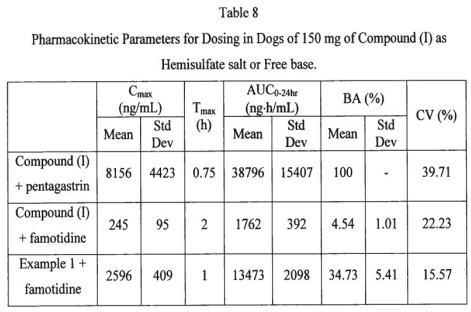
4. Learned counsel for the appellant opened her submissions by pointing out that the monopoly claims are in respect of a hemisulphate salt of Compound (I) and that the international non-proprietary name (INN) given to the substance by the WHO is Rimegepant. With reference to the impugned order, learned counsel pointed out that the objections with regard to both novelty and inventive step were rejected by the first respondent. On account of claim 6 being deleted, she further submitted that the objection with reference to section 3 (e) was rendered moot. In effect, learned counsel submitted that the application was rejected solely by relying on section 3 (d). As regards such rejection, learned counsel submitted that the first respondent failed to appreciate the data provided to support the claim that the invention disclosed enhanced bioavailability resulting in enhanced therapeutic efficacy. She submitted that calcitonin gene-related peptides (CGRP), which are naturally occurring amino-acid peptides, bind to receptors and are known to trigger pathophysiologic conditions, such as neurogenic vasodilation, neuroge
AI
Enhanced bioavailability must be substantiated with data demonstrating enhanced therapeutic efficacy to meet patentability criteria under Section 3(d) of the Patents Act.

An interlocutory injunction can be granted if infringement is established, and no credible challenge to patent validity is presented, even when prior publications and claims are involved.

Point of Law : Intellectual Property Law - Revocation of patents - Appropriateness of Bioavailability and Bioequivalency as Pre- Market Clearance Considerations” by Jane Moffitt, which opined that “a....

A new form of a known substance can only be considered patentable provided the same demonstrates enhanced efficacy.
The main legal point established in the judgment is that an amended patent claim must not broaden the scope beyond the originally filed claims and must demonstrate significant enhancement of therapeu....
A claimed patent must demonstrate novelty and an inventive step, which cannot be established by mere derivations that lack enhanced efficacy.
The Controller must provide a reasoned decision on pre-grant opposition addressing all raised grounds, particularly under Sections 3(d) and 3(e), to ensure compliance with natural justice standards.




An indispensable Tool for Legal Professionals, Endorsed by Various High Court and Judicial Officers
Please visit our Training & Support
Center or Contact Us for assistance

Scan Me!
India’s Legal research and Law Firm App, Download now!


For Daily Legal Updates, Join us on :



 Back to top


