Back
Back





2025 Supreme(Mad) 2157
IN THE HIGH COURT OF JUDICATURE AT MADRAS
R.Sakthivel, J.
Kumara Ravikumar - Appellant
Vs.
K.Chandrasekaran @ Durai - Respondent
S.A.NO.91 OF 2018 AND CMP NO.2015 OF 2018
Decided On : 08-01-2025
Advocate Appeared:
For the Appellant : Mr.A.Sundaravadhanan
For the Respondents: Mr.S.Mukund Senior Counsel for M/s.I.C.Vasudevan
The court affirmed the validity of a Partition Deed, ruling that the plaintiffs were entitled to their claims and that the defendants' objections regarding property boundaries were unfounded.
Headnote:(A) Partition Act, 1893 - Partition Deed dated June 18, 1983 - Dispute over property boundaries and rights - The plaintiffs sought declaration of title and permanent injunction regarding 5.19 Acres of land, claiming rights under a Partition Deed. The Trial Court decreed the suit, which was upheld by the First Appellate Court. The Second Appeal raised the issue of boundary identification as per the Partition Deed. (Paras 12, 16)
(B) Legal Principles - The court emphasized that the plaintiff can only claim his share of the 'A' Schedule Properties as per the terms of the Partition Deed and cannot encroach upon the first defendant's properties. The Advocate Commissioner's report was deemed inconsistent with the Partition Deed. (Paras 13, 15)
Facts of the case:
The plaintiffs, husband and wife, claimed ownership of 5.19 Acres based on a Partition Deed, while the defendants contested the validity of the Settlement Deed and the description of the property. (Paras 3.1, 4.1)
Findings of Court:
The court found that the plaintiffs were entitled to partition the 'A' Schedule Properties as per the Partition Deed and that the boundaries needed to be established correctly. (Paras 18)
Issues: The main issue was whether the courts below were justified in granting a decree for declaration and injunction without proper identification of the Cart Track boundaries. (Para 8)
Ratio Decidendi: The court ruled that the plaintiffs could only claim their rightful share as per the Partition Deed and that the boundaries must be respected as per the established terms. (Paras 12, 16)
Result: The Second Appeal is partly allowed, and a preliminary decree for partition is passed. (Para 18)
JUDGMENT :
This Second Appeal is directed against the Judgment and Decree dated October 20, 2017, passed in A.S.No.9 of 2017 by the 'Subordinate Court, Sathyamangalam' ['First Appellate Court' for brevity], whereby the Judgment and Decree dated October 17, 2016 passed in O.S.No.207 of 2013 by the 'District Munsif, Sathyamangalam' ['Trial Court' for brevity] was confirmed.
2. For the sake of convenience, hereinafter, the parties will be referred to as per their array in the Original Suit.
PLAINTIFFS' CASE
3. Brief facts necessary for the disposing of this Second Appeal are as follows:
3.1. The plaintiffs are husband and wife and they have been living in the farm house in the Suit Property. 1st defendant is the younger brother of the 1st plaintiff, while 2nd defendant is his elder sister. The 1st and 2nd defendants own lands adjoining the Suit Property.
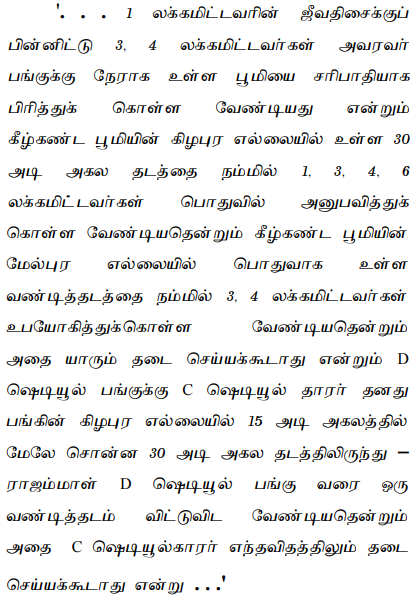
3.2. The first plaintiff, the defendants 1 and 2 along with their mother and two other brothers divided their ancestral properties by a Registered Partition Deed dated June 18, 1983. Vide the said Partition Deed, first plaintiff was allotted ‘C’ Schedule Properties therein consisting of 4.41 Acres of land in Survey No.314, and the first defendant was allotted ‘D’ Schedule Properties therein, while their mother – Rajammal was given life estate over ‘A’ Schedule Properties therein which consists of 2 Acres of land in R.Survey No.314/3. According to the said Partition Deed, after Rajammal’s lifetime, first plaintiff and first defendant alone are entitled to ½ share each over the said ‘A’ Schedule Properties. Accordingly, post the lifetime of Rajammal, the plaintiff became entitled to 5.41 Acres (4.41 Acres + 1 Acre).
3.3. Even though vide Partition Deed dated June 18, 1983 Rajammal was given life estate over 'A' Schedule property thereunder consisting of two Acre of land, she never took possession of the same. Instead, during the lifetime of Rajammal itself, first plaintiff and first defendant took possession of their respective shares in the said two Acre of land i.e., one Acre each and began enjoying it.
3.4. The first plaintiff has settled in favour of second plaintiff/ his wife, an extent of 30 Cents along with common 1/7 share in well vide registered Settlement Deed dated December 22, 2005.
3.5. Upon measuring the Suit Property, the first plaintiff learnt that he is in possession and enjoyment of only 5.19 Acres instead of 5.41 Acres, after leaving common Cart Track on all sides of his land. The first plaintiff has perfected title from 1983 to an extent of 5.19 Acres along with his wife.
3.6. The defendants obstructed the plaintiffs from harvesting the ripen crop in the Suit Property and threatened them on September 10, 2012.
3.7. Hence, the Suit for declaration of title, permanent injunction, demarcating the Suit Property (5.19 Acres), costs and other reliefs.
DEFENDANTS’ CASE
4. The defendants filed separate written statements denying the plaint averments. Sum and substance of their written statements is that the registered Settlement Deed dated December 22, 2005 is not valid and binding on the defendants for various reasons. The first plaintiff had no right to execute the same when he himself is not aware of the extent under his possession. Further, the mother – Rajammal was alive on the date of Settlement Deed and the first plaintiff was entitled to only 4.41 Acres. Further, the Settlement Deed is in respect of common 30 Cents and hence, the first plaintiff could not have handed over possession to second plaintiff. The first plaintiff refused to measure the properties and demarcate their respective boundaries, when called upon by the defendants. Boundaries are not yet ascertained. Further, the plaintiffs claim that they are in possession and enjoyment of 5.41 Acre but the Suit Property as described by the plaintiff in the Suit description of property is only 5.19 Acre. There is no information about the alleged remaining 22 Cents.
4.1. 30 feet common Cart Track to the east of first defend