
 Back
Back





BEFORE THE MADURAI BENCH OF MADRAS HIGH COURT
S. SRIMATHY, J.
Selva Rajakumar – Petitioner
Versus
The Commissioner, Hindu Religious and Charitable Endowment Department, Government of Tamil Nadu, Chennai – Respondent
W.P. (MD) No. 2327 of 2016, W.M.P. (MD) No. 2047 of 2016
Decided On : 25-04-2024
ORDER :
Prayer: Writ Petition filed under Article 226 of the Constitution of India for issuance of Writ of Declaration, declaring that the respondents 1 to 3 have no jurisdiction or power to appoint a fit person for the Thirukkan Mandagapadi private trust founded by Subbiah Nadar through a deed, dated 24.05.1912 under the provisions of the Tamil Nadu Hindu Religious and Charitable Endowments Act, 1959.
1. This writ petition is filed for Writ of Declaration to declare that the Respondents Nos. 1 to 3 have no jurisdiction or power to appoint a Fit person for the Thirukkan Mandagapadi Private Trust founded by Subbaiah Nadar through a Settlement Deed, dated 24.05.1912 under the Provisions of the Tamil Nadu Hindu Religious and Charitable Endowments Act, 1959.
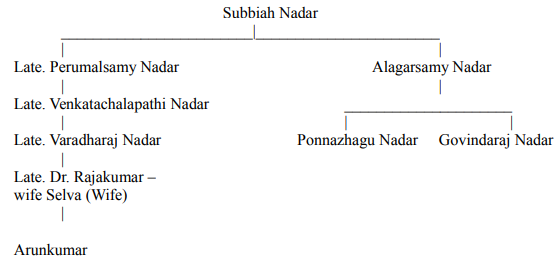
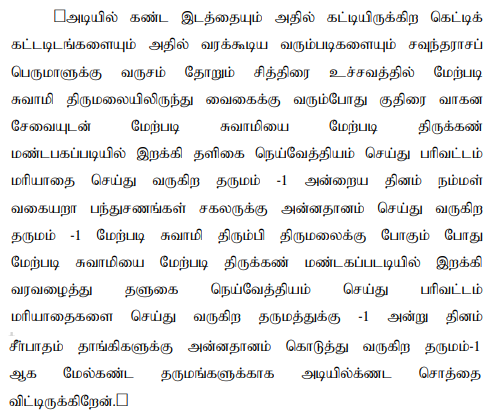
2. The petitioner is a doctor by profession and the petitioner’s husband died on 08.11.2014. The petitioner’s husband’s great grandfather Subbaiah Nadar executed a Registered Settlement Deed, dated 24.05.1912 in Document No. 974/1912 creating private Thirukkan Mandagapadi Trust. As per the settlement deed, the Thirukkan Mandagapadi has to be established every year, during Chithra Pournami Festival in Madurai, when Lord Shri Kallazhagar Soudarraja Perumal Swamy comes from Azhagar Kovil for the celestial wedding of Goddess Meenakshi Amman and Lord Sundareswarar and enters the river Vaigai. At the time, the idol of Kallazhagar would be invited to Thirukkan Mandagapadi for the worship by Subbiah Nadar his descendants and relatives. At that time, Annathanam has to be provided to the relatives of Subbiah Nadar and the persons carrying the idol.
3. Further, Thaligai, Neiveithiyam and Parivattan were offered to the Deity. The said Subbiah Nadar was carrying out the said Mandagapadi till his life time and thereafter his descendants are continuing the same to till date. The said Thirukkan Mandagapadi is carried on during the Chitra Pournami festival and Purattasi festival in the property earmarked by the said Subbiah Nadar till date by establishing a Thirukkan Mandagapadi Private Trust. The idol of Lord Kallalagar is invited to the Mandagapadi every year and the descendants and relatives of the said Subbiah Nadar worship the same.
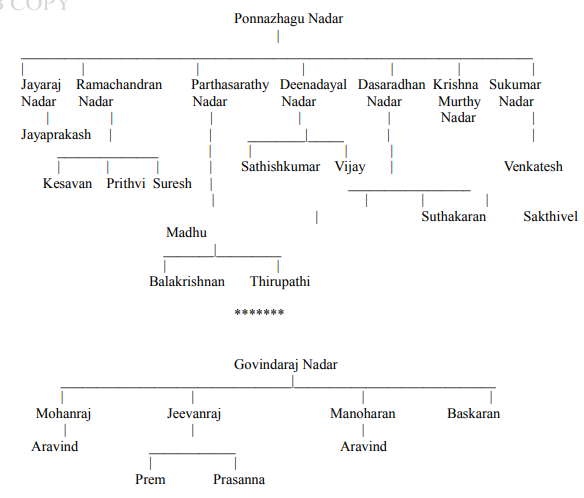
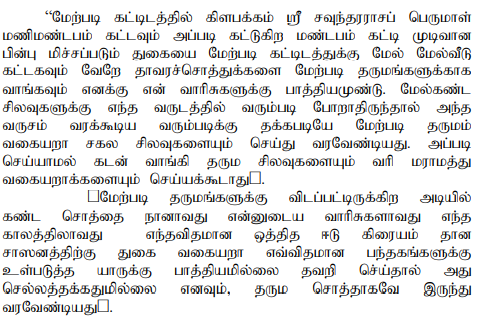
4. In the year 1968, the descendants of the said Subbiah Nadar, namely his great grandson Varadharaj Nadar and his grandsons Ponnazhagu Nadar, Govindaraja Nadar have partitioned the property of the Subbiah Nadar through a registered partition deed, dated 03.05.1968 in Document No. 2883 of 1968. In the partition deed, the property earmarked by the Subbiah Nadar for establishing the Thirukkan Mandagapadi is shown as ‘D’ schedule property and it is recited that the said Thirukkan Mandagapadi Private Trust has to be performed by the descendants in rotation basis. Subsequently, the children of Govindaraj Nadar had entered registered partition deed dated 06.05.1999 in Document No. 1102 of 1999 partitioning the properties of Govindaraj Nadar allotted in the earlier registered partition deed, dated 03.05.1968. Subsequently, the children of Govindaraj Nadar, namely Jeevanraj and Manoharan had alienated some portions of the property obtained by them through a partition deed dated 06.05.1999. The petitioner submitted that neither the petitioner’s husband nor his ascendents had alienated any portion of the property either obtained from Subbiah Nadar or earmarked by him for performing Thirukkan Madagapadi Private Trust. When the petitioner’s husband was alive, he was performing the Thirukkan Mandagapadi once in three years as per rotation basis. After his demise, the petitioner is continuing the same as per rotation basis.
5. In the year 2015, the petitioner performed the same based on her rotation and the petitioner had to perform the same during Chithirai Festival in the year 2016. While that being so, a tenant who was in occupation of a portion of the property allotted to Jeevanraj created trouble. He setup the 5th respondent herein to make the complaint to the respondents 1
A trust serving specific individuals without public access is classified as a private trust, exempting it from the provisions of the Tamil Nadu Hindu Religious and Charitable Endowments Act, 1959.

The main legal point established in the judgment is the inalienability of specifically endowed properties for religious purposes and the bar on alienation of Trust property under the TNHR&CE Act, 195....



The main legal point established in the judgment is that under the Tamil Nadu Hindu Religious and Charitable Endowments Act, a property dedicated for charitable activities cannot be alienated, and an....



An indispensable Tool for Legal Professionals, Endorsed by Various High Court and Judicial Officers
Please visit our Training & Support
Center or Contact Us for assistance

Scan Me!
India’s Legal research and Law Firm App, Download now!


For Daily Legal Updates, Join us on :



 Back to top


