
 Back
Back





IN THE HIGH COURT OF JUDICATURE AT MADRAS
R. SUBRAMANIAN, R. SAKTHIVEL, JJ.
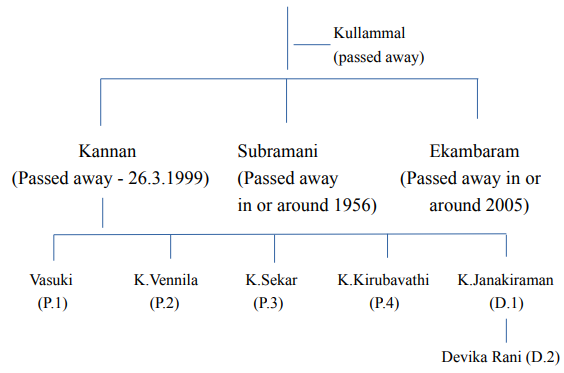
Vasuki – Appellant
Versus
K. Janakiraman – Respondent
A.S. No. 564 of 2019
Decided On : 02-08-2024
JUDGMENT :
R. SAKTHIVEL, J.
Prayer: First Appeal filed under Section 96 read with Order XLI Rule 1 of Code of Civil Procedure, 1908, praying to set aside the Judgment and Decree dated 27.02.2019 made in O.S. No. 47 of 2016 on the file of II Additional District Judge, Vellore @ Ranipet, Vellore District.
1. Feeling aggrieved with the judgment and decree dated February 27, 2019, passed in O.S. No. 47 of 2016 on the file of ‘II Additional District Judge, Vellore @ Ranipet’ (henceforth ‘Trial Court’) the plaintiffs therein have filed this appeal under Section 96 of the Code of Civil Procedure, 1908 praying to set aside the judgment and decree, allow the Appeal and decree the Suit as prayed for in the plaint.
2. Since the fourth appellant-K. Kirubavathi passed away during the pendency of the appeal, her legal representatives were brought on record as Appellant Nos. 5 to 7, vide order of this Court dated February 22, 2022 made in CMP No. 1765 of 2022 in A.S. No. 564 of 2019.
3. For the sake of convenience, henceforth, the parties to this appeal suit will be referred to as per their array in the Original Suit i.e. the ‘appellants’ herein and the ‘respondents’ herein will be referred to as ‘plaintiffs’ and ‘defendants’ respectively.
Plaintiffs’ case
4. The case of the plaintiffs is that the plaintiffs and the first defendant are children of the couple Kannan-Valliammal. Plaintiffs’ and first defendant’s paternal grandparents, Munusamy and Kullammal, had three sons namely Kannan, Subramani and Ekambaram. Their common ancestor-Munusamy owned considerable amount of ancestral properties. Munusamy passed away in or around 1968. His son Subramani predeceased him as a Bachelor in or around 1956. After the demise of their common ancestor-Munusamy, an oral partition took place between Kannan and Ekambaram whereby, approximately an extent of 1 Acre 30 Cents in various Survey Numbers was allotted to Kannan. That apart, after the demise of Subramani (Kannan’s brother) as a bachelor around 1956, his share devolved upon his mother-Kullammal. Later, Kullammal divided the said properties, giving 19 cents landed properties to Kannan and a house property to Ekambaram. In that way, 19 Cents originally allotted to Subramani was acquired by Kannan. Out of the said 19 Cents, the National Highways Department acquired 13 cents of land to widen the MBT Road.
4.1. Further, there were also 42 cents of wet-land at Veppur Village irrigated by Palar River, as well as 30 cents of wet-land at Veppur Village situated opposite C. Abdul Hakeem Engineering College. Furthermore, there was an extent of 33 cents of wet-land at Veppur Village having irrigation from Soolai Kuttai Lake and Palar River. These were enjoyed by Kannan as ancestral properties. Apart from these lands, a wet land to the extent of 58 cents at Veppur Village having Palar River irrigation was purchased by Valliammal, mother of the plaintiffs and the first defendant, by selling her jewels, in the name of Kannan. Kannan and Valliammal, parents of the plaintiffs and the first defendant, constituted a Hindu Joint family and primarily cultivated the aforementioned lands for their income. Kannan was the ‘Kartha’ of the joint family. Kannan was also a Tailor and derived modest income through his tailoring profession.
4.2. While so, Kannan, father of the plaintiffs and the first defendant, sold the 6 Cents of landed property remaining after acquisition by the Highways Department to one person, the said 42 Cents and 30 cents of wet-land with Palar River irrigation to one Ganesan and the said 33 cents of wet-land to one Kanni @ Kanniappan. The 58 cents of land purchased by Valliammal was sold to one Somu. The sale consideration received from selling these lands was retained by Kannan in his capacity as Kartha of the joint family.
4.3. In fact, all the aforementioned lands were sold, in order to purchase the second item of the Suit Properties, which is situated in one location, unlike the ancestral properties and Valliamma
AI
The court upheld the validity of the WILL for self-acquired properties while recognizing the plaintiffs' entitlement to a share in the ancestral property, affirming the distinction between self-acqui....

Properties inherited from a divided father are considered separate and not ancestral, affecting claims for partition under Hindu law.
The claimant must prove the existence of joint family properties; mere familial ties do not suffice for partition claims.
The judicial presumption of joint ownership requires proof of a family nucleus, and mere existence of a joint family does not automatically classify all properties as joint.

The absence of evidence proving the joint family status of properties allows a presumption that they are individual assets; thus, plaintiffs' claim for partition is dismissed.
The burden of proof lies on the person claiming property as self-acquired to establish that it was acquired without the aid of joint family funds.
The court affirmed that admissions made during trial are binding, and ancestral properties cannot be dismissed based on a registered Partition Deed that does not negate the rights of coparceners.
The court affirmed that items 1 and 2 of suit properties are ancestral, and items 3 to 11 are self-acquired, highlighting the plaintiffs' burden to prove family property claims.

Daughters became coparceners under Hindu Succession (Tamil Nadu Amendment) Act, 1989, allowing them equal rights in joint family properties.



An indispensable Tool for Legal Professionals, Endorsed by Various High Court and Judicial Officers
Please visit our Training & Support
Center or Contact Us for assistance

Scan Me!
India’s Legal research and Law Firm App, Download now!


For Daily Legal Updates, Join us on :



 Back to top


