
 Back
Back





IN THE HIGH COURT OF JUDICATURE AT MADRAS
R. SUBRAMANIAN, R. SAKTHIVEL, JJ.
Mr. Mohan - Appellants
Versus
Mrs. Susila Tharani and Ors. – Respondents
A.S. Nos.299 AND 688 OF 2018 AND CMP SR.NO.23810 OF 2021 IN A.S.NO.299 OF 2018 CMP NO.7407 OF 2018 IN A.S.NO.299 OF 2018 CMP NOS.19063 & 19065 OF 2018 IN A.S.NO.688 OF 2018
Decided On : 02-07-2024
JUDGMENT :
(R. Sakthivel, J.)
(Prayer: First Appeal filed under Section 96 read with Order XLI Rule 1 of Code of Civil Procedure, 1908, praying to set aside the judgment and decree dated 22.12.2017 made in O.S.No.237 of 2005 on the file of Additional District Judge, Chengalpattu and dismiss the Original Suit.)
(PRAYER: First Appeal filed under Section 96 read with Order XLI Rule 1 of Code of Civil Procedure, 1908, praying to set aside the judgment and decree dated 22.12.2017 made in O.S.No.237 of 2005 on the file of Additional District Judge, Chengalpattu and decree the Suit as prayed in the Original Suit.)
Feeling aggrieved with the judgment and decree dated December 22, 2017 passed in O.S.No.237 of 2005 by ‘the Additional District Court, Chengalpattu’ (henceforth 'Trial Court'), the plaintiffs therein filed an Appeal Suit in A.S.No.688 of 2018, and the defendants 3 to 11 therein filed an Appeal Suit in A.S.No.299 of 2018. Since both the Appeal Suits arise out of the same judgment and decree, they are disposed of by this Common Judgment.
2. For the sake of convenience, henceforth, the parties will be referred to as per their array in the suit.
Case of the Plaintiffs:
3. The plaintiffs and the first defendant - Devan are sisters and brother respectively, born to the couple - Murugan and Kuppammal. Murugan died in the year 1974 and Kuppammal died in the year 1995 leaving behind the plaintiffs and the first defendant (D1) as their legal representatives.
3.1.Item Nos.1, 2, 3, 4, 8 and 9 of the Suit Properties are ancestral properties. From the income derived from the above properties, Item Nos. 5 to 7 of the Suit Properties were purchased in the name of D1. Thus, Item Nos. 1 to 9 of the Suit Properties are all ancestral properties.
3.2.D1 with a view to defeat and defraud the lawful claim of the plaintiffs, tried to create sham and nominal documents in favour of second defendant (D2). Hence, the plaintiffs issued a legal notice dated March 11, 2005. D1 issued separate reply notices to the plaintiffs on March 24, 2005 with incorrect particulars. Hence, the plaintiffs filed a Suit for partition seeking to divide the Suit Properties into three equal shares and allot 2/3 share jointly to the plaintiffs.
Case of the Defendants:
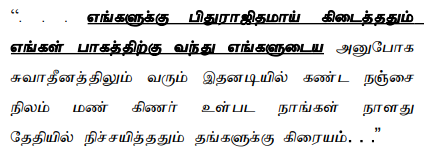
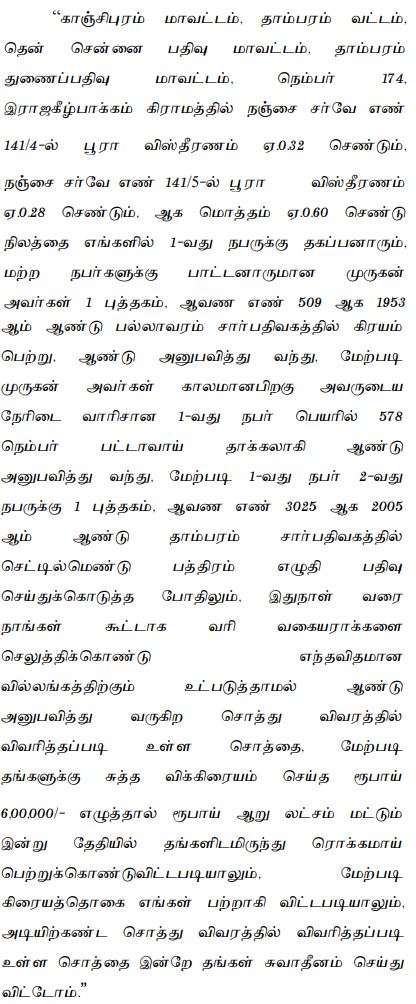
4. D1 filed a written statement stating that the Suit properties are not ancestral properties of the plaintiffs. Item Nos.5 to 7 of the Suit Properties are separate properties of D1. He had purchased Item Nos.5 and 6 of the Suit Properties vide Sale Deed dated December 2, 1971 and Item No.7 of the Suit Properties vide Sale Deed dated December 14, 1962. D1 sold Item Nos.5 to 7 of the Suit Properties to the second defendant (D2) vide Sale Deeds dated December 15, 1999 and October 12, 2000. Further, Item Nos.3 and 4 of the Suit Properties were sold to one Mr.Shanmugam in the year 2005. Thereafter, the purchaser Shanmugam is in possession and enjoyment of Item Nos.3 and 4 of the Suit Properties.
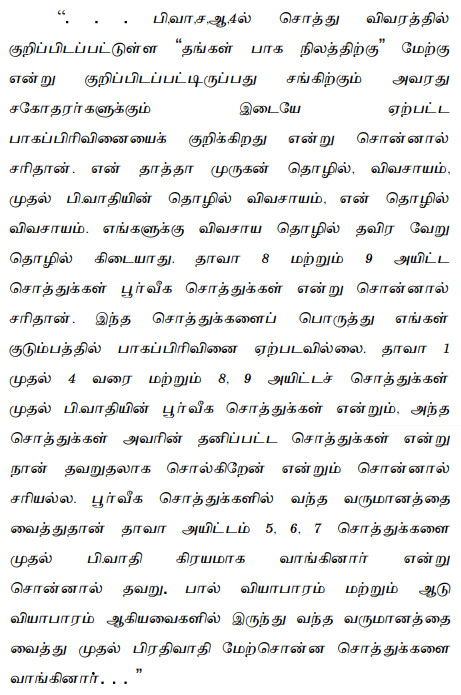
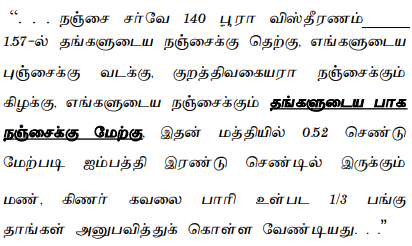
4.1. Further, D1 has stated that the plaintiffs had been already given properties measuring 47 Cents in Survey No.52/1, and 31 Cents in Survey No.118 of Rajakilpakkam Village under various registered documents. Further, the plaintiffs were permitted to construct a building for their own use in the land measuring 12 Cents in Survey No.30 at Rajakilpakkam Village.
4.2. In short, the case of D1 is that the Suit Properties are not ancestral properties and Item Nos. 1 and 3 to 7 of the Suit Properties had already been sold. Accordingly, he prayed to dismiss the Suit.
5. Pending the Suit, D1 – Devan died on December 12, 2012. Hence, Defendant Nos.3 to 11 being legal representatives of D1, were added as parties and they have filed written statement wherein, they have reiterated the averments of the written statement filed by their father Devan (D1).
6. D2, who is the purchaser of Item Nos.5 to 7 of the Suit Properties has filed a written statement


AI
Daughters are coparceners by birth under the amended Hindu Succession Act, entitled to equal shares in ancestral properties.


The properties in question were determined to be ancestral, granting coparcenary rights to the daughter under the Hindu Succession (Amendment) Act, 2005.
The court affirmed that the plaintiff, as a coparcener by birth, is entitled to a ½ share in ancestral properties under the Hindu Succession Act, 1956, and ruled against the validity of transactions ....
Properties inherited from a divided father are considered separate and not ancestral, affecting claims for partition under Hindu law.
The absence of evidence proving the joint family status of properties allows a presumption that they are individual assets; thus, plaintiffs' claim for partition is dismissed.
The court affirmed that admissions made during trial are binding, and ancestral properties cannot be dismissed based on a registered Partition Deed that does not negate the rights of coparceners.

Point of law: A daughter of a coparcener by birth becomes a coparcener in her own right in the same manner as the son. She has the same rights in the coparcenary property as she would have had if she....
The plaintiff failed to prove that the Suit 'B' Schedule properties were ancestral, and the Suit was barred by limitation under Article 60 of the Limitation Act, 1963.



An indispensable Tool for Legal Professionals, Endorsed by Various High Court and Judicial Officers
Please visit our Training & Support
Center or Contact Us for assistance

Scan Me!
India’s Legal research and Law Firm App, Download now!


For Daily Legal Updates, Join us on :



 Back to top


