
 Back
Back





IN THE HIGH COURT OF JUDICATURE AT MADRAS
M.SUNDAR, K.GOVINDARAJAN THILAKAVADI, JJ.
P.Chinnasamy - Appellant
Versus
The District Collector, Tiruppur, Tiruppur District - Respondent
W.P.No.24443 of 2021
Decided on : 25-03-2025
(A) Tamil Nadu Land Encroachment Act, 1905 - Section 6 and Section 10 - Writ petition seeking removal of encroachments - The impugned order under Section 6 was found to be appealable by the writ petitioner, but the court clarified that an appeal lies under Section 10 for any decision made by a Tahsildar. The court emphasized that the writ petitioner has an effective alternate remedy and does not fall under exceptions to the Alternate Remedy Rule. (Paras 9, 10, 15, 19)
(B) Alternate Remedy Rule - The court reiterated that the existence of an alternate remedy is a self-imposed restriction for writ courts, and the petitioner must pursue the statutory appeal available under the Act. (Paras 14, 15)
Facts of the case:
The writ petitioner sought a direction for the removal of encroachments on land classified as 'road' in revenue records, previously addressed in earlier writ petitions. The impugned order concluded that no action was necessary as access was not fully obstructed.
Findings of Court:
The court found that the writ petitioner has an efficacious alternate remedy through a statutory appeal under Section 10 of the Act.
Issues: The main issue was whether the order under Section 6 was appealable and if the writ petitioner had an effective remedy.
Ratio Decidendi: The court ruled that the writ petitioner has an effective alternate remedy through a statutory appeal under Section 10 of the Act, and the petition was disposed of accordingly.
Result: Writ petition disposed of, relegating the petitioner to statutory appeal.
ORDER :
M.SUNDAR, J.
In the captioned main 'Writ Petition' (hereinafter 'WP' for the sake of brevity), Mr.S.Umashankar, learned counsel representing Mr.M.Guruprasad, learned counsel on record for writ petitioner, Mr.T.K.Saravanan, learned Additional Government Pleader for official respondents/R1 and R2 are before us. As regards R3/private respondent (Ms.Lakshmi, W/o.Mr.Raj), R3 has been duly served and name and address of R3 is shown in the cause list but there is no representation either in the physical Court or on VC (video conferencing) platform. To be noted, this is a hybrid hearing, which is a regular/routine/daily feature in this Court. This Court is informed by the Registry that R3 has not chosen to enter appearance through any counsel.
2. This Court heard out captioned WP.
3. Subject matter of captioned WP is 'land comprised in Survey No.619/16 in Chengapalli Village, Uthukuli Taluk, Tiruppur District' (hereinafter 'said land' for the sake of convenience and clarity).
4. Writ petitioner came to this Court by way of a writ petition being W.P.No.16854 of 2018 with a mandamus plea seeking a direction to the official respondents to consider the petitioner's representations dated 15.02.2017 and 14.05.2018 seeking removal of encroachments said to have been put up by R3 in said land. This writ petition was disposed of by another Hon'ble Division Bench in and by an order dated 06.07.2018 iner-alia directing action under 'The Tamil Nadu Land Encroachment Act, 1905 (Tamil Nadu Act III of 1905)' {hereinafter 'said 1905 Act' for the sake of brevity}.
5. Pursuant to aforesaid order, action under said 1905 Act was commenced and the same culminated in a notice/order dated 24.09.2018 made by R2 [Revenue Tahsildar, Uthukuli Taluk, Tiruppur District] being an order under Section 6 of said 1905 Act. This 24.09.2018 order was assailed by R3 (Ms.Lakshmi) by way of a writ petition being W.P. No.27573 of 2018 and this writ petition came to be disposed of by another Hon'ble Division Bench in and by an order dated 16.10.2018 wherein and whereby 24.09.2018 order under Section 6 of said 1905 Act was set aside. R2 was directed to consider the reply/objection for Section 7 notice and R2 was further directed to pass a reasoned order on merits and in accordance with law within a time frame of two months.
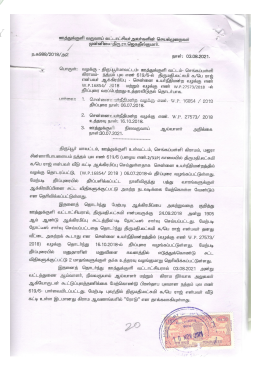
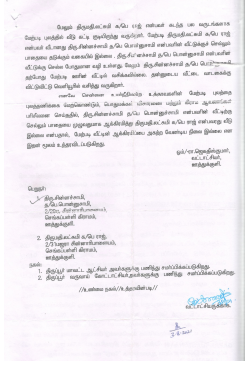
6. Thereafter, R2 adverting to both aforementioned orders of this Court i.e., order dated 06.07.2018 in W.P. No.16854 of 2018 and order dated 16.10.2018 in W.P. No.27573 of 2018 conducted a joint survey of said land and concluded that R3 (Ms.Lakshmi) had put up a superstructure (house) but said land has been classified as 'road' in the revenue records. Thereafter, R2 concluded that no action for removal of superstructure put up by Ms.Lakshmi is necessary as access to Mr.Chinnsamy's property is not fully obstructed. This is vide 'order dated 03.08.2021 bearing reference e/f/988-2018-m2 made by R2' (hereinafter 'impugned order' for the sake of convenience and clarity). Assailing the impugned order and seeking a direction to official respondents to remove the encroachment in said land, captioned WP has been filed.
7. To be noted, certiorari limb of the prayer assails impugned order and vide mandamus limb, a direction has been sought for removal of encroachment in said land.
8. At this juncture, before proceeding further, we deem it appropriate to capture the common stated position of learned counsel for writ petitioner as well as learned State counsel. Learned counsel on both sides submit in one voice that there is a typographical error in the impugned order and survey number of said land has been wrongly mentioned as 619/6 whereas it is 619/16. This common submission made by both sides without any disputation or contestation is recorded and all further proceedings will be on this basis.
9. Reverting to the main legal drill at hand, from the narrative thus far, it is clear that impugned order is an order under Section 6 of said 1905 Act. Writ petitioner has file
The court held that the writ petitioner has an effective alternate remedy through a statutory appeal under Section 10 of the Tamil Nadu Land Encroachment Act, 1905, and thus the writ petition was dis....

The court clarified that the impugned order was a final order under Section 10 of the Tamil Nadu Land Encroachment Act, allowing for statutory revision as an alternate remedy.
The court emphasized that disputes regarding land ownership under the Tamil Nadu Land Encroachment Act should be resolved through statutory appeals, affirming the Act's status as a self-contained cod....

The Tamil Nadu Land Encroachment Act is a self-contained code allowing for a structured process regarding encroachments and appeals, ensuring rights preservation for all parties involved.
The court upheld the validity of impugned orders under the Tamil Nadu Land Encroachment Act, confirming that proper notices were served and emphasizing the efficacy of statutory appeals as an alterna....
The court affirmed that the Appellate Authority under the Tamil Nadu Land Encroachment Act has the power to stay execution of orders and that the Alternative Remedy rule is not absolute but discretio....
The necessity of a show cause notice under the Tamil Nadu Land Encroachment Act before issuing an order under Section 6 is essential for valid proceedings.
The court affirmed that the statutory appeal under the Tamil Nadu Land Encroachment Act is the appropriate remedy, and the Act is a self-contained code barring jurisdiction of courts over its orders.
The Tamil Nadu Land Encroachment Act, 1905 is a self-contained code, requiring proper notice and response procedures, with the court emphasizing the preservation of rights for both parties.
The court emphasized the need to protect the petitioner's interest until the Statutory Appeal is disposed of, considering the nature of the land and the lack of opportunity for a fair hearing.



An indispensable Tool for Legal Professionals, Endorsed by Various High Court and Judicial Officers
Please visit our Training & Support
Center or Contact Us for assistance

Scan Me!
India’s Legal research and Law Firm App, Download now!


For Daily Legal Updates, Join us on :



 Back to top


