
 Back
Back





IN THE HIGH COURT OF JUDICATURE AT MADRAS
M. SUNDAR, K. RAJASEKAR, JJ.
Haripriya, Wife of K. Jagadeeshwaran - Petitioner
Versus
The Tahsildar Tambaram Taluk, Tambaram and Anr. – Respondents
W.P. No.1726 of 2025 & W.M.P No.1977 of 2025 in W.P. No.1726 of 2025
Decided On : 23-01-2025
ORDER :
(M. SUNDAR, J.)
Subject matter of captioned main writ petition is land comprised in 'S.No.206/1 [admeasuring 0.10.00 hectares.ares] at No.17, Agaramthen Village, Tambaram Taluk, Chengalpattu District' [hereinafter 'said land' for the sake of brevity and convenience].
2. Captioned writ petition has been filed assailing an 'order dated 31.12.2024 bearing reference  made by R1' [hereinafter 'impugned order' for the sake of convenience and clarity]. To be noted, impugned order has been made by R1 in exercise of powers under Section 6 of 'The Tamil Nadu Land Encroachment Act, 1905 (Tamil Nadu Act III of 1905)' {hereinafter 'said 1905 Act' for the sake of brevity, convenience and clarity}.
3. Mr.K.Sakthivel, learned counsel for writ petitioner submitted that the impugned order is completely without jurisdiction as according to him said land is private land.
4. Issue notice.
5.Mr.M.S.Arasa Kumar, learned Government Advocate accepts notice for both the respondents and submits on instructions that said land is 'punjai tharisu' and there are other alleged encroachers, who are also covered by the impugned order and other encroachers have preferred statutory appeals under Section 10 of said 1905 Act.
6. Owing to the limited scope of the captioned main writ petition, with the consent of learned counsel on both sides, main writ petition was taken up.
7. Notwithstanding very many averments/grounds raised in the writ affidavit, learned counsel for writ petitioner predicated his campaign against the impugned order on the following points:
i) Impugned order is completely without jurisdiction as said land is a private land and said 1905 Act does not apply;
ii) Prior to impugned order, a notice signed by R1 on 22.10.2024 was issued under Section 7 of said 1905 Act, writ petitioner sent a reply dated 04.11.2024 but impugned order has been made without holding enquiry which is a requirement vide sub-section (2) of Section 6 of said 1905 Act.
8. Before we set out the response of the State counsel to the aforesaid points, we deem it appropriate to capture some factual points and trajectory the matter has taken, the details of which are as follows:
i) One B.Santhanam filed a 'Public Interest Litigation' ['PIL' for the sake of brevity] inter alia with regard to said land, this PIL came to be disposed of by another Hon'ble Division Bench in and by an order dated 22.02.2024 and the same reads as follows:
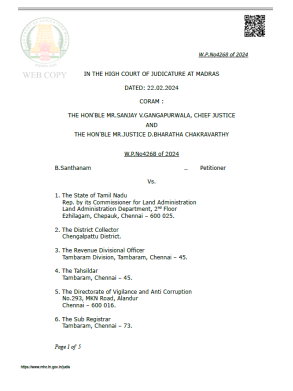
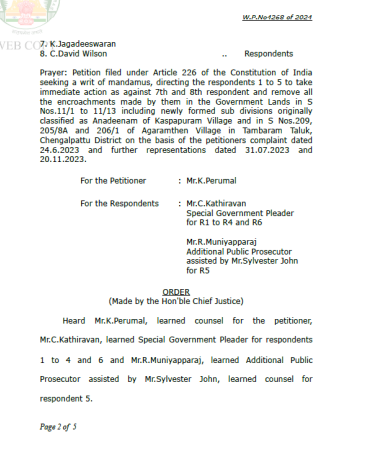
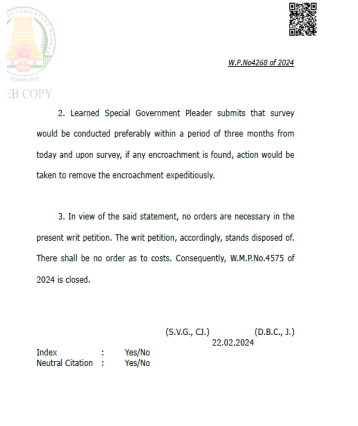
Complaining of non-compliance with aforereferred order, Mr.B.Santhanam has filed a contempt petition in Contempt Petition No.3193 of 2024 and another Hon'ble Division Bench is in seizin of the same.
8. Reverting to the points urged by learned counsel for writ petitioner, response of the State counsel is as follows:
(i) It is incorrect to say that the said land is private land by placing reliance on a Gazette Publication dated 04.05.1966. It is submitted that said Gazette publication pertains to Tamil Nadu Land Reforms (Fixation of Ceiling on Land) Act, 1962 and there is a reference to S.No.206 (not sub-divided) admeasuring 25 cents declaring the same to be surplus land qua one T.V.Jeyachandra Naidu (to be noted, copy of the Gazette Publication has been placed before us by the writ petitioner). Another Gazette Publication dated 07.05.1980 (placed before us by the writ petitioner) is also under the same Act and the same cannot be relied on to say that said land has not been declared as surplus land that is required for public purpose. Learned State counsel substantiated his submission stating that one Ms.Rajina, wife of Mr.Rajendran who is similarly placed qua writ petitioner filed a writ petition in W.P.No.794 of 2025 seeking patta and the same has been dismissed by this Court in and by order dated 10.01.2025;
(ii) Impugned order was made after eqnuiry.
9. We now deem it appropriate to discuss the three case laws relied on by the writ petitioner in support of points raised:
i) D.Sathish case [D.Sathish Vs. Tahsildar, Sirkali Taluka and Others reported in CDJ 1997 M
The court emphasized that disputes regarding land ownership under the Tamil Nadu Land Encroachment Act should be resolved through statutory appeals, affirming the Act's status as a self-contained cod....
The court upheld the validity of impugned orders under the Tamil Nadu Land Encroachment Act, confirming that proper notices were served and emphasizing the efficacy of statutory appeals as an alterna....

The court affirmed that the statutory appeal under the Tamil Nadu Land Encroachment Act is the appropriate remedy, and the Act is a self-contained code barring jurisdiction of courts over its orders.
The court affirmed that the Appellate Authority under the Tamil Nadu Land Encroachment Act has the power to stay execution of orders and that the Alternative Remedy rule is not absolute but discretio....
The court held that the writ petitioner has an effective alternate remedy through a statutory appeal under Section 10 of the Tamil Nadu Land Encroachment Act, 1905, and thus the writ petition was dis....
The necessity of a show cause notice under the Tamil Nadu Land Encroachment Act before issuing an order under Section 6 is essential for valid proceedings.

The Tamil Nadu Land Encroachment Act is a self-contained code allowing for a structured process regarding encroachments and appeals, ensuring rights preservation for all parties involved.
The court clarified that the impugned order was a final order under Section 10 of the Tamil Nadu Land Encroachment Act, allowing for statutory revision as an alternate remedy.
A writ petition challenging proceedings under the Land Encroachment Act is premature if alternative remedies exist.
The court emphasized the need to protect the petitioner's interest until the Statutory Appeal is disposed of, considering the nature of the land and the lack of opportunity for a fair hearing.



An indispensable Tool for Legal Professionals, Endorsed by Various High Court and Judicial Officers
Please visit our Training & Support
Center or Contact Us for assistance

Scan Me!
India’s Legal research and Law Firm App, Download now!


For Daily Legal Updates, Join us on :



 Back to top


