
 Back
Back





IN THE HIGH COURT OF JUDICATURE AT MADRAS
M. SUNDAR, K. GOVINDARAJAN THILAKAVADI, JJ.
V. Palaniammal W/o Late Venkatachala Gounder - Appellant
Versus
The District Collector, Tiruppur - Respondent
W.P. No. 4850 of 2025, W.M.P. No. 5374 of 2025
Decided On : 13-02-2025
| Table of Content |
|---|
| 1. counsel's submission on order (Para 2 , 4) |
| 2. nature of impugned order (Para 7) |
| 3. final order under section 10 (Para 9 , 10 , 11 , 12 , 13 , 14 , 15 , 16 , 17) |
| 4. writ petition disposed of (Para 18) |
ORDER :
1. Captioned main 'Writ Petition' {hereinafter 'WP' for the sake of brevity, convenience and clarity} has been filed assailing an 'order dated 22.11.2024 bearing reference Na.Ka.2196/2024/Aa3 made by R1 [the District Collector, Tiruppur District, Tiruppur]' {hereinafter 'impugned order' for the sake of brevity, convenience and clarity}.
2. Mr.R.Viduthalai, learned Senior Counsel appearing on behalf of counsel on record for writ petitioners, adverting to impugned order of R1 submitted that the same has been made vide Section 10-B of 'the Tamil Nadu Land Encroachment Act, 1905 (Tamil Nadu Act III of 1905)' {hereinafter 'said 1905 Act' for the sake of brevity} which is a provision which provides for stay pending decision in an appeal or revision.
 paragraph No.6 thereunder and concluding paragraph which read as follows: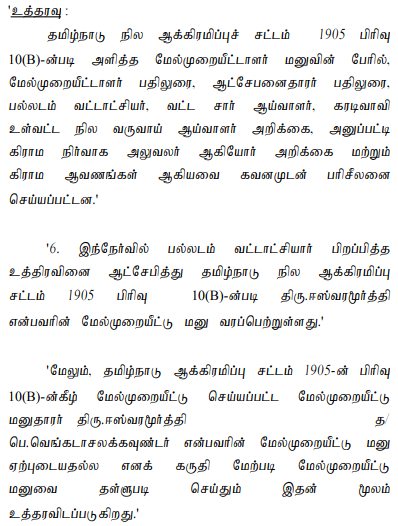
4. Learned Senior Counsel, on instructions, submitted that writ petitioners have now under pain of dispossession construing the impugned order to be disposal of their main appeal.
5. Issue notice to official respondents.
6. Mr.T.K.Saravanan, learned Additional Government Pleader accepts notice for R1 to R3 and submits on instructions that the impugned order is a final order in main appeal under Section 10 of said 1905 Act and is not an interim order under Section 10-B of said 1905 Act. To buttresses his submission, learned counsel drew our attention to the subject part of impugned order and relevant portion of subject reads as follows:

7. Learned State Counsel also pointed out that no stay petition under Section 10-B of said 1905 Act seeking stay pending decision of appeal has been taken out by writ petitioners. We also find that no stay petition has been annexed to typed set of papers.
8. We make it clear that all rights and contentions of private respondent (R4) are preserved and therefore, there is no impediment in taking up the main WP in the Admission Board with the consent of learned counsel on both sides.
9. As we have recorded the stated position of learned State Counsel made on instructions that the impugned order is an order in main appeal under Section 10 of said 1905 Act, the legal drill on hand becomes fairly simple. It comes to light that those portions of the impugned order which refer to Section 10-B of said 1905 Act are either not happily worded or there are inadvertent errors. Suffice to say that the impugned order being order dated 22.11.2024 bearing reference Na.Ka.2196/2024/Aa3 made by R1 is now construed as an order in statutory main appeal under Section 10 of said 1905 Act.
10. This takes us to the alternate remedy point.
11. Before we delve into the same, it is made clear that alternate remedy rule, no doubt is not an absolute rule and it is a rule of discretion. It is also a self-imposed restraint. Nonetheless, this Court has repeatedly held that 'the Tamil Nadu Land Encroachment Act, 1905 (Tamil Nadu Act III of 1905)' which is being referred to as 'said 1905 Act' is a self contained Code. The reason inter-alia is that there is a provision to have the alleged encroacher show caused under section 7 followed by an order (considering the cause shown). The order under section 6 is appealable under section 10 [District Collector is the appellate authority] and there is a provision for further revision to the Government under Section 10-A [Section 10-A(3) to be precise] of said 1905 Act. Pending appeal / revision, there is a provision for making interim prayer vide Section 10-B of said 1905 Act. Therefore, said 1905 Act is a self contained Code in every sense of the expression.
12. A careful perusal of the scheme of said 1905 Act makes it clear that writ petit
The court clarified that the impugned order was a final order under Section 10 of the Tamil Nadu Land Encroachment Act, allowing for statutory revision as an alternate remedy.

The court held that the writ petitioner has an effective alternate remedy through a statutory appeal under Section 10 of the Tamil Nadu Land Encroachment Act, 1905, and thus the writ petition was dis....
The court affirmed that the Appellate Authority under the Tamil Nadu Land Encroachment Act has the power to stay execution of orders and that the Alternative Remedy rule is not absolute but discretio....

The court emphasized the need to protect the petitioner's interest until the Statutory Appeal is disposed of, considering the nature of the land and the lack of opportunity for a fair hearing.
The court emphasized the right to appeal under the Tamil Nadu Land Encroachment Act, directing that appeals be entertained irrespective of limitation for fair resolution.
The court affirmed that the statutory appeal under the Tamil Nadu Land Encroachment Act is the appropriate remedy, and the Act is a self-contained code barring jurisdiction of courts over its orders.
The Tamil Nadu Land Encroachment Act is a self-contained code allowing for a structured process regarding encroachments and appeals, ensuring rights preservation for all parties involved.
Writ petition not maintainable if alternative statutory revision remedy available under land encroachment laws.
The court upheld the validity of impugned orders under the Tamil Nadu Land Encroachment Act, confirming that proper notices were served and emphasizing the efficacy of statutory appeals as an alterna....
Judicial intervention is unnecessary when the issue at hand, such as land encroachment, has already been resolved, as per statutory provisions.



An indispensable Tool for Legal Professionals, Endorsed by Various High Court and Judicial Officers
Please visit our Training & Support
Center or Contact Us for assistance

Scan Me!
India’s Legal research and Law Firm App, Download now!


For Daily Legal Updates, Join us on :



 Back to top


