
 Back
Back





IN THE HIGH COURT OF JUDICATURE AT MADRAS
D. BHARATHA CHAKRAVARTHY, J.
The Tiruvannamalai District Central Co-operative Bank Ltd. - Petitioner
Versus
The Joint Registrar of Co-operative Societies, Tiruvannamalai District & Ors. - Respondents
W.P.No.3571 of 2023 and WMP.Nos.3629 & 3632 of 2023
Decided On : 02-01-2025
| Table of Content |
|---|
| 1. overview of the disciplinary action and subsequent reinstatement order. (Para 1 , 2 , 3) |
| 2. arguments presented regarding the appropriateness of punishment. (Para 4) |
| 3. arguments regarding the nature of charges and personal circumstances of the workman. (Para 5 , 6) |
| 4. final decision reinstating the original dismissal order. (Para 7) |
| 5. court's disapproval of leniency in severe misconduct cases. (Para 8 , 9 , 10) |
| 6. restoration of the dismissal order based on serious charges. (Para 11) |
ORDER :
The writ petition is filed by the petitioner Bank aggrieved by the order of the Joint Registrar of Cooperative Societies, Thiruvannamalai Region, Thiruvannamalai District dated 25.02.2022, whereby, the revision petition filed by the second respondent Workman was allowed by the Joint Registrar.
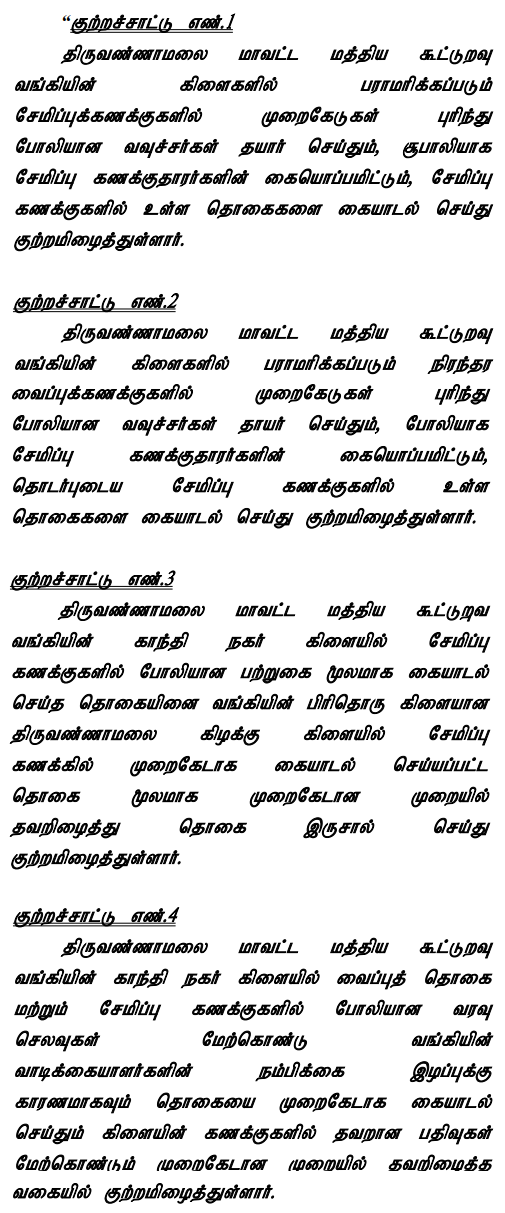
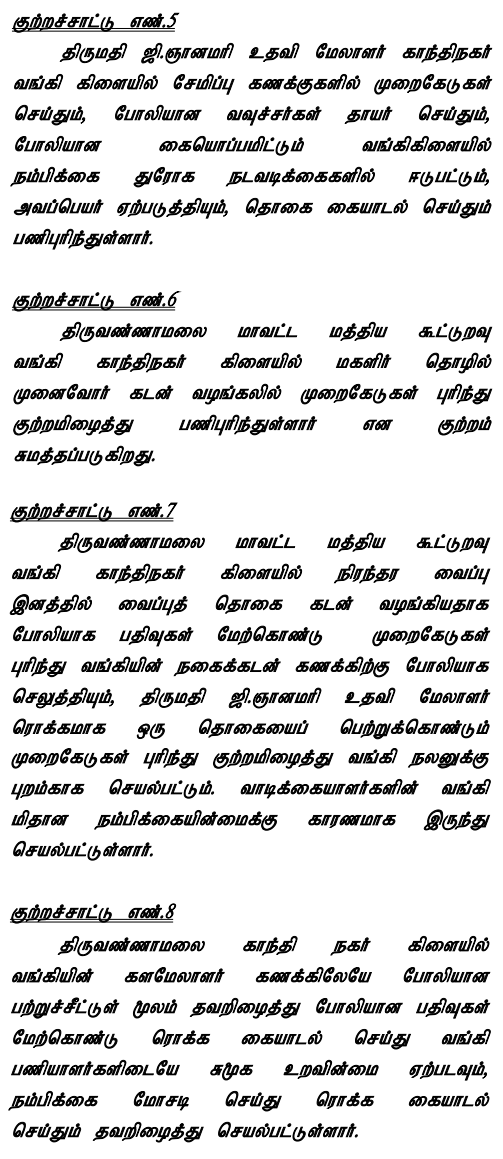
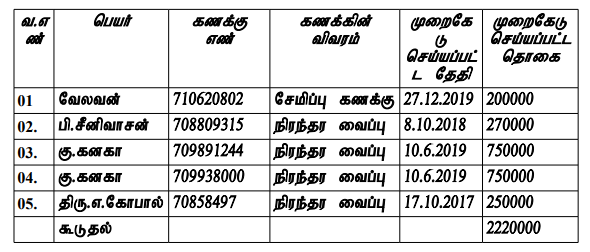
2. The brief factual background, in which, this writ petition arises is that the second respondent Gnanamari, who was working as Assistant Manager in the petitioner Bank. While so, a charge memorandum dated 20.02.2020 was issued against her. It is essential to extract the charges against the Second respondent Gnanamari and they read as hereunder:
Details of the Misappropriated funds:
3. Thereafter, disciplinary action continued and by an order dated 05.01.2021, the second respondent was dismissed from service. As against the order of dismissal, the second respondent preferred the revision under Section 153 of the Tamil Nadu Co-operative Societies Act.
4. The first respondent considered the case of the parties. In respect of each of the charges, detail findings are given. Apart from, the fact that the each and every charge has been duly proved in the enquiry, the revisional authority also considered the revision and the additional explanation of the Workman. It is the primary case of the Workman that subsequently, the misappropriated amount has been paid back to the bank. She therefore also undertakes that she will not further involved in such mistakes. She has been neglected by her husband and struggling with two children, who are studying in second year and third year of engineering and she also has one physically handicapped brother and his wife and children to take care and therefore, she prayed that instead of the capital punishment, she must be given any other punishment. The first respondent considered the case of the workman. The first respondent considered the fact that she was 46 years and therefore, she cannot now get employment anywhere else. The Workman had paid all the balance amount to the Society. No criminal case or surcharge proceedings is pending against the Workman. Therefore, the first respondent considered that dismissal from service is disproportionate to the charges levelled and therefore, ordered reinstatement with a lesser punishment of Increment cut for a period of 3 years with cumulative effect and the period of non employment was to be treated as treated on the basis of no work, no pay. Aggrieved by the same, the bank is before this court.
5. Ms.Reshmi Christy, learned counsel appearing on behalf of the petitioner Bank, taking this court through the charges, submitted that the second respondent faces very serious charge. She has indulged in forgery falsification of accounts and withdrawal of the deposit amounts of the customers of the Bank totalling to Rs.22,20,000/- which has been proved to hilt by the bank. The charges are very serious in nature and therefore, the order of the first respondent is erroneous in law.
6. Per contra, Mr.Shanmugasundaram, the learned counsel appearing on behalf the Workman would submit that while imposing the punishment, the condition of the employee should also be taken into account. When the petitioner is a woman aged about 46 years and has been neglected by her husband and finding it difficult to run the life with two children and also with the physically handicapped brother and his family, the Authority has taken a right decision. As a matter of fact, the petitioner herself has cat
AI
Employment law requires that disciplinary action for severe misconduct, such as misappropriation and forgery, must be commensurate with the offenses committed, prioritizing accountability over rehabi....
The standard of proof required under the Co-operative Societies Act is distinct and different from that required under Criminal Law, and preponderance of probabilities suffices for punishment under t....
The court ruled that disciplinary dismissals must adhere to natural justice and have sufficient evidence, particularly when severe penalties are imposed, as seen in cases of clerical errors.

Disciplinary action must align with evidence; disproportionate punishment is not permissible when actions were taken in good faith.
Employee dismissal requires substantial evidence of misconduct; failure to provide independent proof necessitates reconsideration of disciplinary actions.
The court confirmed the validity of termination due to substantiated charges of misconduct and financial irregularity, emphasizing integrity in public service.


The court established that an employee must exhaust available administrative remedies before seeking judicial review in cases of dismissal.



An indispensable Tool for Legal Professionals, Endorsed by Various High Court and Judicial Officers
Please visit our Training & Support
Center or Contact Us for assistance

Scan Me!
India’s Legal research and Law Firm App, Download now!


For Daily Legal Updates, Join us on :



 Back to top


