
 Back
Back





IN THE HIGH COURT OF JUDICATURE AT MADRAS
R.Hemalatha, J.
M.Selvaraju - Appellant
Vs.
E.Ramasamy Gounder (Died) - Respondent
S.A.No.44 of 2019 and C.M.P. Nos.2636 and 842 of 2019
Decided On : 30-01-2025
JUDGMENT :
The unsuccessful plaintiff before both the Courts below has filed the present second appeal.
2. The plaintiff, M.Selvaraju filed the suit in O.S.No.583 of 1997 before the Principal Sub Court, Salem, for declaration of his title to the suit property and for a permanent injunction restraining the defendants 3 to 5 and their men and agents from interfering with his peaceful possession and enjoyment of the suit property or in the alternative directing the defendants 3 to 5 to deliver possession of the suit property to the plaintiff. The suit property morefully described in the plaint is a vacant land in survey number 19/2A1B3B1 of Meyyanur Village, Salem Taluk, Salem District, measuring 0.03.0 hectares within the boundaries stated in the plaint schedule.
3. For the sake of convenience, the parties are referred to as per their rank in the trial court and at appropriate places, their rank in the present second appeal would also be indicated.
4. The case of the plaintiff in a nutshell is as follows :
The plaintiff is the absolute owner of the suit property. The suit property originally belonged to one Sengottuvelu Gounder. He created a public charitable trust in the name and style of "P.Sengottuvelu and Pavayammal Charitable Trust" through a Trust deed dated 10.06.1988 (Ex.B1). Sengottuvelu Gounder and one Nalliappan were trustees and the suit property was settled in favour of the Trust by Sengottuvelu Gounder vide a registered settlement deed dated 14.06.1988 (Ex.A1 = Ex.A22). Thereafter, the trustees executed a Power of Attorney in favour of one Nagarajan authorising him to deal with the suit property on behalf of the Trust. Accordingly, Nagarajan, the Power of Attorney holder, sold the suit property in favour of the second defendant through a registered sale deed dated 22.11.1990 (Ex.A3). The second defendant in turn sold the suit property in favour of the plaintiff vide a registered sale deed dated 29.08.1991 (Ex.A4). Ever since the date of purchase the plaintiff has been in possession and enjoyment of the suit property. He also constructed a compound wall around the suit property and put up a gate. The first defendant who is a total stranger is attempting to trespass into the suit property and one such attempt was made on 09.01.1997. The first defendant, in fact, claimed right over the suit property pursuant to the sale deed executed by the court in O.S.No.800/1990 on the file of the Additional Sub Court, Salem. The decree passed in O.S.No.800/1990 is not a valid decree. In any event, the plaintiff is a bonafide purchaser for value without notice of the earlier court proceedings. The first defendant filed the suit in O.S.No.800/1990 against Sengottuvelu Gounder for specific performance of contract based on a sale agreement dated 27.02.1984 (Ex.A17). The signature of Sengottuvelu Gounder on the sale agreement was forged. Though the property was sold by Sengottuvelu Gounder to the second defendant, the second defendant was not shown as a party in O.S.No.800/1990 and therefore, the decree passed in the said suit would not bind the plaintiff. The Power of Attorney holder had a valid right to sell the suit property in favour of the second defendant. Moreover, the suit in O.S.No.800/1990 was filed on 13.09.1990 and the decree was passed on 06.04.1994 (Ex.A16). The decree passed in O.S.No.800/1990 on the file of the Additional Sub Court, Salem, is an ex parte decree. Since the property was sold in favour of the plaintiff's vendor on 22.11.1990 itself the sale is not hit by lis pendens. Hence, the plaintiff is entitled for all the reliefs as prayed for by him.
5. During the pendency of the suit the first defendant died and his legal heirs were impleaded as defendants 3 to 5. The second defendant remained absent before both the courts below and was set ex parte. The suit was resisted by the defendants 3 to 5 on the following grounds:
i. All the allegations contained in the plaint are false.
ii. It is true that the suit property origin
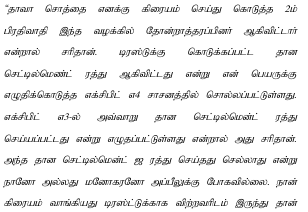
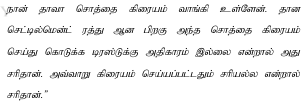
The court upheld the validity of prior decrees and ruled that a Power of Attorney executed by trustees was invalid, affirming that the plaintiff's claims were barred by lis pendens and suppression of....

A suit for possession must include a declaration of title when there is a dispute over ownership; mere possession cannot support recovery claims.


The distinction between judgment in rem and judgment in personam, and the binding nature of judgment in rem on anyone claiming interest in the property.
The burden of proof lies on the party asserting facts, with claims of forgery regarding a registered power of attorney necessitating all relevant parties to be joined to the suit for effective adjudi....
An agreement of sale does not create any interest or charge on property; subsequent deeds must be joined in a suit for title claim.
Registered attested documents like settlement deeds require proof of execution under S.68/69 Evidence Act; registration presumes no validity when challenged.



An indispensable Tool for Legal Professionals, Endorsed by Various High Court and Judicial Officers
Please visit our Training & Support
Center or Contact Us for assistance

Scan Me!
India’s Legal research and Law Firm App, Download now!


For Daily Legal Updates, Join us on :



 Back to top


