
 Back
Back





IN THE HIGH COURT OF JUDICATURE AT MADRAS
D. BHARATHA CHAKRAVARTHY, J.
The Management, Shri Anandakumar Mills Limited, Represented by its General Manager - Petitioner
Versus
The Presiding Officer, Labour Court, Coimbatore and Ors. – Respondents
W.P. No.254 of 2010 and M.P. Nos.1 to 3 of 2010
Decided On : 28-01-2025
ORDER :
(D. BHARATHA CHAKRAVARTHY, J.)
This Writ petition is filed challenging the common order, dated 24.06.2009 passed by the Labour Court, Coimbatore in C.P.Nos.597 to 603 and 605 of 2006. By the said order, the Computation Petitions, filed by the eight workmen, who are arrayed as respondent Nos.2 to 9 herein, were partly allowed. A sum of Rs.1,04,500/- to the petitioner in C.P.No.597 of 2006, a sum of Rs.1,00,700/- to the petitioner in C.P.No.598 of 2006, a sum of Rs.1,02,600/- each to the petitioners in C.P.Nos.599 to 603 of 2006 and a sum of Rs.1,04,500/- to the petitioner in C.P.No.605 of 2006 were ordered to be paid.
2. The claim of the workmen before the Labour Court is that they are the employees of the mill. There were 190 permanent employees, 152 badlis and 26 apprentices in the management mill, which is a Group - D mill. On 17.05.1996, the management entered into a settlement under Section 18(1) of the Industrial Disputes Act, 1947 (hereinafter referred to as the 'Act'), in which, it agreed to accord permanency to the badlis and apprentices who had put in 45 months of continuous service. However, the settlement was not implemented. Therefore, the trade union raised a dispute. A failure report was submitted on 06.06.2003.
3. Under the circumstances, the management, with an ulterior motive, failed to pay electricity charges and attempted to stop the operation of the mill. Again, a fresh dispute was raised before the Assistant Commissioner of Labour and even though workers agreed to increase the productivity by 100%, the management refused to operate the mill and intended to engage coolies. On 06.07.2003, the management also declared a lockout without following the provisions of the law. Thereupon, the Assistant Commissioner of Labour sent a report on 09.01.2004 informing all these facts. The Government referred the dispute to the Industrial Tribunal for adjudication. The earlier dispute was also referred for adjudication as per G.O.D.No.1195, dated 16.09.2004. The same was pending in I.D.No.444 of 2004.
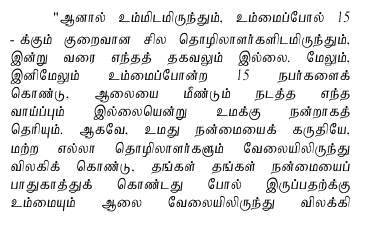
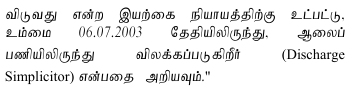
4. In the meanwhile, the management obtained resignation letters from some of the employees and paid compensation to them. The workmen, involved in the present case, did not accept the demands of the management and did not resign their job. While so, on 07.01.2005, the management issued a notice to the workman Nos.2 to 10 that from 06.07.2003, they were discharged from service. The workmen sent a reply on 21.01.2005 refuting the allegations. When the dispute raised is already pending before the Court, the order of dismissing the workmen on 07.01.2005 with effect from 06.07.2003 is illegal. The management ought to have obtained permission to dismiss the workmen from service. Therefore, the order of dismissal of the workmen is illegal and thus, the workmen are entitled to salary and other benefits for the period from 06.07.2003 to 31.01.2005. Therefore, the Claim Petitions were filed.
5. The Claim Petitions were resisted by the management. The operation of the mill was stopped only because of an increase in the cost of raw materials, whereby, the management was not able to sell the yarn even for the market prices. Therefore, on 06.07.2003, the operation of the mill was temporarily suspended. It was informed to the workers that they will not be entitled to salary and the lay-off salary for the suspension period. The management only suspended the operation of the mill and did not close down the mill. The dispute raised by the Labour Union is pending in I.D.No.444 of 2004. The Computation Petitions are not maintainable as they do not have any pre-existing rights. Out of 365 workers, 352 workers have settled their claim under the Section 18(1) settlement. It is open for the workman Nos.2 to 9 settle their claim or if they agree to abide by the new conditions of the new management, they can continue the employment.
6. On the said pleadings, the Labour Court proceeded with the enquiry. On behalf of the workmen, one A.R.Kaliappan wa
Termination of workmen deemed punitive under Section 33 of the Industrial Disputes Act requires prior permission, rendering any non-compliant termination void ab initio.

Termination of service without prior permission under Section 33 of the Industrial Disputes Act is void if deemed punitive, entitling workmen to salary and benefits during the period of deemed servic....

Termination classified as punitive requires prior approval under statutory provisions, rendering non-compliance void ab initio.
Termination of employment deemed punitive requires prior permission under Section 33 of the Industrial Disputes Act, 1947, which was not obtained, rendering the termination illegal.


The central legal point established in the judgment is the requirement of a pre-existing right and entitlement of the employees as a prerequisite for entertaining a Claim Petition under Section 33 (C....

The main legal point established in the judgment is that the jurisdiction of the Tribunal under Section 33C(2) of the Industrial Disputes Act is limited to the recovery of money due to a Workman from....

Failure to seek approval under Section 33(2)(b) of the Industrial Disputes Act renders dismissal void and inoperative, as established by the Supreme Court in Jaipur Zila case.



An indispensable Tool for Legal Professionals, Endorsed by Various High Court and Judicial Officers
Please visit our Training & Support
Center or Contact Us for assistance

Scan Me!
India’s Legal research and Law Firm App, Download now!


For Daily Legal Updates, Join us on :



 Back to top


