
 Back
Back





BEFORE THE MADURAI BENCH OF MADRAS HIGH COURT
R. KALAIMATHI, J.
The Branch Manager, United India Insurance Company Limited – Appellant
Versus
Kavitha and Ors. – Respondents
C.M.A.(MD)No.898 of 2024 and C.M.P.(MD) No.9617 of 2024
Decided On : 28-01-2025
| Table of Content |
|---|
| 1. arguments of learned counsel (Para 2) |
| 2. commissioner held insurer liable (Para 4) |
| 3. jurisdiction confined to substantial questions (Para 5) |
| 4. appeal dismissed confirming order (Para 14 , 15) |
JUDGMENT :
(R. KALAIMATHI, J.)
This Civil Miscellaneous Appeal has been preferred by the Insurance Company against the Award dated 19.10.2023 passed in E.C.No.37 of 2022 by the Employees Compensation Commissioner, Dindigul.
2. Heard the arguments of the learned counsel for the appellant, the learned counsel for the first respondent and the learned Additional Government Pleader appearing for the third respondent.
3. At trial, to substantiate the claim, on the claimant side, the claimant has been examined as P.W.1 and six documents were marked. On the first respondent side, one witness (Suresh son of Nagamuthu) was examined and no document was marked. On the second respondent/Insurance Company side, two witnesses (Raj and V.S.Sekar) were examined and three documents were marked.Ex.R3 is the copy of policy of insurance.
4. Upon consideration, the learned Workmen Compensation Authority has held that on the date of accident, the policy was in force and the deceased was working under the first respondent as cleaner and therefore, the second respondent, who is the insurer of the first respondent, was made liable to pay compensation.
5. As per the law laid down by the Hon’ble Supreme Court in Golla Rajanna vs. Divisional Manager, United India Insurance Company Limited reported in 2017 ACJ 1 (SC) and North East Karnataka Road Transport Corporation vs. Sujatha reported in 2019 ACJ 29 (SC), the jurisdiction of the Appellate Court is confined to the substantial question of law and it cannot re- appreciate the evidence and under the scheme of the Act, the Commissioner is the last authority on facts. Hence, this Court is of the considered view that the Commissioner has given its finding based on a sound appreciation of evidence.
6. Section 30 of the Workmen Compensation Act, 1923 is extracted hereunder, for easy understanding:
30. Appeals:
1. An appeal shall lie to the High Court from the following orders of a Commissioner, namely:
(a) an order awarding as compensation a lump sum whether by way of redemption of a half-monthly payment or otherwise or disallowing a claim in full or in part for a lump sum;
(aa) an order awarding interest or penalty under section 4-A;
(b) an order refusing to allow redemption of a half-monthly payment;
(c) an order providing for the distribution of compensation among the dependants of a deceased workman, or disallowing any claim of a person alleging himself to be such dependant;
(d) an order allowing or disallowing any claim for the amount of an indemnity under the provisions of sub-section (2) of section 12; or
(e) an order refusing to register a memorandum of agreement or registering the same or providing for the registration of the same subject to conditions:
Provided that no appeal shall lie against any order unless a substantial question of law is involved in the appeal, and it the case of an order other than an order such as is referred to in clause (b) unless the amount in dispute in the appeal is not less than three hundred rupees:’
...
(11) Under the scheme of the Act, the Workmen’s Compensation Commissioner is the last authority on facts. Parliament has thought it fit to restrict the scope of the appeal only to substantial questions of law, being a welfare legislation. Unfortunately, the High Court has missed this crucial question of limited jurisdiction and has ventured to re- appreciate the evidence and recorded ints own findings on percentage of disability for which als othere is no basis. Thewhole exercise made by the High Court is not within the competence of the High Court under Section30 of the Act.”
7. It is also relevant to refer to the observations made by the Hon’ble Supreme Court in the case of North East Karnataka Road Transport Corporation (cited supra) as follows:
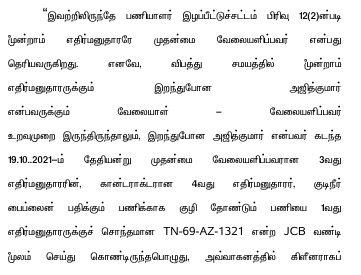
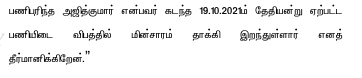
“9. At the outset, we may take note o
The High Court's jurisdiction in appeals under the Workmen Compensation Act is limited to substantial questions of law, and it cannot re-evaluate evidence or findings of fact.

The limited jurisdiction of the High Court to examine substantial questions of law only and not to reappreciate evidence or findings of fact.
The main legal point established is the limited jurisdiction of the High Court to examine substantial questions of law under the Workmen's Compensation Act, emphasizing the finality of the Commission....

The appellate jurisdiction of the High Court is confined only to examine the substantial questions of law arising in the case, as provided under Section 30 of the Workmen's Compensation Act, 1923.

The High Court's jurisdiction under Section 30 of the Workmen's Compensation Act is limited to substantial questions of law, and it cannot re-evaluate factual findings.
Limited jurisdiction of the High Court in appeals under the Workmen's Compensation Act, 1923.
Limited jurisdiction of the High Court under Section 30 of the Workmen's Compensation Act to examine substantial questions of law only.
The High Court's jurisdiction under Section 30 of the Workmen's Compensation Act is limited to substantial questions of law; it cannot re-evaluate evidence or disturb findings unless they are pervers....
The judgment established the principle that the High Court's jurisdiction under the Workmen's Compensation Act is confined to examining substantial questions of law only.
The High Court's jurisdiction under Section 30 of the Workmen's Compensation Act is limited to substantial questions of law, and it cannot re-appreciate evidence or disturb factual findings.



An indispensable Tool for Legal Professionals, Endorsed by Various High Court and Judicial Officers
Please visit our Training & Support
Center or Contact Us for assistance

Scan Me!
India’s Legal research and Law Firm App, Download now!


For Daily Legal Updates, Join us on :



 Back to top


