Back
Back





2026 Supreme(Mad) 46
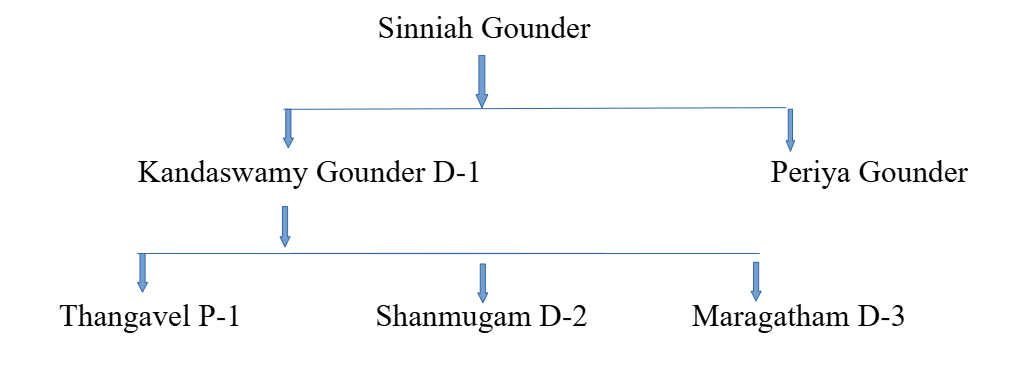
IN THE HIGH COURT OF JUDICATURE AT MADRAS
V. Lakshminarayanan, J.
Thangavelu - Appellant
Versus
Kandaswami Gounder, S/o Chinna Gounder – Respondent
SA No. 175 of 1994
Decided On : 20-02-2026
For the Appellant : M/s.K.Mayilsamy
For the Respondent: M/s.R.Dillikumar, M/s.L.Mouli, R. Babu, Mr.Anwar Sadath
The Kartha of a joint family must prove legal necessity for alienation of family property; failure to demonstrate necessity invalidates alienation for coparceners' shares.
Headnote:(A) Code of Civil Procedure - Section 100 - Hindu Law - Alienation of joint family property by Kartha for legal necessity - Burden of proof lies on the purchaser to demonstrate existence of legal necessity; sale deed valid only to the extent of seller's share, not affecting coparceners’ rights. (Paras 29, 47)
(B) The sale must satisfy legal standards of necessity and proper inquiry by the purchaser, beyond mere recitals in the sale deed. (Paras 29, 30, 39)
Facts of the case:
The plaintiff sought partition of family property, asserting that a sale executed by the Kartha, allegedly for family necessity, was invalid as no evidence supported the underlying debts claimed to justify the sale. (Paras 2-19)
Findings of Court:
The court found that defendants failed to prove legal necessity for the sale by the Kartha, leading to a decree in favor of the plaintiff. (Paras 47)
Issues: Whether the purchaser established the debt's existence and whether Kartha could alienate property without other coparceners' consent. (Paras 19, 29)
Ratio Decidendi: The court held that mere pleadings do not constitute proof; a purchaser must corroborate claims of legal necessity with evidence. The sale was found valid only as to the portion owned by the Kartha. (Paras 29, 39)
Result: Second appeal allowed; sale deed only binding to the share of the first defendant.
| Table of Content |
|---|
| 1. partition and possession claims (Para 2 , 3 , 4) |
| 2. defendant allegations and defense (Para 5 , 6 , 7 , 8 , 9 , 10) |
| 3. appeals and decisions (Para 14 , 18) |
| 4. substantial questions of law in appeals (Para 19 , 20 , 21) |
| 5. burden of proof in property sales (Para 23 , 24 , 25) |
| 6. legal necessity and proof (Para 29 , 30 , 31) |
| 7. insufficiency of pleadings as evidence (Para 39 , 40) |
| 8. conclusion and recent judgments (Para 47 , 48) |
ORDER :
V. Lakshminarayanan, J.
The plaintiff appeals. For the sake of convenience, the parties shall be referred as per their ranks in the suit.
2.The plaintiff presented OS.No.653 of 1978, seeking partition and separate possession, on the file of the Sub Court at Coimbatore. The prayer in the suit was as follows:-
“a)directing the division of Schedule II and IV and 3/4th share in Schedule III into 3 equal shares and put the plaintiff in possession of one such a share;
b)divide 1/4th share in Schedule III into four equal shares and allot one such share to the plaintiff;
c)to appoint a commissioner to divide the properties.”
3.The plaintiff, defendants 2 & 3 are the children of the first defendant and one, Marathal. The first defendant and his brother, one, Periya Gounder were the sons of one, Sinniah Gounder. By way of a partition between the first defendant and his younger brother Periya Gounder, a house in Kaikolapalayam and lands measuring 48 cents in S.F.No.36/2 and 60 cents in S.F.No.38 in Vellanaipatti Village, Coimbatore Taluk, Coimbatore District, were allotted to the first defendant. As the first defendant could not conveniently enjoy the said properties for himself and on behalf of his minor children, he executed a sale deed on 21.11.1963, in favour of two persons, Periya Gounder and Ramasamy Gounder. From and out of the sale proceeds and joint family funds, the first defendant purchased the suit second schedule mentioned property. Marathal’s father owned the properties described in schedule 3. After his death, his four daughters divided the property amongst themselves. Marathal got 1/4th share and the remaining 3/4th share was purchased by the first defendant. The purchase was, from and out of, the joint family funds. The plaintiff got married in the year 1977. He wanted to move away from the family. Hence, the defendants 1 & 2 executed a deed releasing their right over their house property and the plaintiff became the absolute owner of the same.
4.On account of the misunderstanding that arose between the daughter in law (wife of the plaintiff) and the first defendant, the first defendant alienated the suit second schedule property in favour of the fourth defendant on 01.08.1977. The plaintiff pleaded that the sale is, sham and nominal, brought about to defeat the interest of the plaintiff. He urged that the family had sufficient income and it was from that income, the fourth schedule property had been purchased by the first defendant. The plaintiff stated that he issued a lawyer’s notice on 30.03.1978, seeking partition. The same came to be denied by the defendants 1 & 4. Hence, the suit for partition.
5.Summons were served on the defendants. The first and fourth defendants filed separate written statements. The first defendant admitted the relationship between the parties and the averments in paragraph No.5 and 6 of the plaint relating to the manner in which the second schedule property was purchased. He pleaded that he was a Mill Worker and from and out of his income, Schedule III of the property was purchased. He alleged that when the property was purchased, the plaintiff and the 2nd defendant were minors and did not contribute towards the purchase of the said property. He added there was no income from the property mentioned in the II Schedule, and that the plaintiff is not entitled to any share in the III Schedule property. He agreed that there was a release deed executed on 30.01.1978 by defendants 1 to 3 in favour of the plaintiff regarding the house property situated at Kaikolapal