
 Back
Back





BEFORE THE MADURAI BENCH OF MADRAS HIGH COURT
G.JAYACHANDRAN, K.K.RAMAKRISHNAN, JJ.
M/s. Megala Construction – Appellant
Versus
The Superintending Engineer (Highways) Thiruchirappalli – Respondent
W.A. (MD) Nos. 38, 39, 64, 67, 68, 72, 79, 80, 119, 120 of 2026, C.M.P. (MD) No. 479 of 2026
Decided On : 17-02-2026
| Table of Content |
|---|
| 1. eligibility criteria for contractor bids. (Para 2) |
| 2. discussion on proof of ownership. (Para 3 , 5 , 6) |
| 3. confirmation and rationale for rejection. (Para 4 , 8) |
| 4. court's direction on future qualifications. (Para 9) |
| 5. disposal of writ appeals. (Para 10) |
JUDGMENT :
G. JAYACHANDRAN, J.
1. A batch of writ appeals in two sets, one filed by Megala Construction and another by Velavan Builders Private Limited, are directed against the common order passed by the learned single Judge on 18.12.2025.
2. The brief facts leading to filing of the writ appeals are as below:
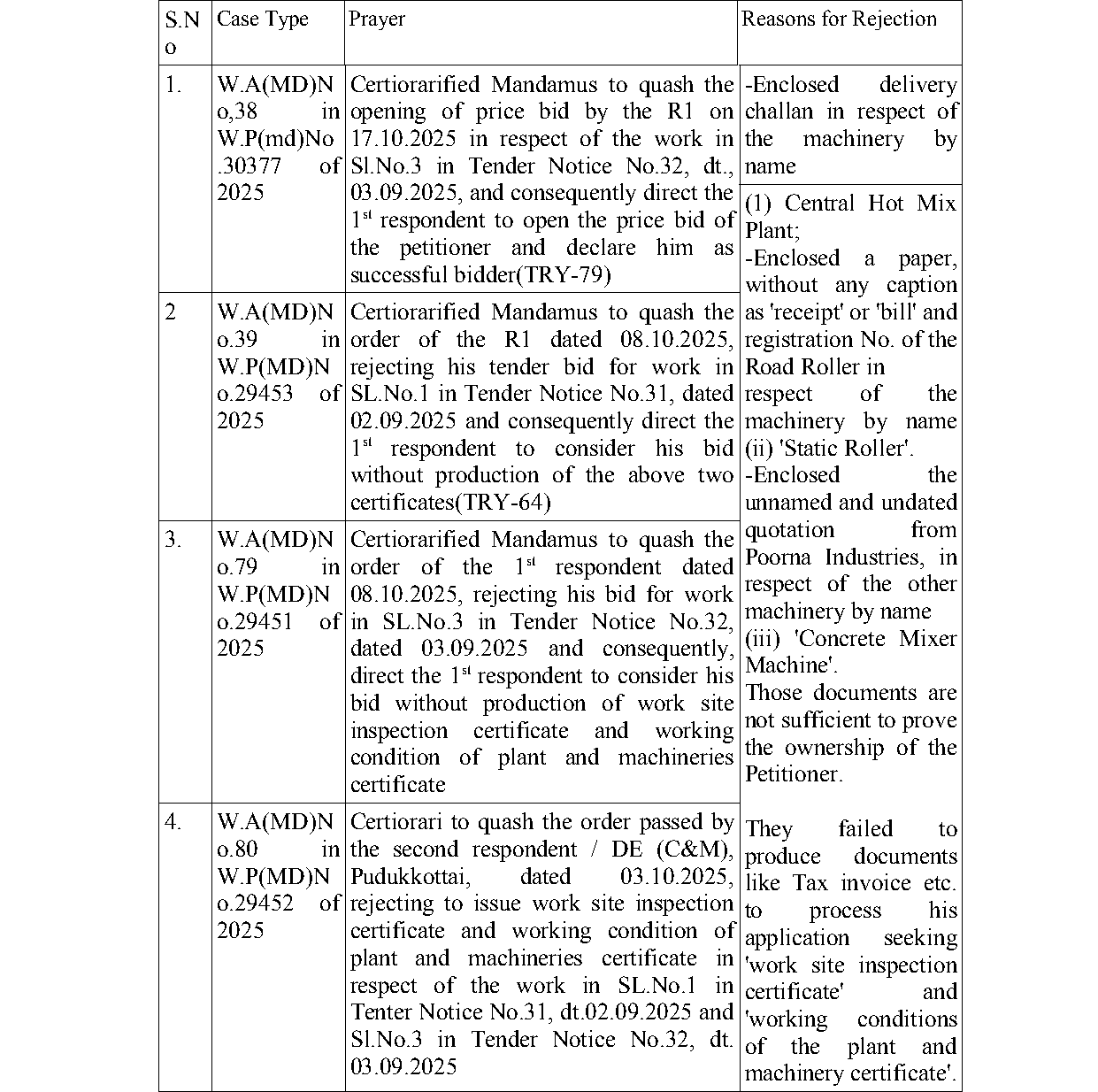
the appellants are Class-I Contractors under the Highways Department. They have applied for work contract in respect of Pudukottai (H) C&M Division CRIDP 2025-2026. Pursuant to the tender notification issued by the first respondent dated 02.09.2025, their applications were considered and rejected on the first stage itself, since the respondents were not satisfied regarding the mandatory possession/ownership of critical plants and machinery to get eligible for pre-qualification. The rejection order clearly specified the plants and machinery for which the appellants were not able to produce acceptable proof of ownership.
3. The contention of the respondents is that for proof of ownership of plants and machinery mentioned in the tender, the contractors should produce legible tax invoices and proof for purchase. Whereas in this case, the contractors failed to produce tax invoice for the plants and machinery. For some machinery, only delivery challens were produced which were not considered as proof of ownership.
4. The learned single Judge, on appreciating the terms of tender contract and the deficiency pointed out by the respondents in rejecting the qualification bid, upheld the rejection order of the respondents. Challenging the order of the learned single Judge, these batch of writ appeals have been filed.
5. The learned counsel appearing for the appellants primarily submitted that the delivery challen is, as good as tax invoice. The respondents ought not to have rejected the qualification bid on the ground that the contractors have produced only delivery challen for proof of ownership.
6. To buttress his argument, the learned counsel appearing for the appellants/contractors submitted that most of the machineries were purchased from Gujarath under the Value Added Tax Rules applicable only in the State of Gujarath, and if it is an interstate transaction between two registered dealers, the tax invoice is not to be issued, the only proof for ownership is the delivery challen, wherein the owner of the plants and machinery will be mentioned along with the value of the machinery and tax bid. The learned counsel also produced a copy of the delivery challen to substantiate his submission and also relied upon Section 60 of Gujarath Value Added Tax Act, 2005. The said Section reads as below:
60. (1) A registered dealer who sells taxable goods to another registered dealer, 112[shall provide him] at the time of sale, with a tax invoice containing such particulars as may be prescribed and retain a copy thereof:
Provided that a tax invoice shall not be issued by a dealer-
(a) in respect of the goods specified in Schedule I or exempt by notification under sub-section (2) of section 5; has given an option to pay lumpsum tax in lieu of tax under 113[section 14, - 14A, 114[14B, 14C] or 14D;]
(c) for sale in the course of inter-State trade or commerce or export out of the territory of India; 115[ * ]
(d) to a person who is not a registered dealer; 116[ or ] 117(e) [in such other cases as the State Government may, by notification in the Official Gazette, specify.]
(2) Except when tax-invoice is issued under sub-section (1), if a registered dealer sells any goods exceeding rupees one hundred in value in any one transaction to any person, he shall issue to the purchaser a retail invoice, containing such particulars as may be prescribed and retain a copy thereof.
(3) if any registered deale
AI
Delivery challans can serve as valid proof of ownership for machinery in interstate transactions, substituting tax invoices under the Gujarath Value Added Tax Act, 2005.
Failure to provide valid proof of ownership for mandatory equipment results in the rejection of tender applications, reaffirming the importance of compliance with tender conditions.

Tender rejection upheld as petitioner failed to provide sufficient proof of machinery ownership as mandated, highlighting strict adherence to bid requirements.
Tenderers must provide documented proof of ownership of required machinery, failing which bids may be lawfully rejected.


Judicial intervention in tender processes is limited to preventing arbitrariness; courts prioritize public interest over individual grievances when evaluating tender acceptance decisions.
The court upheld the interpretation of tender conditions regarding equipment ownership, dismissing the appeal as unmeritorious.



An indispensable Tool for Legal Professionals, Endorsed by Various High Court and Judicial Officers
Please visit our Training & Support
Center or Contact Us for assistance

Scan Me!
India’s Legal research and Law Firm App, Download now!


For Daily Legal Updates, Join us on :



 Back to top


