
 Back
Back





THE HIGH COURT OF JUDICATURE AT MADRAS
P.B. BALAJI, J.
K.A.Shanmugham - Appellant
Versus
M.K.Basheer - Respondent
A.S.No.135 of 2023, CMP.No.5287 of 2023
Decided On : 30-01-2026
| Table of Content |
|---|
| 1. conclusion and order of the court. (Para 1 , 6 , 18) |
| 2. agreement classified as security for borrowing. (Para 2 , 3) |
| 3. issues framed by the trial court. (Para 4) |
| 4. arguments presented by both parties. (Para 7 , 8) |
| 5. decision on refund relates to trial court's error. (Para 9 , 17) |
| 6. burden on defendant to prove agreement was sham. (Para 10 , 11 , 12) |
| 7. trial court's application of section 92 critical. (Para 13 , 14 , 15 , 16) |
JUDGMENT :
P.B. BALAJI, J.
The plaintiff in a suit for specific performance, is the appellant in the above appeal suit.
2.Pleadings:
The plaint in brief:
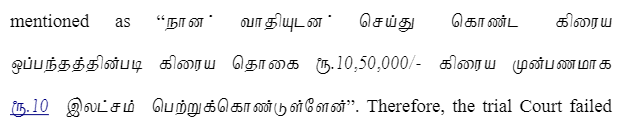
The plaintiff entered into a registered agreement of sale on 07.12.2015 to purchase the properties belonging to the defendant, for a total sale consideration of Rs.10,50,000/-. The agreement was registered in Doc.No.13846 of 2015. On the date of the agreement, the plaintiff paid Rs.10,00,000/- as advance. It was agreed that the balance Rs.50,000/- would be paid within 24 months from the date of agreement and the sale deed would be registered thereafter. The plaintiff has always been ready and willing to perform his part of the contract. On 07.11.2017, the plaintiff sent a lawyer's notice, expressing readiness and willingness and also calling upon the defendant to come to the SRO, Avinashi, to conclude the sale deed to execute and register the sale deed. Despite receipt of the said notice, the defendant turned a deaf ear. As the defendant is trying to defeat and defraud the lawful rights of the plaintiff and making hectic arrangements to alienate the suit properties to third parties, the plaintiff has come forward seeking specific performance of the agreement of sale.
3.The written statement in Brief:
The defendant never agreed to sell the suit properties to the plaintiff. The defendant used to regularly borrow money from moneylenders and it was the usual practice to register documents like sale agreements and mortgages, besides also powers of attorney in favour of the moneylenders as security for the borrowing and after repayment, the moneylenders used to cancel the agreements, mortgages and powers of attorney. The defendant, in order to settle his previous creditor, one Vivekanandan, to whom he was due Rs.5,00,00/-, approached two brokers, who introduced the plaintiff to the defendant. The plaintiff lent only Rs.5,00,000/- on 07.12.2015 and on the same day, the defendant has settled the claim of the previous creditor, Vivekanandan. The mortgage deed in his favour was cancelled by receipt No.13845 of 2015. The plaintiff demanded 24% interest for the sum of Rs.5,00,000/- lent by the plaintiff and the defendant was compelled and forced to execute the registered sale agreement for Rs.10,50,000/-, which was the very next document registered after the cancellation of the mortgage deed. The defendant, who was in urgent need of money, had no other option, but to accept the plaintiff's unlawful demands. The defendant has been paying the interest regularly for which the plaintiff has not issued any receipts. The entire transaction was only a loan transaction and the parties never intended the document to be a sale agreement. The suit property is worth more than Rs.50,00,000/- and as a prudent owner, the defendant would have never agreed to part with the same for a throw away consideration of Rs.10,50,000/-. The defendant has sent an elaborate reply notice on 07.12.2017, which has been received by the plaintiff's counsel on 11.12.2017. The defendant therefore prayed for dismissal of the suit.
4.Issues framed by the trial Court:
Based on the pleadings, the trial Court framed the following issues on 10.12.2019:
1.Whether the sale agreement dated 17.12.2015 was intended for sale or towards loan transaction?
2.Whether the payment of advance amount is proved?
3.Whether the plaintiff was ready and willing to execute the part of contract?
4.Whether the plaintiff is entitled to the relief of specific performance of contract?
5.Whether the plaintiff is entitled to the re
AI
A registered sale agreement may be deemed a loan transaction if its terms are inconsistent with a true sale, supported by the burden of proof on the party disputing its intended meaning.


The court established that an agreement labeled as a sale can be deemed a security for a loan if the evidence supports such a conclusion, and specific performance can be denied if the plaintiff fails....
In suits for specific performance, the burden lies on the defendant to prove claims that a sale agreement was a loan; the plaintiff must demonstrate continuous readiness and willingness to perform th....
The court ruled that a sale agreement intended as security for a loan does not entitle the plaintiff to specific performance, emphasizing the necessity of proving readiness and willingness to perform....
A sale agreement must be proven by its written terms, and inconsistencies in evidence can undermine claims for specific performance.
The burden of proof lies on the party disputing the validity of a written contract, and the conduct of the parties and the plaintiff's readiness and willingness are essential for specific performance....
The court determined that the agreement was intended as a security for a loan rather than a sale, emphasizing the necessity of proving readiness and willingness for specific performance.



An indispensable Tool for Legal Professionals, Endorsed by Various High Court and Judicial Officers
Please visit our Training & Support
Center or Contact Us for assistance

Scan Me!
India’s Legal research and Law Firm App, Download now!


For Daily Legal Updates, Join us on :



 Back to top


