Back
Back





2025 Supreme(Mad) 5414
BEFORE THE MADURAI BENCH OF MADRAS HIGH COURT
G.JAYACHANDRAN, K.K.RAMAKRISHNAN, JJ.
The Executive Officer, Arulmigu Subramanian Swamy Temple, Thirupparankundram, Madurai – Appellant
Versus
Rama Ravikumar – Respondent
W.A(MD) Nos.3188, 3189, 3204, 3211, 3212, 3213, 3217, 3218, 3219, 3220, 3221, 3222, 3223, 3225, 3226, 3227, 3229, 3230, 3231, 3232 of 2025 and C.M.P(MD)Nos.19509, 19508, 19712, 19800, 19832, 19831, 19871, 19870, 19873, 19882 of 2025
Decided On : 06-01-2026
For the Appellant : Mr. N. Jothi, Senior Counsel, for Mr. V. Chandrasekar.
For the Respondents Mr.P.Valliappan, Senior Counsel, for Mr.RM.Arun Swaminathan, Mr.Veera Kathiravan, Addl. Advocate General assisted by Mr.Thilakkumar, Govt. Pleader, Mr.J.Ravindaran, Addl. Advocate General Assisted by Mr.S.Ravi, Addl. Public Prosecutor, Mr.R.Shunmugasundaram, Senior Counsel assisted by Mr.NRR.Arun Natarajan, Special Govt. Pleader, Mr.T.Mohan, Senior Counsel, for Mr.A.Sheik Nasurdeen, Mr.G.Prabhu Rajadurai, for Mr.A.Sheik Nasurdeen, Mr.Abdul Mubeen, for Mr.D.S.Haroon Rasheed, Mr.Niranjan S.Kumar, assisted by Mr.A.K.Amaravel Pandiyan, Mr.C.Arul Vadivel @ Sekar, Senior Counsel, for Mr. S. Vanchinathan.
The court affirmed the right to light Karthigai Deepam at Deepathoon, emphasizing communal harmony and overriding state concerns over public order, based on established customary practices.
Headnote:(A) Tamil Nadu Hindu Religious and Charitable Endowments Act, 1959 - Section 63(e) - Writ Appeals concerning the customary practice of lighting Karthigai Deepam in Thiruparankundram - The learned Single Judge directed the temple management to light the Deepam at Deepathoon, asserting it as a restoration of customs, despite opposition from the State and HR & CE Department regarding potential public disorder. Various parties claimed rights over the hill, with a past decree upholding the temple's ownership of the majority of the area except specific portions designated for the Dharga; issues were complex, involving title and possession disputes between Hindu and Muslim communities. (Paras 6, 60, 78, 115, 141)
Findings of Court:
The Divisional Bench held that the lighting of the Deepam at Deepathoon was permissible, citing public and religious interest, and emphasized communal harmony within the context of customary practices. (Paras 107-141)
Issues: Determination of ceremonial custom for lighting Deepam, and the authority of the temple management versus regulatory authorities in deciding religious practices.
Ratio Decidendi: The court found that there is no evidence prohibiting lighting the Deepam at the specified location, and emphasized the necessity for the temple to accommodate the wishes of devotees while maintaining public order.
Result: Writ appeals were disposed of, directing the Devasthanam to light the Deepam at the Deepathoon with supervision from authorities, ensuring compliance with existing regulations. (Paras 141, 142)
| Table of Content |
|---|
| 1. the case stems from a long-standing religious dispute over lighting a lamp. (Para 2 , 4 , 5) |
| 2. arguments presented indicated the complexity of the relationship between the communities involved. (Para 6 , 16) |
| 3. legal precedents shape the current context and actions regarding religious customs. (Para 8 , 15 , 41) |
| 4. the initial judgment was about restoring a practice rather than creating a new custom. (Para 93 , 113 , 136) |
| 5. the court recognizes the right to alter religious practices as per established laws. (Para 108 , 142) |
JUDGMENT :
G. JAYACHANDRAN,K.K. RAMAKRISHNAN, JJ.
Introduction:
“God said Let there be light and there was light”
It is the famous biblical phrase from Genesis 1:3 where God speaks light into existence, symbolizing creation, hope, and divine power.
2.The controversy under consideration is the judgement of the High Court Bench of Single Judge, which directed the Executive Officer of the Thiruparangundram Devasthanam to lit lamp at the stone lamp pillar in the hill on the full moon evening of the Tamil Karthigai month. The State represented by the District Collector and Superintendent of Police apprehends that the implementation of this order will create disturbance to the public peace. The Hindu Religious and Charitable Department (hereinafter referred to as 'HR & CE Department') says, the order is against ‘Agama Shastra’ and some of the adversaries say, it is a new custom invented by the Court.
3.A dispute, which could have been resolved amicably through dialogues, unfortunately had been escalated by some disgruntled elements. Attempts to demoralize and demean the judiciary with the might of power, had also surfaced. We are thankful to the Learned Senior Counsel Mr. T.Mohan appearing for one of the Appellants for his appropriate reminder to this Court ‘Fiat justitia ruat caelum’ – (Let Justice be done though the heavens fall).
4.We must here also place on record that at the time of hearing the appeals, we thought that it is not late to explore the possibility of amicable settlement through Mediation. However, as the arguments proceeded, slowly we realized the inter-loppers, fence sitters and onlookers outside the ring are waiting to play the spoil game, since they gain as long as the animosity among the two communities continues.
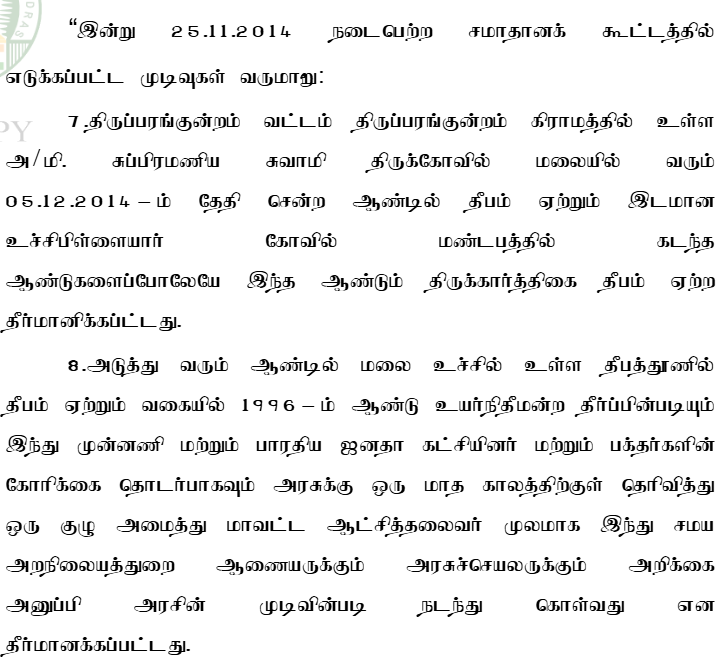
5. The appeals are in short, directed against the right of the worshippers recognized in the batch of Writ Petitions. The Learned Single Judge viewed that by directing the Executive Officer to light the lamp on the Karthigai Deepam Day at the lamp pillar made of stone (‘Deepathoon’ in Tamil), it is a restoration of the religious custom and practice. The said pillar is located on a flat surface of a rock, a little below the highest Peak of the Hill, where the Dharga of Suji Saint is located. Thus the location is the real epicenter of the controversy. In his Judgement, the Learned Judge had also observed that by revival and retrieval of the practice would well assert the property right of the Devasthanam.
6.The State through its District Administration, HR & CE Department through its Commissioner, Joint Commissioner and Executive Officer, and the representatives of other religious group say, ‘No’. There is no such established custom to light the lamp in that particular place of the hill. Any direction by the Court to light the lamp at the stone pillar found near the Dharga, will set a new custom and also cause disturbance to the public peace. The impugned judgement tends to create disharmony. If really there is any dispute regarding the title or possession for assertion of those rights, parties should have been relegated to Civil Court or any other remedy available in the Law. The Writ Court ought not to have decided the title and possession. The Writ Court has exceeded its power by directing the Devasthanam, as he opined ‘what ought to be done’.
Terrain of the Thiruparankundam Hill:
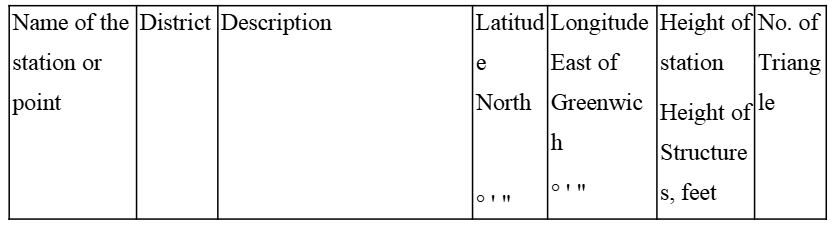
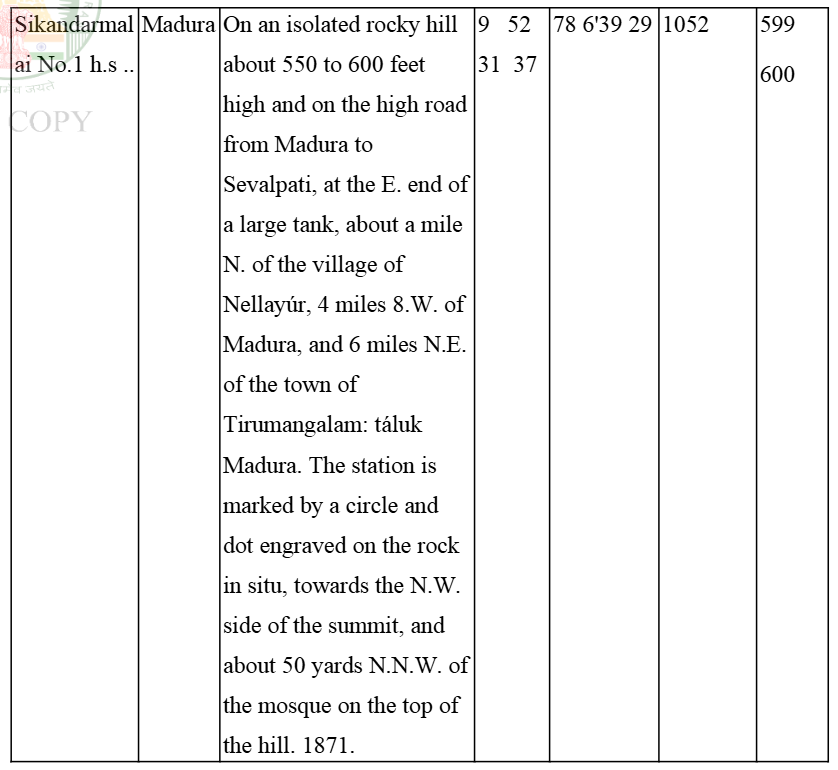
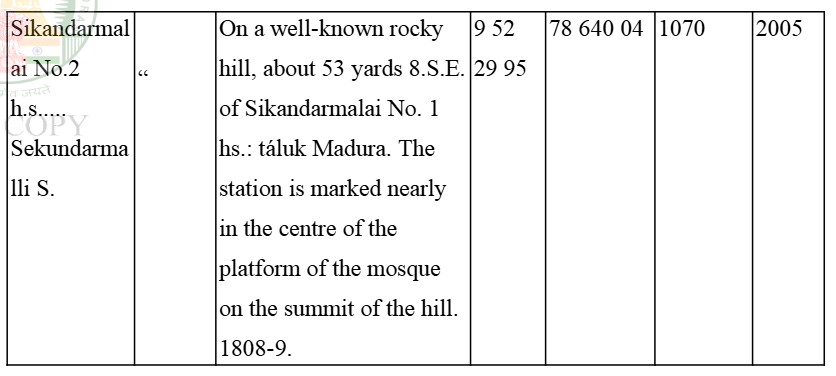
7.The hill called ‘Parankundram’ in ancient Tamil literatures is a hill about 1050 feet height.