
 Back
Back





BEFORE THE MADURAI BENCH OF MADRAS HIGH COURT
G.K.ILANTHIRAIYAN, R.POORNIMA, JJ.
Premalatha - Appellant
Versus
The State of Tamil Nadu, Represented by the Inspector of Police, Nagamalaipudukottai Police Station – Respondent
Crl.A(MD)No.1098 of 2025and Crl.M.P(MD)No.19544 of 2025
Decided On : 19-01-2026
| Table of Content |
|---|
| 1. overview of the prosecution's case (Para 1 , 2) |
| 2. details of trial court's findings (Para 4 , 8) |
| 3. arguments from appellant and prosecution (Para 5 , 6) |
| 4. witness reliability and inconsistencies (Para 9 , 10 , 11 , 12) |
| 5. medical evidence and cause of death (Para 15 , 16 , 17 , 18) |
| 6. prosecution's burden of proof (Para 19) |
| 7. final decision of acquittal (Para 20 , 21) |
JUDGMENT :
G.K.ILANTHIRAIYAN, J.
This appeal is directed as against the Judgment passed in S.C.No.332 of 2012 dated 20.08.2025 by the learned VI Additional District Judge, Madurai, thereby convicted the appellant for the offences punishable under Section 302 of I.P.C (2 counts) and also under Section 201 r/w 302 of I.P.C.
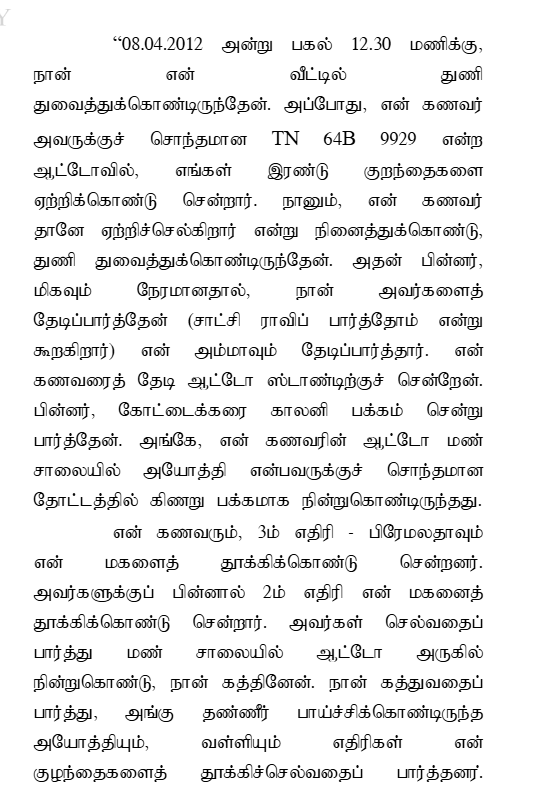
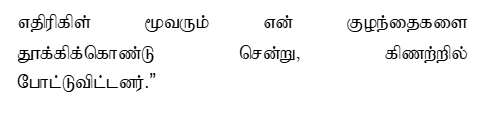
2.The case of the prosecution is that the first accused is the husband of P.W.1. After their marriage, they were blessed with two children. Thereafter, the first accused developed an illicit intimacy with the third accused. While being so, on 08.04.2012 at about 02.30 p.m., when P.W.1 was washing clothes, the first accused came there in an auto and took the two children along with him. Thereafter, they did not return home and as such, P.W.1 along with her mother searched for the children. Ultimately, she found that near the garden of one Ayothi, accused Nos.1 to 3 had taken the children towards a well and dropped them in the well belonging to Ayothi. After hearing the alarm raised by P.W.1, PW.2 and P.W.3, who were working in the nearby field, also witnessed the occurrence. Both the children were taken out from the well and were found dead. Thereafter, P.W.1 went to the police station and lodged a complaint. On receipt of the said complaint, the respondent police registered an F.I.R in Crime No.130 of 2012 for the offences punishable under Sections 302, 201 r/w 34 of I.P.C. After completion of investigation, the respondent filed a final report and the same has been taken cognizance by the Trial Court.
3.In order to bring the charges to home, the prosecution examined P.W.1 to P.W.12 and marked Exs.P1 to P23. On the side of the accused, no witnesses were examined and no documents were produced before the trial Court.
4.During trial, the first accused died. The trial Court found A.2 and A.3 guilty for the offences punishable under Section 302 I.P.C (2 counts) and under Section 201 r/w Section 302 of I.P.C. They were sentenced them to undergo life imprisonment for each count and imposed a fine of Rs.5,000/- for each count, in default, to undergo six months Simple Imprisonment for the offence under Section 302 I.P.C (2 counts) and also sentenced them to undergo three years Simple Imprisonment and imposed a fine of Rs.5,000/- each, in default, to undergo six months Simple Imprisonment for the offence under Section 201 r/w Section 302 I.P.C. Aggrieved by the same, the third accused as appellant has preferred the present appeal.
5.The learned counsel appearing for the appellant submitted that the Trial Court convicted the appellant solely based on the evidence of P.W.1 to P.W.3, who had turned hostile and are interested witnesses. In fact, the complaint itself is doubtful, since the same was lodged by P.W.1 without even mentioning the names of P.W.2 and P.W.3, who were projected as eyewitnesses to the occurrence. Though P.W.1 to P.W.3 turned hostile, the Trial Court convicted the appellant by relying upon their evidence. He further submitted that P.W.1 deposed out of enmity, since the first accused had illicit intimacy with the appellant. Even according to the chief examination of P.W.1, she had no personal knowledge regarding the alleged illicit intimacy between the first accused and the appellant, and she had seen the appellant for the first time in the Court. The prosecution also failed to conduct a test identification parade to identify the accused. Therefore, the prosecution miserably failed to prove the charges and even then, the Trial Court erroneously convicted the appellant.
6.Per contra, the learned Additional Public Prosecutor appear
AI
The prosecution must prove its case beyond reasonable doubt; absence of conclusive evidence necessitates acquittal of the accused.
The prosecution failed to establish proof beyond a reasonable doubt, resulting in the acquittal of the accused due to insufficient and unreliable evidence.

The prosecution must establish a clear motive and a complete chain of circumstantial evidence beyond reasonable doubt for a conviction in criminal cases.

Prosecution must establish motive and a complete chain of circumstantial evidence in murder cases; mere witness testimonies without clear linkage or motive fail to support conviction.
The main legal point established in the judgment is the reliance on witness testimonies and medical evidence to establish guilt in a murder case, and the requirement of evidence for kidnapping or abd....
The prosecution must prove guilt beyond reasonable doubt, and significant procedural irregularities or unreliable witness testimony can lead to an acquittal.
The court ruled that the prosecution failed to prove intent for murder, leading to a conviction for culpable homicide under Section 304 Part II instead of Section 302.
The prosecution must prove charges of murder and kidnapping beyond a reasonable doubt, relying on circumstantial evidence and establishing a clear connection to the crime.
Conviction overturned due to unreliable eyewitness accounts, procedural delays, and failure to establish charges beyond reasonable doubt, emphasizing the principle of parity among co-accused.

An appellate court should not lightly interfere with an order of acquittal, even if it believes that there is some evidence pointing to the guilt of the accused.



An indispensable Tool for Legal Professionals, Endorsed by Various High Court and Judicial Officers
Please visit our Training & Support
Center or Contact Us for assistance

Scan Me!
India’s Legal research and Law Firm App, Download now!


For Daily Legal Updates, Join us on :



 Back to top


