
 Back
Back





BEFORE THE MADURAI BENCH OF MADRAS HIGH COURT
G.K.ILANTHIRAIYAN, R.POORNIMA, J
Rathinaraj - Appellant
Versus
State through, The Inspector of Police, Vilathikulam Police Station,
Crl.A(MD)No.522 of 2022 and Crl.M.P(MD)No.2332 of 2024
Decided On : 21-01-2026
| Table of Content |
|---|
| 1. prosecution's burden to prove guilt beyond reasonable doubt. (Para 2 , 3 , 12) |
| 2. arguments regarding lack of motive and circumstantial evidence. (Para 5 , 8 , 9) |
| 3. reflection on evidentiary standards required for conviction. (Para 14 , 16 , 20) |
| 4. need for uninterrupted circumstantial chain to convict. (Para 17 , 22) |
| 5. final judgment leading to appellant's acquittal. (Para 23 , 24) |
JUDGMENT :
G.K.ILANTHIRAIYAN, J.
This appeal is directed as against the Judgment passed in S.C.No.235 of 2020 dated 28.04.2022 on the file of the II Additional District and Sessions Court, Thoothukudi.
CASE OF THE PROSECTION:
2.The case of the prosecution is that the appellant (the accused herein) and the De-facto Complainant/P.W.1 are brothers. On 22.02.2020, at about 09:00 a.m., the appellant had allegedly taken the children of P.W.1 to the well for taking bath and for teaching them swimming, but the children did not return home that day. Allegedly, the appellant had pushed the two children into the well that belongs to one Vidyasekar, making them drown to death. Thereafter, P.W.1 had searched for his children and subsequently lodged a complaint before the respondent for which an F.I.R was registered in Crime No.79 of 2020. Later the dead bodies of the two children were found and recovered from the well. The Charge sheet was filed in S.C.No.235 of 2020 before the learned Additional District and Sessions Judge, Thoothukudi District.
3.To bring the charges to home, the prosecution examined P.W.1 to P.W.27 and marked Ex.P.1 to Ex.P.31 and Material Objects M.O.1 to M.O.7. On the side of the accused, no witnesses were examined and no documents were marked.
4.On perusal of the oral and documentary evidence, the Trial Court found the appellant guilty for the offence punishable under Section 302 of IPC for two counts and sentenced him to undergo life imprisonment (2 counts) along with fine of Rs.200/- and in default of the same, to undergo three months simple imprisonment. Aggrieved by the same, the present appeal has been filed.
SUBMISSIONS MADE BY THE LEARNED COUNSEL FOR THE APPELLANT:
5.The learned counsel for the appellant submitted various grounds to make his case before this Court. It was submitted that the prosecution failed to establish the motive for the alleged occurrence to hold the appellant guilty and that the Trial Court had convicted the appellant only on the basis of circumstantial evidences. It was pointed out that none of the witnesses who were examined by the prosecution had whispered about the actual motive of the appellant to do the alleged offence. It was stated that no eye witness was examined by the prosecution who witnessed the direct involvement of the appellant in this case despite the possible presence of number of people around the place of occurrence. Further, prosecution witnesses such as P.W.4, P.W.5 and P.W.10 have also turned hostile by not supporting the case of the prosecution.
6.P.W.1 is the father of the deceased children, P.W.2 is the first wife of P.W.1 and the mother of one of the deceased children and P.W.3 is second wife of P.W.1 and sister of P.W.2 and the mother of another deceased child. Even they did not directly see the alleged occurrence and P.W.2 and P.W.3 have only seen the appellant taking the children away.
7.It was further stated that P.W.9 who resides in the same village has deposed that he saw the appellant taking the deceased children towards the well while he was heading out to work but the said statement cannot be legitimate as the occurrence took place during the COVID-19 pandemic and all workplaces would have been shut down due to the lockdown. It was also pointed out that the statements of the witnesses under Section 161(3) of Cr.P.C did not reach the learned Judicial Magistrate right away and there was an undue delay of 4 months and the reason for delay was not properly explained by the respondent.
8.He submitted that P.W.17 is the fireman who recovered the two dead bodies of the decease
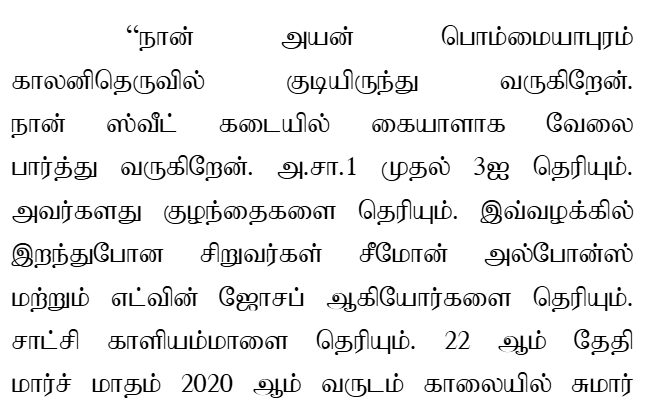
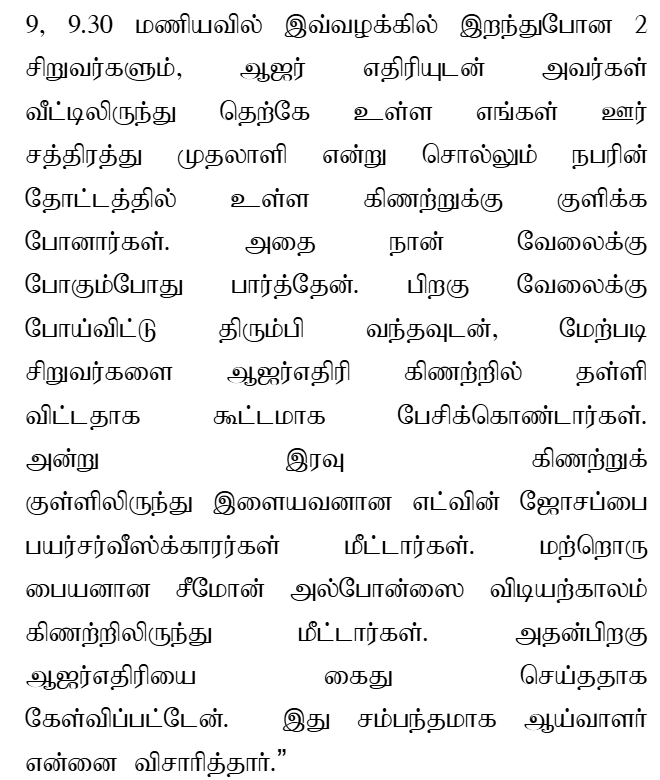
The prosecution must establish a clear motive and a complete chain of circumstantial evidence beyond reasonable doubt for a conviction in criminal cases.

The prosecution failed to establish proof beyond a reasonable doubt, resulting in the acquittal of the accused due to insufficient and unreliable evidence.

Conviction based solely on circumstantial evidence requires a complete and coherent chain of events that excludes all reasonable hypotheses of innocence.
The prosecution must prove its case beyond reasonable doubt; absence of conclusive evidence necessitates acquittal of the accused.

In criminal cases based on circumstantial evidence, the prosecution must establish a complete and unbroken chain of evidence to prove guilt beyond reasonable doubt.


In murder cases based on circumstantial evidence, each link must be established beyond reasonable doubt, with all evidence consistently pointing to the guilt of the accused.
The prosecution must prove guilt beyond reasonable doubt, and significant procedural irregularities or unreliable witness testimony can lead to an acquittal.



An indispensable Tool for Legal Professionals, Endorsed by Various High Court and Judicial Officers
Please visit our Training & Support
Center or Contact Us for assistance

Scan Me!
India’s Legal research and Law Firm App, Download now!


For Daily Legal Updates, Join us on :



 Back to top


