
 Back
Back





BEFORE THE MADURAI BENCH OF MADRAS HIGH COURT
G.K.ILANTHIRAIYAN, R.POORNIMA, JJ.
K.Thangaraj @ Thangam – Appellant
Versus
The State of Tamil Nadu, Represented by, The Inspector of Police, Srivilliputhur Town Police Station – Respondent
Crl.A(MD)No.283 of 2023
Decided On : 03-02-2026
| Table of Content |
|---|
| 1. factual background of the case. (Para 2 , 3) |
| 2. arguments regarding evidence and credibility. (Para 6 , 8 , 10) |
| 3. court's observations on the evidence presented. (Para 11 , 17 , 18) |
| 4. ratio decidendi regarding the charges and responsibility. (Para 12 , 14 , 21) |
| 5. final conclusion on the appeal's dismissal. (Para 16 , 24) |
JUDGMENT :
G.K.ILANTHIRAIYAN, J.
1.This appeal arises out of the Judgment passed in S.C.No.115 of 2017 dated 23.11.2022 on the file of the learned Sessions Judge, Fast Track Mahila Court, Virudhunagar District @ Srivilliputhur, thereby convicting the appellant for the offences punishable under Sections 302 and 364 of I.P.C.
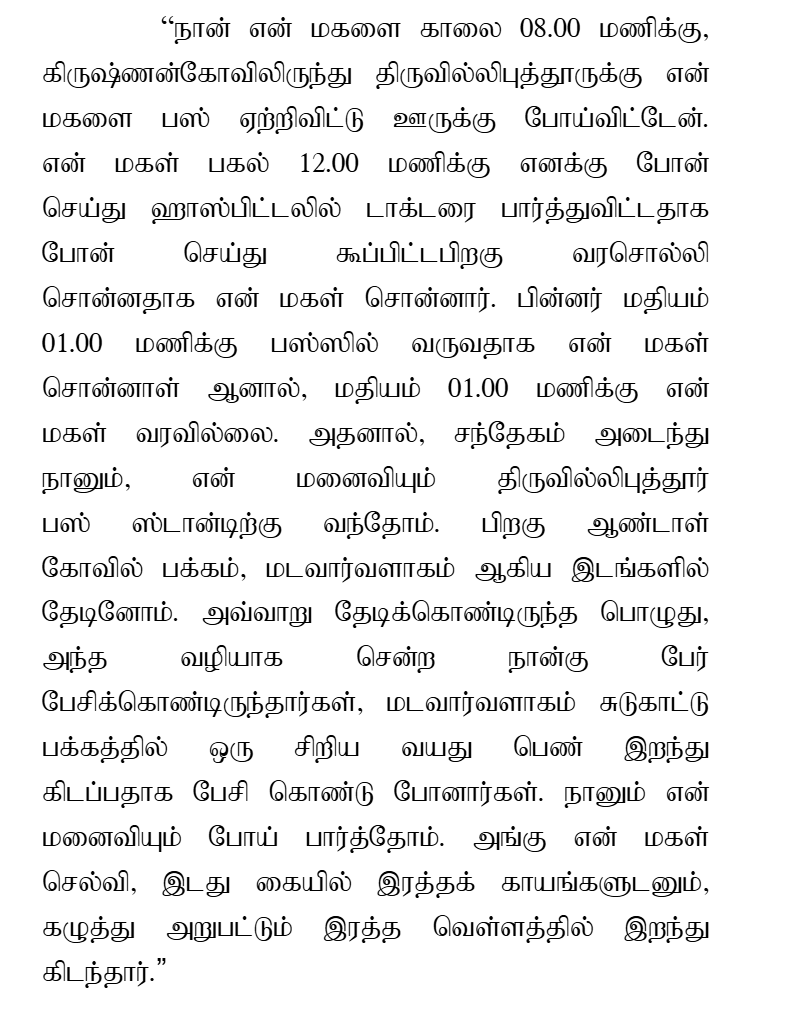
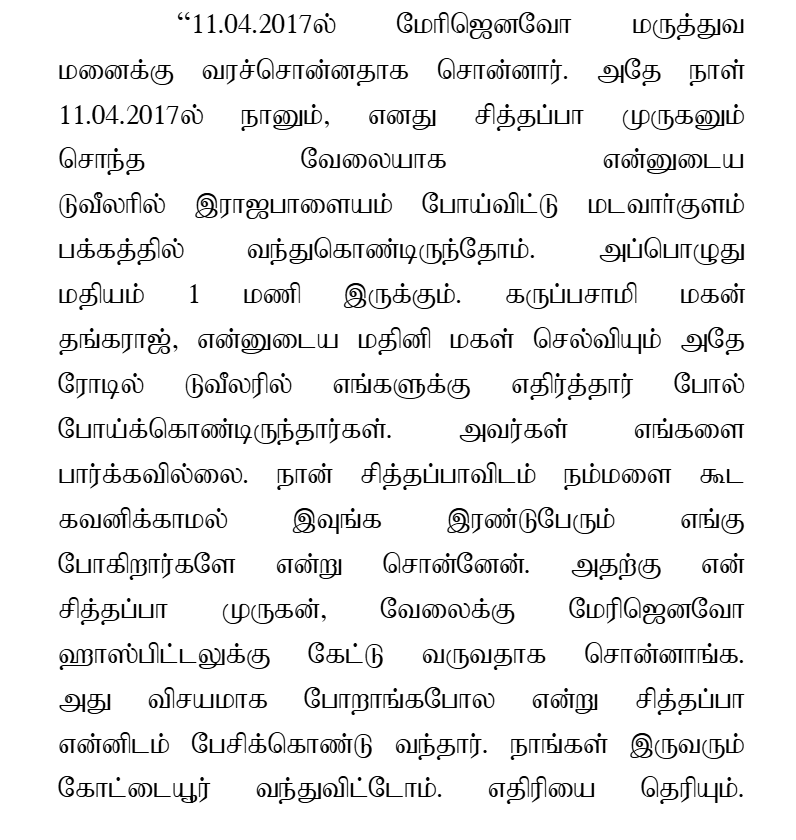
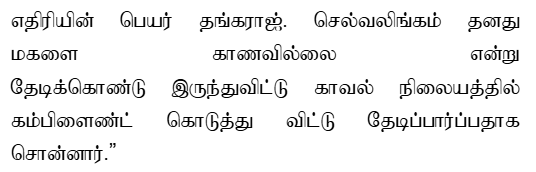
2.The case of the prosecution is that the accused and the deceased were relatives and share a brother and sister relationship. The accused had discontinued 12th standard studies and was working as a driver. During her vacation, the deceased went to her native place and, while returning to Gobichettipalayam with her mother, the accused also accompanied them. As a result, the accused and the deceased became acquainted with each other and fell in love. Thereafter, they were also in a sexual relationship. Therefore, the parents warned the accused. Twenty days before the date of the incident, the deceased was seen by another person with the intention of marrying her. This came to the knowledge of the accused and thereafter, the complainant scolded the deceased instructing her not to speak to him. The deceased then ended her relationship with the accused. Even then, the accused compelled her to marry him and tortured her in the name of love. When the deceased did not comply to his request, the accused intended to do away with the life of the deceased and purchased a knife.
3.On the date of occurrence ie., on 11.04.2017, when the deceased went by bus to Mary Jenova Hospital, Srivilliputhur, for work, the accused followed the bus in his two wheeler and called the deceased to come to VPM Jewellery shop, Srivilliputhur at about 01.15 p.m. He brainwashed her, telling her that she was going to marry someone else anyway, and that until then, they could continue to chat. He compelled her to board his motorcycle and took her to Periyakulam Kanmai. Thereafter, he stopped the vehicle and compelled the deceased to marry him. It was refused by the deceased and as such, when she insisted ongoing back home, the accused assaulted her with knife on her neck. Therefore, she sustained grievous injuries and died.
4.On the complaint, the respondent registered an F.I.R in Crime No.256 of 2017 for the offences punishable under Sections 364 and 302 of I.P.C. After completion of investigation, a final report was filed and the same has been taken cognizance by the trial Court.
5.In order to bring the charges to home, the prosecution had examined P.W.1 to P.W.12 and marked Ex.P1 to P16. The prosecution had produced Material Objects M.O.1 to M.O.15. On the side of the accused, no witnesses were examined and no documents were produced before the trial Court.
6.On perusal of oral and documentary evidence, the trial Court found the accused guilty for the offences punishable under Sections 302 and 364 of I.P.C. He was sentenced to undergo life imprisonment and to pay a fine of Rs.2,000/- in default, to undergo six months Rigorous Imprisonment for the offence punishable under Section 302 of I.P.C and he was sentenced to undergo life imprisonment and to pay a fine of Rs.2,000/- in default, to undergo six months Rigorous Imprisonment for the offence punishable under Section 364 of I.P.C. Aggrieved by the same, the present appeal has been preferred by the appellant.
7.The learned counsel appearing for the appellant submitted that no one has spoken about the forcible taking of the deceased by the accused to attract the charge under Section 364 of I.P.C. It is a case based on circumstantial evidence and no one had seen the accused along with the deceased prior to the alleged occurrence. Only one person, a close relative of
The prosecution must prove charges of murder and kidnapping beyond a reasonable doubt, relying on circumstantial evidence and establishing a clear connection to the crime.

The prosecution failed to prove its case beyond reasonable doubt, leading to the appellant's acquittal.
Prosecution must establish motive and a complete chain of circumstantial evidence in murder cases; mere witness testimonies without clear linkage or motive fail to support conviction.
Circumstantial evidence and extra-judicial confessions require strict scrutiny and corroboration for a conviction under murder charges, highlighting their inherent weaknesses.
Dying declarations must be reliable; mere speculation of suicide may lead to alternative charges if harassment is proven.

The prosecution must prove its case beyond reasonable doubt; absence of conclusive evidence necessitates acquittal of the accused.
The prosecution failed to establish proof beyond a reasonable doubt, resulting in the acquittal of the accused due to insufficient and unreliable evidence.
In a murder case based on circumstantial evidence, mere last seen testimony is insufficient; a clear chain of circumstances must be established to support a conviction.
The prosecution's reliance on circumstantial evidence and an extra-judicial confession was insufficient to establish murder, leading to a conviction for culpable homicide instead.
Circumstantial evidence must establish a clear chain of events linking the accused to the crime; failure to prove motive or support claims undermines conviction.



An indispensable Tool for Legal Professionals, Endorsed by Various High Court and Judicial Officers
Please visit our Training & Support
Center or Contact Us for assistance

Scan Me!
India’s Legal research and Law Firm App, Download now!


For Daily Legal Updates, Join us on :



 Back to top


