2026 Supreme(Mad) 943
BEFORE THE MADURAI BENCH OF MADRAS HIGH COURT
C.V.KARTHIKEYAN, P.T.ASHA, K.K.RAMAKRISHNAN, JJ.
Kaman @ Kamatchi (Died) Nallasivam - Petitioner
Versus
The District Collector Dindigul District Dindigul – Respondent
W.P.(MD).Nos. 19720 of 2017, 8855, 18441, 18436, 16605, 20083, 21072, 28927, 25142, 22162 & 21323 of 2025
Decided On : 06-03-2026
Advocates Appeared:
For the Appellant : Mr.M.Mahaboob Athiff for M/s. Ajmal Associates
For the Respondent: Mr.R.Ramanlal AAG, assisted by Mr.T.Arun Kumar, Additional Government Pleader, Mr.Aayiram K.Selvakumar
Occupied residential village habitation lands are private holdings and do not vest with the state. Consequently, the summary eviction power granted under the land encroachment legislation cannot be invoked against individuals in possession of such lands, as they fall outside the statutory definition of Government property.
Headnote:(A) Tamil Nadu Land Encroachment Act, 1905 - Section 2 - Property rights - Applicability of summary eviction proceedings to residential village sites - Legislative intent behind statute specifically excludes house sites and backyards from definition of Government property.
(B) Grama Natham - Nature and character - Village habitation sites - Concept of vesting versus occupation - Whether occupation of residential plots constitutes a proprietary right immune from summary state eviction.
(C) Appellate Jurisdiction - Reference to larger bench - Conflict of judicial precedents regarding vesting of habitational village land in State authorities - Necessity to resolve the legal status of individuals in occupation of residential village land.
(D) Statutory Construction - Interpretation of Section 2 of the 1905 Act - Distinction between public utility/communal land and residential village sites - Exclusion of residential sites from the scope of 'property of Government'. (Paras 16, 17, 19, 21)
Facts of the case:
The petitioners sought the quashing of eviction orders issued by revenue authorities targeting their possession of residential village land. The state contended that the land in question was either vacant or communal and thus vested with the Government, granting it the right to initiate eviction proceedings under the 1905 Act. The matter was referred to a Full Bench due to conflicting judicial views on whether such land constitutes Government property or private holding.
Findings of Court:
The Court held that the classification of land as a village habitation site implies that such land was never intended to vest in the state. By specific legislative exclusion, house sites are not subject to the summary powers exercised against unauthorised encroachment on Government property. The state and its instruments cannot classify occupied village residential sites as Government property to facilitate arbitrary eviction.
Issues: Whether occupied residential village habitational lands vest in the Government and whether the 1905 Act can be invoked by authorities to evict individuals from such lands.
Ratio Decidendi: Occupied residential village sites are not Government property. Provisions governing the summary eviction of encroachers from public land do not extend to individuals in possession of residential plots in such designated areas. The historical, social, and legislative recognition of habitation sites as distinct from communal or public land prevents the application of summary eviction laws, as such land is inherently excluded from the definition of property vesting in the state.
Result: Reference answered in the negative; occupied residential village habitation sites do not vest in the Government, and the 1905 Act is not applicable to such lands.
Legal Category Hierarchy
-
administrative law
-
land revenue administration
-
government land classification
(Para 5, 6, 7, 8, 17, 19, 20, 21)
-
revenue records and registers
-
natham settlement scheme
(Para 34)
-
statutory interpretation
-
land encroachment act 1905
(Para 9, 15, 17, 19, 20, 21)
-
inam abolition acts
-
estates abolition act 1948
-
constitutional law
-
parens patriae jurisdiction
-
protection of public property
-
social justice
-
property law
-
land tenure
-
grama natham house sites
(Para 5, 6, 7, 8, 23, 24, 27, 32, 33, 34)
-
communal lands
(Para 23)
-
poramboke lands
(Para 17, 19, 20, 21)
-
occupancy and possession rights
(Para 23, 24, 27, 33)
-
adverse possession
-
civil procedure
-
writ jurisdiction
(Para 25, 28, 35, 36)
-
reference to full bench
(Para 35)
Table of Contents
1. Occupation of grama natham village house sites — whether such lands vest with Government — and whether Land Encroachment Act 1905 can be invoked to evict occupants. (Para
5
,
6
,
7
,
8
,
9
,
10
,
11
,
12
,
13
,
14
,
15
,
17
,
19
,
20
,
21
,
35
,
36
,
38
,
39
,
40
,
41
)
2. Whether occupied grama natham lands vest with the Government?
No, occupied grama natham lands do not vest with the Government; the occupants hold possessory rights as private house sites, and the Government has no title over such occupied lands. (Para
23
,
24
,
27
,
33
,
34
)
3. Whether the Land Encroachment Act 1905 can be invoked against occupants of grama natham lands?
No, the Act cannot be invoked as Section 2 specifically exempts lands owned as house sites or backyards, and occupied grama natham does not vest with the Government. (Para
17
,
19
,
20
,
21
)
4. Whether grama natham is communal property or private property of villagers?
Grama natham is not communal property; it is the private house site of villagers, and those in occupation are the absolute owners with title to dispose of the same. (Para
23
,
24
,
33
)
ORDER :
C.V.KARTHIKEYAN , J .
Kaman @ Kamatchi had filed W.P.(MD).No. 19720 of 2017 in the nature of a certiorari seeking records relating to an order of the fourth respondent, the Block Development Officer cum Executive Officer, Gujiliyamparai Panchayat Union, Vedasandur Taluk at Dindigul District in Na.Ka.No.1088/2017/D3 dated 19.10.2017 and to quash the same.
2. The said order had been passed by the fourth respondent taking recourse to the provisions under the Land Encroachment Act, 1905 holding that the writ petitioner had encroached upon natham land in Vedapatti Village in Gujiliyamparai Panchayat Union and consequently issuing a direction to the Revenue Officials to evict the writ petitioner from the premise under his occupation.
3. The Writ Petition came up for consideration before a Division Bench comprising of the then Chief Justice [K.R.Shriram, CJ] and Hon'ble Mrs. Justice S.Srimathy, on 20.06.2025. The Division Bench expressed an opinion that conflicting Judgments have been rendered on the issue whether grama natham lands vest with the Government or do not vest with the Government. If they vest with the Government then the authorities had the right to invoke the provisions of the Land Encroachment Act 1905 and if they do not. then, the Officials cannot invoke the provisions of the said Act. The central issue also was whether the provisions of the said Act could be invoked with respect to occupied grama natham lands.
4. Taking into consideration, the contradictory views on this issue, the Division Bench had framed the following point for reference to a larger bench:-
“Whether the occupied grama natham lands vest with the Government and thereby the provisions of the Land Encroachment Act 1905 can be invoked in respect of occupied grama natham lands?”
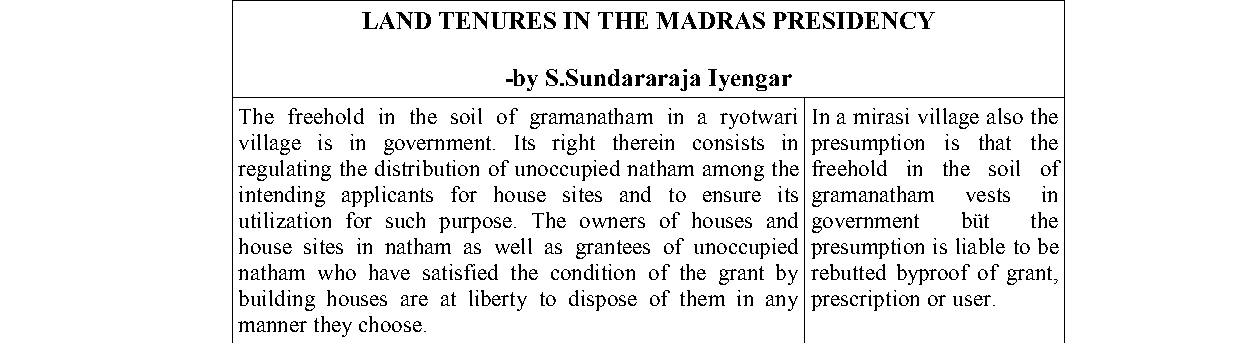
5. Grama natham has been defined in the Law Lexicon as “ground set apart on which the house of a village may be built.”
6. In a glossary of Vernacular Judicial and Revenue Terms compiled by the Department of Revenue, Agricultural and Commerce and Public in 1871, the word 'natham' had been defined as “the site of the dwelling of the villagers.” It had also been defined as “the site of the dwelling of the villagers as distinct from the lands attached to the village”. It was also defined as “that part of the village land on which the houses of the mirasidars are built.”
7. It is thus evident that a natham signifies a site of dwelling of the villagers and as ground set apart on which the houses of villagers may be built. In effect, it would signify a house site in a village.
8. The issue under reference is whether such occupied house site could be subject to the provisions of the Land Encroachment Act 1905. The word “occupied” could signify that a house had actually been built for residential purposes and that, the house site has been occupied. It could also signify a house site in physical occupation though a house had actually not been built.
9. The Madras Land Encroachment Act, 1905 came to be enacted as a result of a Judgment of a Full Bench of this Court reported in (1904) ILR 27 Mad 386 [ Madathapu Ramaya Vs. the Secretary of State for India in Council ]. The brief facts of that case was that a demand was laid for a sum of 4 annas and one pie by the Government on the appellant for constructing a pial attached to his house upon land which was part of a public road. The Government collected what was described as “prohibitory assessment” and directed the appellant to remove the pial and issued a notice informing him that continuous existence of the pial would ential levy of enhanced assessment.
10. The appellant instituted a suit to recover the amount which had been demanded and collected by the Government. The trial Court dismissed the suit. On appeal, the High Court upheld the claim of the appellant.
11. The High Court held that the impost was not land revenue and therefore, the demand as if it was revenue was unauthorised and therefore, the appellant was entitled for a decree.
12. S
Click Here to Read the rest of this document


 Back
Back