
 Back
Back





IN THE HIGH COURT OF JUDICATURE AT MADRAS
N.SATHISH KUMAR, R.SAKTHIVEL, JJ.
M.Balasundaram, S/o. M.Mani – Appellant
Versus
A/M Vaikunda Perumal Temple Kancheepuram, Rep. By its Executive Officer – Respondent
A.S. No.731 of 2018 AND C.M.P. NOS.16630 AND 15359 of 2023 AND C.M.P. No.25998 of 2025
Decided On : 03-06-2026
| Table of Content |
|---|
| 1. introduction to the case history and party alignment. (Para 1 , 2) |
| 2. pleadings and structural claims asserted by the plaintiff, defendants, and specific reliance on act no. 30 of 1963. (Para 3 , 4 , 5 , 6) |
| 3. trial court proceedings, appeal initiation, and adjudication of interlocutory applications for additional evidence. (Para 7 , 8 , 9 , 10 , 11 , 12 , 13 , 14 , 15 , 16) |
| 4. appellate arguments regarding lease rights, ownership vs. tenancy, and the effect of patta proceedings. (Para 17 , 18) |
| 5. judicial assessment of inam fair register and historical cawl deeds determining the nature of land grant. (Para 19 , 20 , 21 , 22 , 23) |
| 6. estoppel against tenants and necessity of formal lease termination before recovery of possession. (Para 24 , 25) |
| 7. final appellate order set aside with liberty for fresh suit upon proper legal notice. (Para 26 , 27) |
JUDGMENT :
R.SAKTHIVEL, J.
1.Feeling aggrieved by the Judgment and Decree dated December 22, 2017 passed in O.S. No.208 of 2010 by 'the learned District Judge, District Court-II, Kancheepuram' ['Trial Court' for convenience], the first defendant therein has preferred this Appeal Suit under Section 96 and Order XLI Rule 1 of 'the Code of Civil Procedure, 1908' ['CPC' for brevity].
2. For the sake of convenience, hereinafter, the parties will be referred to as per their array in the Original Suit.
PLAINTIFF'S CASE IN BRIEF:
3. Case of the plaintiff is that 'the Arulmighu Vaikundaperumal Temple' [hereinafter 'plaintiff-temple'] is an ancient temple built by Pallavas. It is a public temple governed by the 'Tamil Nadu Hindu Religious and Charitable Endowments Act, 1959' ['HR & CE Act' for brevity].
3.1. The vacant site comprised in Survey No.847/49-B and C, having Door No.33-A in Vaikundaperumal South Mada Street, Kanchipuram is the suit property herein and the same belongs to the plaintiff-temple. It is a minor Inam granted to the plaintiff-temple. The suit property forms part of a larger extent in Town Survey No.847 totally measuring 8 Acre 37 Cents which also belongs to the plaintiff-temple.
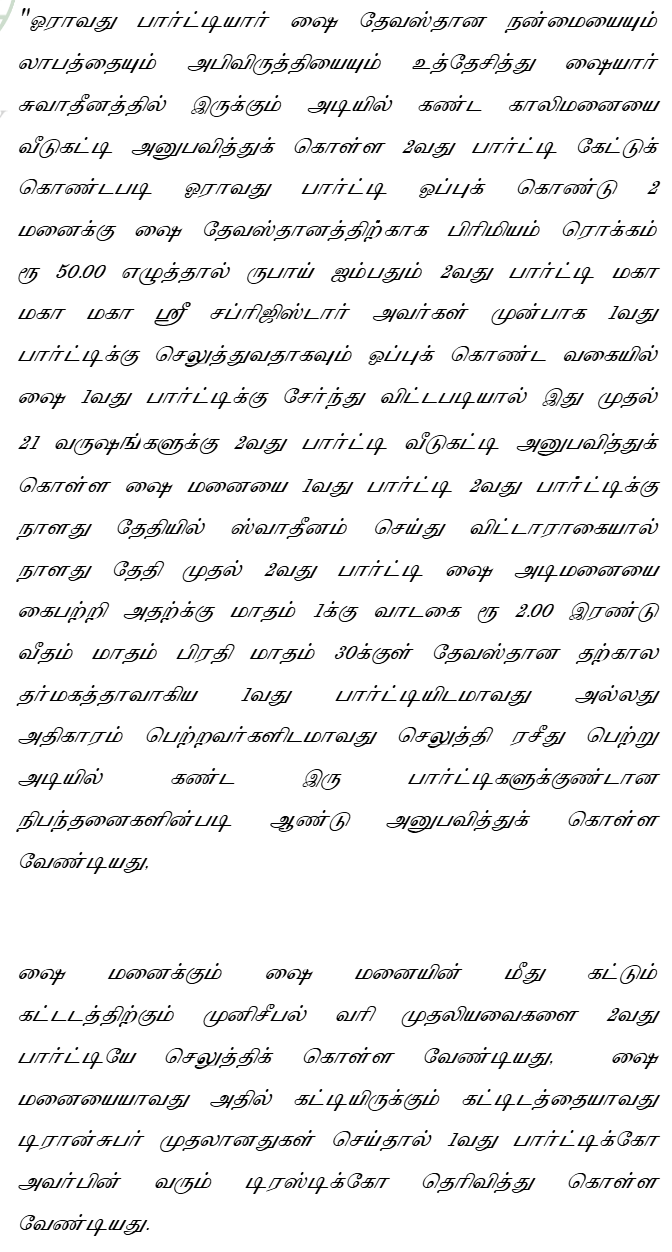
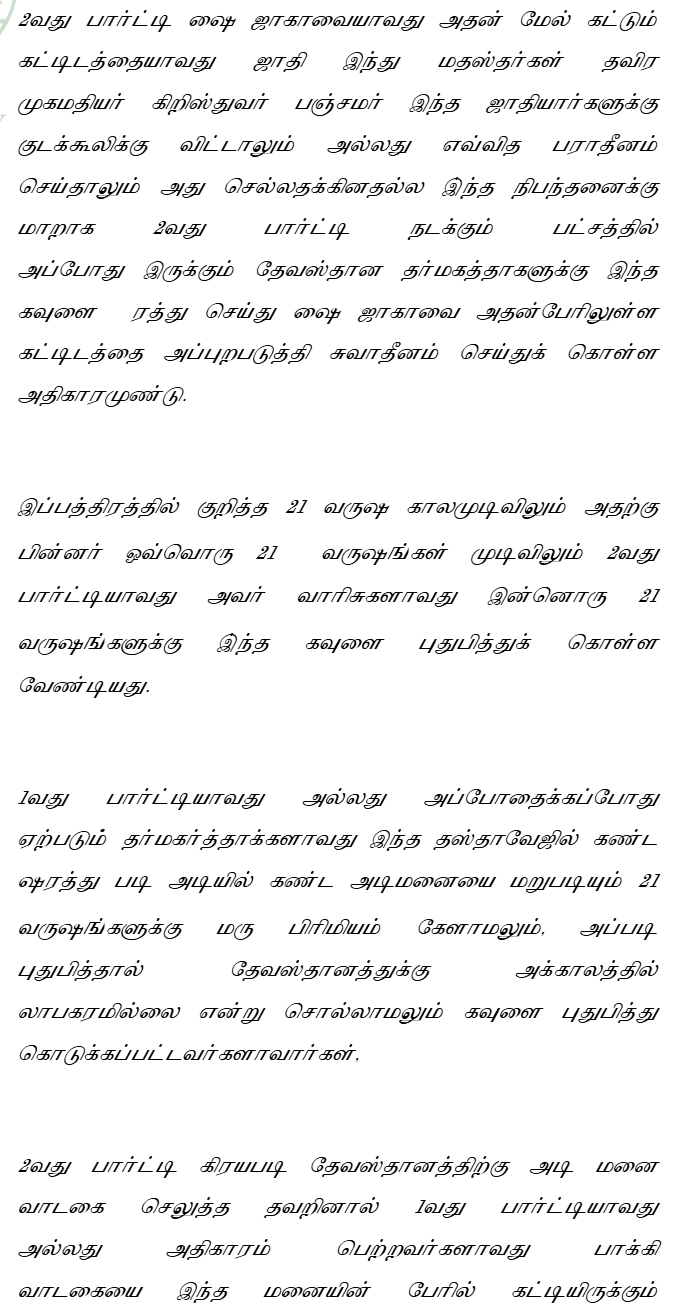
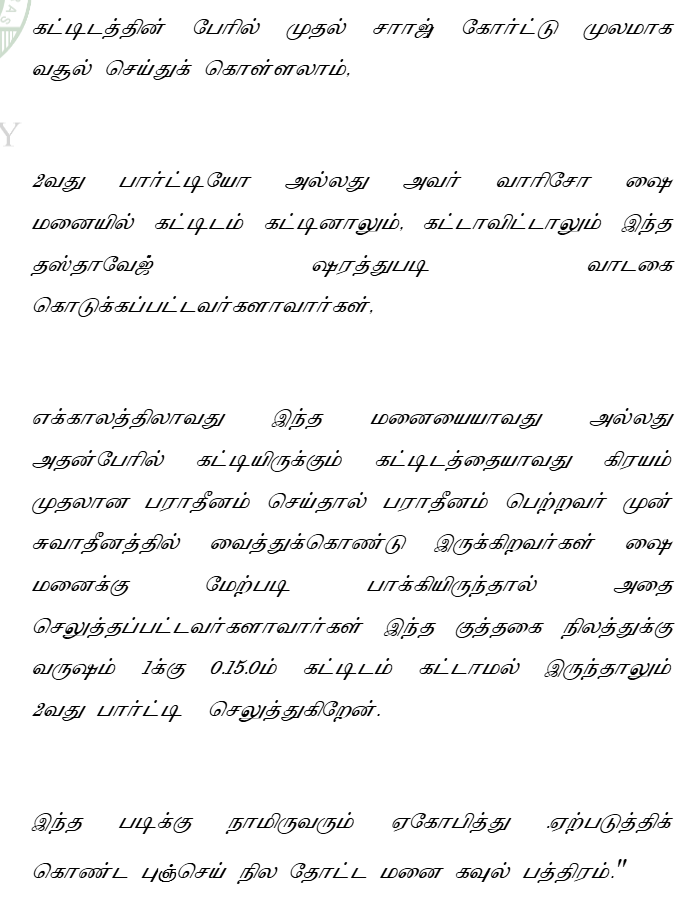
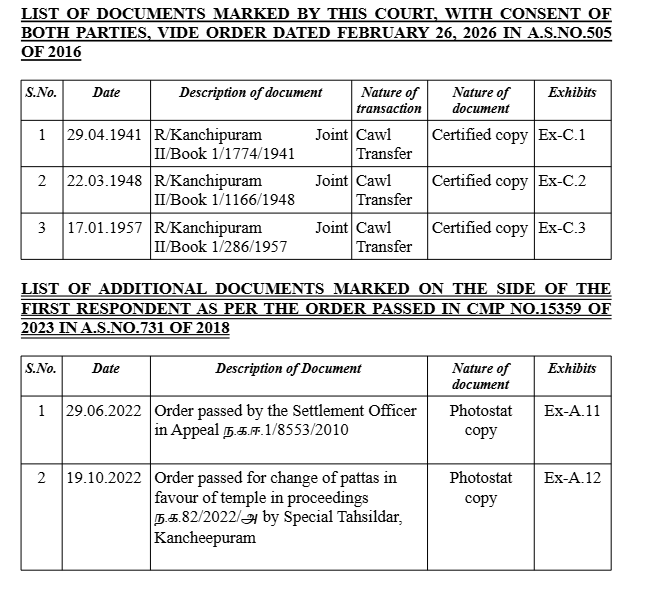
3.2. On April 29, 1941, the plaintiff-temple represented by its then Devasthana Dharmakartha - M.Thiruvenkadamudaya Iyer executed a Cawl (lease) Deed in favour of one K.K.Venkatrama Iyer for a monthly rent of Rs.2/- for the Suit vacant land, for the purpose of house construction. K.K.Venkatarama Iyyar transferred the Cawl to one Kodadhanda Mudhaliar on March 22, 1948 on the condition that the transferee shall pay the lease amount to the plaintiff-temple as per the original Cawl Deed. On January 17, 1957, the said Kodadhanda Mudhaliar transferred the Cawl in favour of one R.S.Natraja Mudhaliar, who in turn on February 12, 1959, transferred the Cawl in favour of one R.Natraja Mudhaliar.
3.3. The said R.Nataraja Mudhaliar, who is the only a transferee of the Cawl, without any legal right, as if he is the absolute owner of the suit property, sold a portion of suit property to one Deivasigamani Mudhaliar vide registered Sale Deed dated April 30, 1991 (Document No.608 of 1991) and the remaining portion to one R.K.Krishnan under registered Sale Deeds dated April 30, 1991 (Document No.609 of 1991) and February 2, 1991. In turn, said R.K.Krishnan and the legal heirs of Deivasigamani sold the suit property to the first defendant herein vide Sale Deed dated August 3, 2009. The sale in favour of the first defendant is not valid and binding upon the plaintiff-temple. It will not confer any right, title or interest on the first defendant or anyone else for that matter.
3.4. The aforesaid R.Nataraja Mudhaliar, during his lifetime claimed Ryotwari Patta before the Assistant Settlement Officer, Thanjavur. As it went against the plaintiff-temple, it filed an appeal before the Settlement Officer, Chepauk, Chennai. The first defendant and his predecessors are under the erroneous impression that they had become the owner of the suit property after passing of the Tamil Nadu Minor Inams Abolition and Conversion into Ry
A suit for recovery of possession against a lessee is premature without formal termination of the lease under the Transfer of Property Act. Moreover, revenue settlement proceedings do not negate the ....

The main legal point established in the judgment is that the Executive Officer has the right to file a suit for temple properties, and the Civil Court has jurisdiction to decide the title of the prop....

The Appellate Court erred by dismissing the cross-appeal without independent consideration, contravening procedural fairness, and the temple's claim to property based on service grant was upheld.
The court ruled that rightful ownership evidenced through proper documentation takes precedence over claims of adverse possession by the defendant regarding property allegedly belonging to a temple.
Point of law : Where a cloud is raised over the plaintiff's title and he does not have possession, a suit for declaration and possession, with or without a consequential injunction, is the remedy. Wh....
The main legal point established in the judgment is that the Civil Court had no jurisdiction under Section 21 of Act 30 of 1963, and the possession was not with the first defendant, but with the seco....
The main legal point established in the judgment is the determination of property ownership, the requirement of notice under S.80 C.P.C., and the maintainability of the suit under S.108 of the Hindu ....
A party claiming ownership must prove their title independent of any weaknesses in the opponent's case; admissions in legal documents undermine claims.



An indispensable Tool for Legal Professionals, Endorsed by Various High Court and Judicial Officers
Please visit our Training & Support
Center or Contact Us for assistance

Scan Me!
India’s Legal research and Law Firm App, Download now!


For Daily Legal Updates, Join us on :



 Back to top


