
 Back
Back





BEFORE THE MADURAI BENCH OF MADRAS HIGH COURT
P. VADAMALAI, J.
Valliammal, W/o. Chelladurai – Appellant
Versus
A. Chelladurai, S/o. Late. Arunachala Konar - Respondent
C.M.S.A(MD)No.44 of 2021
Decided On : 01-06-2026
| Table of Content |
|---|
| 1. procedural history and statement of facts regarding matrimonial discord. (Para 1 , 2 , 3 , 4 , 5 , 6 , 7 , 8 , 9) |
| 2. contentions regarding condonation of delay, burden of proof on cruelty, and limits of judicial power. (Para 10 , 11 , 12 , 13 , 14 , 15 , 16) |
| 3. defamatory complaints and removal of thali constitute mental cruelty. (Para 17 , 18 , 19 , 20 , 21) |
| 4. long-term separation without effort for restitution constitutes mental cruelty warranting divorce. (Para 22 , 23 , 24) |
JUDGMENT :
P. VADAMALAI, J.
1.This Civil Miscellaneous Second Appeal is preferred against the judgment and decree, dated 04.09.2019 passed in C.M.A.No.53 of 2018 on the file of the Additional District and Sessions Judge/Fast Track Court, Tenkasi, confirming the judgment and decree, dated 04.12.2017 passed in H.M.O.P.No.157 of 2014 on the file of the Principal Subordinate Court, Tenkasi.
2.The appellant is the respondent/wife in H.M.O.P.No.157 of 2014 on the file of the Principal Subordinate Court, Tenkasi.
3. For the sake of convenience, the parties are referred to as petitioner and respondent in H.M.O.P.No.157 of 2014 on the file of the Principal Subordinate Court, Tenkasi.
4. Brief facts of the case of the petitioner (Husband)
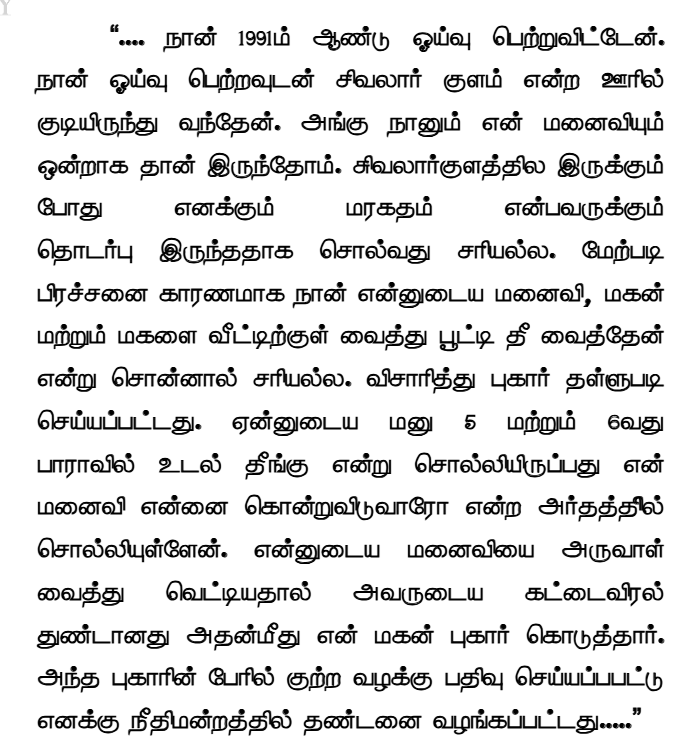
The petitioner and the respondent are husband and wife. Their marriage was solemnized on 30.08.1977 as per Hindu Rites and Customs. Out of wedlock, they were blessed with a son, Premkumar (age 36) and a daughter, Smitha (age 33). From the very beginning of marriage, upon suspicion, the respondent frequently quarreled with the petitioner as if he had illegal contacts with several women and made an insult in the presence of the general public. The petitioner was working in the Army, and the respondent wrote a letter to higher officials on 19.09.1989 mentioning abusive versions against the petitioner. The respondent, through her son, lodged a police complaint and the same was registered in Crime No.333 of 1997 by Alangulam Police Station, and the case was taken on cognizance in C.C.No.388 of 1998 by the Principal Assistant Sessions Court, Tenkasi. In that case, the petitioner was convicted for 7 years and on appeal, the sentence was reduced. Thereafter, the petitioner has been living separately. In order to grab the self-acquired properties of the petitioner, the respondent created concocted documents, for which a criminal case in C.C.No.347 of 2009 is pending against the respondent. The respondent converted to Christianity and adopted Christian rites, and thereby causing mental agony to the petitioner. By these acts, the respondent caused mental cruelty and she deserted the petitioner. There is no possibility of reunion. Hence, the petitioner has filed a petition in HMOP.No.157 of 2014 against the respondent seeking divorce U/s.13(1)(ia)(ib), (ii) of the Hindu Marriage Act.
5. Brief facts of the case of the respondent (Wife)
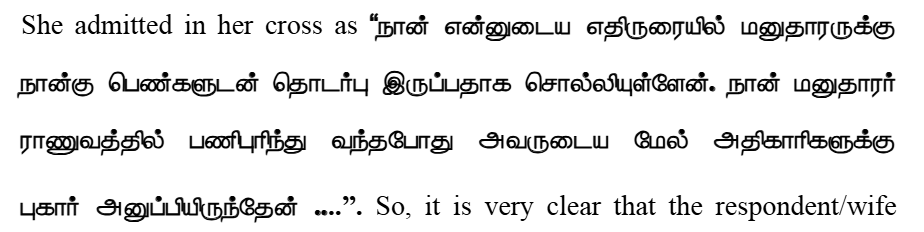
The petitioner was working in the Indian Army at Allahabad. After marriage, the petitioner took the respondent to Allahabad, where she became pregnant. The respondent came to her parental home for delivery. The petitioner used to visit her parental home, where he developed an illegal contact with one girl, Muthukutti. On enquiry, the petitioner admitted the said relationship even before marriage, however, the respondent continued matrimonial life. Their matrimonial life continued on good terms till 1985. Then, the petitioner harassed the respondent to give her sister in marriage to him. So, the respondent wrote a letter to the higher officials of the petitioner. The petitioner retired in 1991 and started living with the respondent at their hometown, Sivalarkulam. Thereafter, he developed illegal intimacy with one Maragatham. While questioning the same, on 02.12.1996, the petitioner confined the respondent and her children inside the house and set it on fire. So, the respondent gave a complaint before the Alangulam police station. Again, the petitioner had illegal contact with another woman, Poornam and

Persistent, unproven, defamatory accusations against a spouse to professional superiors causing reputational damage constitutes mental cruelty. When combined with long-term separation and the symboli....
The main legal point established is that the conduct amounting to mental cruelty, as defined under the Hindu Marriage Act, can lead to the grant of divorce.

The main legal point established in the judgment is that allegations of mental cruelty and adultery must be proven, and divorce cannot be granted on the ground of irretrievable break-down of marriage....

The court held that the divorce petition lacked sufficient evidence of mental cruelty and desertion, and that the litigation initiated by the wife for the protection of her rights could not be consid....

Divorce – Cruelty includes mental cruelty and it need not be physical – In some cases even very conduct complained of itself is sufficient to infer mental cruelty and impact of injury caused by offen....


Conduct constituting unfounded accusations can constitute mental cruelty and justify divorce when the marriage is irretrievably broken.
The main legal point established in the judgment is that false accusations, defamatory publications, and complaints to the employer can constitute mental cruelty under the Hindu Marriage Act, leading....

Cruelty as a ground for divorce under the Hindu Marriage Act requires substantial proof, which was not established in this case.



An indispensable Tool for Legal Professionals, Endorsed by Various High Court and Judicial Officers
Please visit our Training & Support
Center or Contact Us for assistance

Scan Me!
India’s Legal research and Law Firm App, Download now!


For Daily Legal Updates, Join us on :



 Back to top


