Back


2025 Supreme(Ori) 2
IN THE HIGH COURT OF ORISSA AT CUTTACK
R.K. PATTANAIK, J.
Gajendra Chandra Singh – Appellant
Versus
Rameswar Prasad Singh & Others – Respondents
MSA No.6 of 2016
Decided On : 07-08-2025
Important Points
Subject
Civil Law - Customary Rights
Act Referred
CIVIL PROCEDURE CODE : O.9 R.13
Headnote
For the Appellant :Mr. S.K. Padhi, Senior Advocate along with Mr. Satya Smruti Mohanty, Advocate
For the Respondents: Mr. A.K. Mohapatra-1, Mr. A.K. Nath, Adv., Mr. Milan Kanungo, Senior Adv.
| Table of Content |
|---|
| 1. challenged authority's decision on inheritance for religious rites. (Para 1 , 2 , 4) |
| 2. indicates need for detailed enquiry into custom versus judicial findings. (Para 5) |
JUDGMENT :
R.K. PATTANAIK, J.
1. Instant appeal under Section 44(2) of the Odisha Hindu Religious Endowments Act, 1941 (hereinafter referred to as ‘the OHRE Act’) is at the behest of the appellant assailing the impugned judgment dated 31st October, 2016 at Annexure-10 passed in connection with F.A. No. 10 of 2016 by the learned Commissioner of Endowments, Odisha, Bhubaneswar confirming the decision and order of the learned Assistant Commissioner of Endowments, Odisha dated 23rd June, 2016 i.e. Annexure-8 in O.A. Case No. 12 of 2013 on the grounds stated.
2. In the case at hand, respondent No.1 filed an application under Section 41 (e) of the OHRE Act registered as O.A. Case No. 12 of 2013 praying therein to allow him to perform the ‘chhera pahanra seva’ on the chariots of Lord Jagannath Jew, Lord Balabhadra Jew and Devi Subhadra on the occasion of Rath Yatra and Bahuda Yatra at Nayagarh and learned Assistant Commissioner of Endowments, Odisha, Bhubaneswar by judgment dated 23rd June, 2016 allowed the same as per Annexure-8. Being aggrieved of the aforesaid decision, the appellant preferred an appeal under Section 44(1) of the OHRE Act in F.A. No. 10 of 2016 before the learned Commissioner of Endowments, Odisha, Bhubaneswar but the same stood dismissed vide Annexure-10 confirming the order as at Annexure-8. As against the confirmation order and the judgment vide Annexure-10, the present appeal under Section 44(2) of the OHRE Act is filed on the grounds inter alia that the impugned decisions of the learned authorities below while dealing with the customary rights adversely claimed are not legally tenable and hence, liable to be set aside.
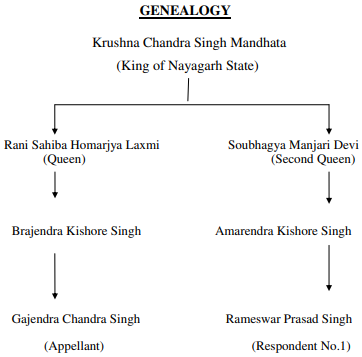
3. It is pleaded on record by the appellant that prior to independence, his late grandfather, namely, Krushna Chandra Singh Mandhata was the Ruling Chief of Nayagarh Estate and the Memoranda of the Indian Estates, 1938 corrected up to then and published by the Government of India reveals the hierarchy of the Rulers of the Estate. It is further pleaded that the appellant’s grandfather was born on 15th August, 1911 and married to Rani Sahiba, namely, Homarajya Laxmi, the daughter of the second son of late Prime Minister of Nepal held on 29th January, 1931, whereas, his father was born on 4th September, 1933 out of the said wedlock. It is also pleaded that the grandfather of the appellant was installed on the throne with the coronation performed on 20th July, 1933. A copy of the Memoranda as at Annexure-1 is referred to in support of such claim. It is pleaded that the Directory showing up to date details of the princely States of India and Burma reveals that the late grandfather of the appellant was the Ruler of the Nayagarh Estate and his father, namely, Brajendra Kishore Singh as the heir-apparent and the same is also referred to as at Annexure-2. It is claimed that after the death of the King on 24th June, 1983, as the successor and being the prince, the appellant’s father was coronated as Raja of Nayagarh Estate as per the custom and tradition and thereafter, the latter performed the chhera pahanra seva during the car festival being invited by the local Administration and in support of such claim, Annexure-6 series is placed reliance on. The further claim is that late grandfather of the appellant developed intimacy with one Soubhagya Manjari Devi of Hindol, who was his maternal uncle’s daughter and on account of such relationship, a male child was born, who is the father of respondent No.1, but as the marriage was not lawful, hence, the British Crown did not approve the same. It is pleaded that respondent No.1’s father, namely, Amarendra Kishore Singh claiming himself to be the Raja of Nayagarh Estate started creating disturbance, as a result of which, a suit was instituted by the father of the appellant registe