
 Back
Back





IN THE HIGH COURT OF ORISSA AT CUTTACK
A.C. BEHERA, J.
B. Prabhavati – Appellant
Versus
Kota Achuta (Dead) and Others – Respondents
S.A. No. 253 of 1992
Decided On : 23-12-2025
| Table of Content |
|---|
| 1. joint family property and its partition (Para 4 , 5 , 6 , 10) |
| 2. contest of defendant over joint property claim (Para 12 , 16) |
| 3. legal effect of arbitration and res judicata (Para 15 , 20 , 21 , 22 , 23 , 24 , 25 , 27 , 28) |
| 4. dismissal of appeal and confirmation of lower court's decision (Para 29 , 30 , 31 , 32) |
JUDGMENT :
A.C. BEHERA, J.
1. This 2nd appeal has been preferred against the partly confirming judgment.
2. The appellant in this 2nd appeal was the defendant no.2 before the trial court in the suit vide T.S. No.03 of 1987 and the appellant no.1 before the 1st appellate court in the 1st appeal vide T.A. No.06 of 1992.
The respondent no.1 in this 2nd appeal was the sole plaintiff before the trial court in the suit vide T.S. No.03 of 1987 and the respondent no.1 before the 1st appellate court in the 1st appeal vide T.A. No.06 of 1992.
3. The Respondent Nos.2, 3, 4 and 5 in this 2nd appeal were the defendant nos.1, 3, 4 and 5 in the suit vide T.S. No.03 of 1987 before the trial court and they were appellant nos.2 and 3 and Respondent nos.2 and 3 before the 1st appellate court in the 1st appeal vide T.A. No.06 of 1992.
4. The suit of the plaintiff(K. Achuta Rao, respondent no.1 in this 2nd appeal) was a suit for partition. The plaintiff and defendants belong to one family.
In order to have a clarity, the undisputed family pedigree of the plaintiff and defendants as per to the pleadings of the parties is depicted hereunder:-
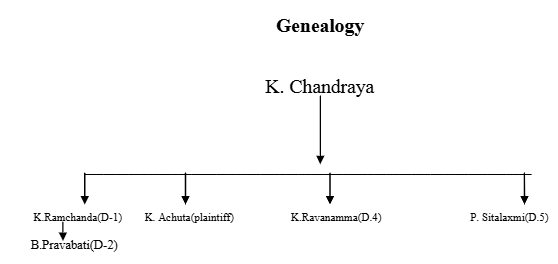
5. As per the above undisputed genealogical tree of the parties, K. Chandraya was their common ancestor. K. Chandraya died leaving behind his widow wife K. Ratnalamma(defendant no.3), two sons and two daughters, i.e., K. Ramachandra Rao(defendant no.1), K. Achuta(plaintiff), K. Ravanaamma(defendant no.4) and Patnuru Sitalaxmi (defendant no.5).
The defendant no.2(B. Pravabati) is the daughter of K. Ramachandra Rao(defendant no.1).
The suit land, i.e., Plot No.625/1099 an area A.0.105 decimals under Khata No.72 at Prasadraopetta, Jeypore described in schedule of the plaint is a house site.
6. According to the plaintiff’s case, he(plaintiff) and defendants are all Hindus and they were guided and governed by Mitakshara school of Hindu Law.
The suit properties along with other properties were the self-acquired properties of his father K. Chandraya. After the death of his father K. Chandraya, all the properties including the suit properties left by him devolved upon him(plaintiff) and defendant nos.1, 3, 4 and 5 simultaneously and said properties including the suit properties have become the joint properties of the plaintiff, defendant nos.1, 3, 4 and 5.
In the year 1968, due to some misunderstanding between him (plaintiff) and his mother(defendant no.3), his mother appointed some Arbitrators for distribution of their joint properties and the Arbitrators distributed their joint properties between them, but, he(plaintiff) did not agree with the same alleging that, the said award of the Arbitrators was the outcome of the influence. So, the so-called award of the Arbitrators could not become the rule of court. As such, the said award was not acted upon.
In the year 1976, the defendant no.1 K. Ramchandra Rao, (eldest brother of the plaintiff) filed a suit for partition in the court of the learned Sub-ordinate Judge, Jeypore in respect of their joint and undivided properties situated in village Dangora, but, that suit was dismissed on the ground of non-joinder of necessary parties and non-inclusion of all the joint properties. To which, defendant no.1 challenged preferring an appeal vide T.A. No.16 of 1979. In the judgment and decree of the 1st appeal vide T.A. No.16 of 1979, the learned District Judge, Jeypore held that, the so-called award passed by the Arbitrators in the year 1968 was neither acted upon nor the same was the rule of court and dismissed to the said 1st appeal vide T.A. No.16 of 1979 of the defendant no.1.
In spite of the dismissal of the suit as well as 1st appeal vide T.A. No.16 of 1979 of the
AI
An arbitration award without court recognition lacks binding legal effect in partition disputes concerning jointly owned family properties under Hindu Law.

Joint ownership claims persist until partition; rights in a partition suit are not bound by limitation, and the burden to prove legal necessity for property transfer lies with the transferee.
The conditions for claiming benefits under Section 4 of the Partition Act require a dwelling house to be in existence at the time of transfer, which the appellant failed to establish.


In disputes regarding partition of joint Hindu family property, the burden of proof lies on the party asserting partition, and the presumption of jointness remains unless clear evidence to the contra....

In partition suits under the Hindu Succession Act, successors are entitled to equal shares regardless of prior unauthorized mutations in land records, affirming co-ownership rights.



An indispensable Tool for Legal Professionals, Endorsed by Various High Court and Judicial Officers
Please visit our Training & Support
Center or Contact Us for assistance

Scan Me!
India’s Legal research and Law Firm App, Download now!


For Daily Legal Updates, Join us on :



 Back to top


