
 Back
Back





IN THE HIGH COURT OF ORISSA AT CUTTACK
A.C.BEHERA, J.
Kalakanhu Bariha & Others - Appellant
Versus
Artatrana Meher & Others - Respondent
SA No.4 of 2000
Decided on : 19-07-2024
| Table of Content |
|---|
| 1. background of the case and parties involved (Para 1 , 2 , 3 , 4 , 5 , 6) |
| 2. defendant's stand on the sale deed (Para 7 , 8) |
| 3. arguments and counterarguments in trial (Para 9 , 10) |
| 4. findings of the trial and appellate courts (Para 11 , 12 , 13 , 14 , 15) |
| 5. legal requirements for sale of minor's interest (Para 17 , 18 , 19 , 20) |
| 6. confirmation of lower court findings (Para 21) |
| 7. dismissal of the appeal and final order (Para 22) |
JUDGMENT :
A.C. Behera, J.
1. This Second Appeal has been preferred against the confirming judgment.
2. The appellants of this Second Appeal were the plaintiffs before the Trial Court in the suit vide T.S. No.30 of 1986 and they were the appellants before the 1st Appellate Court in the first appeal vide T.A.No.20 of 1996.
The respondents of this 2nd Appeal were the defendants before the Trial Court in the suit vide T.S. No.30 of 1986 and they were the respondents before the 1st Appellate Court in the 1st appeal vide T.A. No. 20 of 1996.
3. The suit of the plaintiffs vide T.S. No.30 of 1986 before the Trial Court was a suit for declaration, confirmation of possession, in alternative recovery of possession.
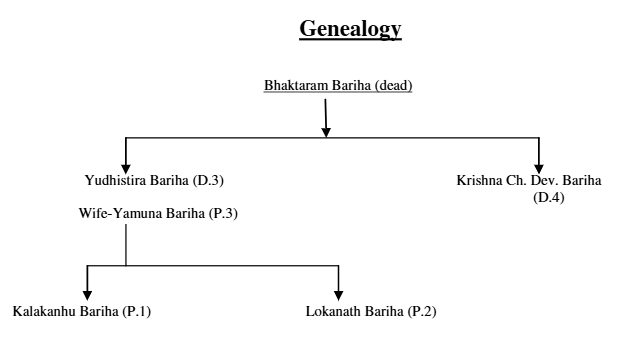
4. The plaintiffs and defendant Nos.3 and 4 are the members of one family. The defendant Nos.3 and 4 are two brothers. The plaintiff No.3 is the wife of defendant No.3. The plaintiff Nos.1 and 2 are the two sons of the defendant No.3 and plaintiff No.3.
5. In order to have an instant reference, the genealogy (family pedigree) of the plaintiffs and defendant No.3 is depicted hereunder:-
6. According to the case of the plaintiffs, they (plaintiffs) and defendant Nos.3 and 4 belong to Scheduled Tribe Community having their sub caste Binjhal. They are guided and governed by Mitakshara School of Hindu Law. The suit properties described in the schedule of the plaint is the part of their ancestral properties. They (plaintiffs) along with the defendant No.3 have been possessing the suit properties along with their other properties jointly, those were allotted in their share during the partition of their all ancestral properties. But, in course of time, the defendant No.3 (husband of the plaintiff No.3 and father of plaintiff Nos.1 and 2) became a habitual drunkard and ganja smoker and failed to manage their family properly, by which, the economical condition of their family ruined day by day gradually. In order to, save their family from economic disaster, in the year 1978, the wife of the defendant No.3 i.e. plaintiff No.3 took over the charge of management of their family as Karta by the consent of her husband i.e. defendant No.3. Taking the advantage of the drunkardness of the defendant No.3 and his necessity of money for consumption of liquor and for smoking ganja, the defendant Nos.1 and 2 managed to execute a sale deed on dated 23.06.1979 for a consideration of Rs.6000/- in respect of the suit properties from the defendant No.3. The said sale of the joint properties of the plaintiffs and defendant No.3 to the defendant Nos.1 and 2 by the defendant No.3 was neither for legal necessity nor for the benefit of the family members or the estate of their family or for repayment of any debt of the family. The said sale was carried out without the knowledge of the plaintiffs. Whatever amount, the defendant No.3 might have received from the defendant Nos.1 and 2 as consideration for the execution and registration of the sale deed in respect of the suit properties on dated 23.06.1979, the same has been spent by him (defendant No.3) towards his drinking and smoking. As such, the said sale transaction between the defendant No.3 and the defendant Nos.1 and 2 in respect of the suit properties is out and out a paper transaction without delivery of possession of the suit properties indicated in that sale deed in favour of the defendant Nos.1 and 2. They (plaintiffs) are in possession over the suit properties as usual. In fact, the defendant No.3 was not the Karta of their family and he has not sold the suit prope
AI
No court permission is required for a Karta to sell joint family property when such sale is established as for family necessity under Hindu law, even involving minor interests.

Sales executed by a natural guardian without court permission under the Hindu Minority and Guardianship Act are voidable, remaining valid until the minor challenges them within three years of attaini....

Pre-emption rights under Section 22 of the Hindu Succession Act cannot be invoked by non-Class I heirs after property partition and are valid until declared otherwise by a competent court.

The burden of proving legal necessity for the alienation of ancestral property lies on the alienee, and the transaction must be for the family's benefit, binding all undivided family members.

In joint family property disputes, a guardian may transact on behalf of minors without court sanction, provided sales serve family interests.
Joint ownership claims persist until partition; rights in a partition suit are not bound by limitation, and the burden to prove legal necessity for property transfer lies with the transferee.
A co-owner can validly sell their share in joint properties, and the sale deed cannot be declared void if it is within the extent of the seller's interest.

A co-owner can validly alienate their undivided share in joint property, and unilateral cancellation of a sale deed is legally ineffective unless supported by substantial evidence.

A sale executed contrary to a will's prohibition is voidable and must be set aside; failure to do so renders the suit for possession untenable.



An indispensable Tool for Legal Professionals, Endorsed by Various High Court and Judicial Officers
Please visit our Training & Support
Center or Contact Us for assistance

Scan Me!
India’s Legal research and Law Firm App, Download now!


For Daily Legal Updates, Join us on :



 Back to top


