
 Back
Back





IN THE HIGH COURT OF ORISSA AT CUTTACK
A.C.BEHERA, J.
Kailash Chandra Barik & Others – Appellant
Versus
Smt. Kapura Das – Respondent
SA No.395 of 1999
Decided on : 26-07-2024
| Table of Content |
|---|
| 1. inheritance rights based on lineage and documentation (Para 4 , 5 , 6) |
| 2. maintenance of suit based on historical family law (Para 8 , 16 , 18) |
| 3. admissibility of arguments challenging the plaintiff's claim (Para 10 , 12) |
| 4. dismissal of appeal based on lack of merit (Para 19) |
JUDGMENT :
A.C. Behera, J.
1. This Second Appeal has been preferred against the reversing judgment.
2. The appellants of this Second Appeal were the defendants before the Trial Court in the suit vide T.S. No.69 of 1991 and they were the respondents before the 1st Appellate Court in the first appeal vide T.A. No. 4 of 1994.
The respondent of this 2nd Appeal was the sole plaintiff before the Trial Court in the suit vide T.S. No.69 of 1991 and she was the appellant before the 1st Appellate Court in the 1st appeal vide T.A. No. 4 of 1994.
3. The suit of the plaintiff (respondent in this 2nd Appeal) vide T.S. No.69 of 1991 before the Trial Court against the defendants (appellants in this 2nd appeal) was a suit for partition and declaration.
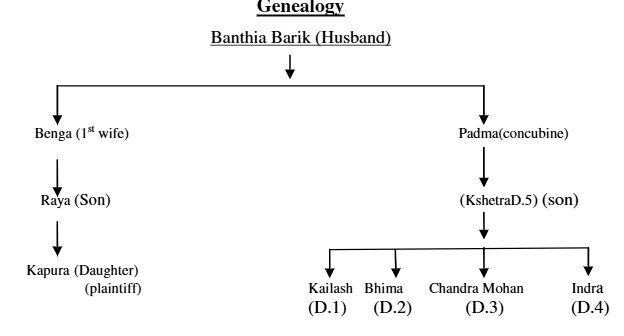
4. The case of the plaintiff was that, Banthia Barik had married Benga, but he (Banthia Barik) had kept Padma as his concubine. Raya Barik was the son of Banthia Barik through Benga. The plaintiff is the sole child and daughter of Raya Barik. Raya Barik expired leaving behind plaintiff as his daughter and sole successor.
The concubine of Banthia Barik i.e. Padma had one son through Banthia Barik i.e. Kshetramohan Barik (defendant No.5). The defendant Nos.1 to 4 are the sons of the defendant No.5 (Kshetramohan Barik).
5. In order to have a better appreciation and so also for an instant reference, the aforesaid genealogy stated by the plaintiff in her plaint is depicted hereunder:-
6. According to the plaintiff, the suit properties were originally belonged to Banthia Barik. After the death of Banthia Barik, the suit properties were recorded in the name of Raya Barik (father of the plaintiff) and Kshetramohan Barik (defendant No.5) jointly in the major settlement. Raya Barik gifted away the suit properties to the plaintiff through registered gift deed No.2527 dated 09.06.1983. As, the plaintiff was the only daughter of Raya Barik and as Raya Barik gifted away the suit properties to the plaintiff, for which, the plaintiff is the owner of the entire suit properties. But on dated 15.02.1991, she (plaintiff) came to know that, the defendant No.1 (Kailash Chandra Barik) has projected him as the adopted son of Raya Barik in a mutation case vide mutation case No.7778 of 1989 and also came to know that, the defendant No.1 has obtained a decree from the Court in T.S. No.42 of 1983 behind the back of Raya Barik declaring him (defendant No.1) as the adopted son of Raya Barik practizing fraud and suppressing the service of summon of that suit on her father Raya Barik. In fact, the defendant No.1 is not the adopted son Raya Barik. But, she (Plaintiff) is the only child and successor of Raya Barik.
Therefore, she (plaintiff) filed the suit vide T.S. No.69 of 1991 against the defendants praying for partition of the suit properties and for a declaration that, the defendant No.1 is not the adopted son of Raya Barik and also to declare that, the judgment and decree passed in T.S. No.42 of 1983 by practicing fraud and through suppression of summons as null and void and to declare her half share in the suit properties.
7. Having been noticed from the Trial Court in the suit vide T.S. No.69 of 1991 filed by the plaintiff, the defendant Nos.1 to 5 contested the same by filing their joint written statement denying the allegations alleged by the plaintiff against them taking their stands inter alia therein that, the suit of the plaintiff is not maintainable. The same is barred by law of limitation. The suit is defective for non-payment of adequate Court fees.
According to them (defendant Nos.1 to 5), the mother of the defendant No.5 i.e. Padma Barik was not the concubine of Banthia Barik, but, she was the legally married wife of Banthia Barik. B
AI
The omission of Section 23 of the Hindu Succession Act allows a married daughter to seek partition in joint family property, disregarding her marital status and absence of other daughters.

Widow's remarriage does not strip her of inheritance rights, and married daughters have equal entitlement to family property under the amended Hindu Succession Act.
Joint ownership claims persist until partition; rights in a partition suit are not bound by limitation, and the burden to prove legal necessity for property transfer lies with the transferee.
In partition suits under the Hindu Succession Act, successors are entitled to equal shares regardless of prior unauthorized mutations in land records, affirming co-ownership rights.
A suit for partition requires substantiating evidence of genealogy and heirs; mere allegations are insufficient. Equal shares were affirmed for the parties, reflecting the law of inheritance. This le....


The main legal point established in the judgment is that the Central enactment prevails over the State law, and the daughters, including those married prior to 1994, are entitled to an equal share in....

(1) Title – Mere recording of name in Record of Rights neither creates title nor extinguishes title in whose favour same is recorded.(2) Donee cannot get better title through gift, than his/her donor....
The conditions for claiming benefits under Section 4 of the Partition Act require a dwelling house to be in existence at the time of transfer, which the appellant failed to establish.



An indispensable Tool for Legal Professionals, Endorsed by Various High Court and Judicial Officers
Please visit our Training & Support
Center or Contact Us for assistance

Scan Me!
India’s Legal research and Law Firm App, Download now!


For Daily Legal Updates, Join us on :



 Back to top


