
 Back
Back





IN THE HIGH COURT OF ORISSA AT CUTTACK
SASHIKANTA MISHRA, J.
Bhagyabati Mahakud - Appellant
Versus
Bhumi Mahakud (Dead) Her LR-Prafulla Mahakud – Respondent
RSA No. 11 of 2011
Decided On :13-09-2024
| Table of Content |
|---|
| 1. property succession rights established. (Para 1 , 4 , 5 , 6) |
| 2. trial court findings on mutual partition. (Para 8 , 9) |
| 3. parties' arguments on evidence and partition. (Para 10 , 12 , 13) |
| 4. court's analysis of partition and will validity. (Para 14 , 15 , 16 , 17) |
| 5. conclusion on appeal dismissal. (Para 18 , 19) |
JUDGMENT :
SASHIKANTA MISHRA, J.
The defendant is the appellant against a reversing judgment. The judgment dated 25.10.2010 followed by decree passed by the learned Addl. District Judge, Boudh in RFA No. 1 of 2010 is impugned in the present appeal whereby judgment dated 04.11.2009 followed by decree passed by the learned Civil Judge (Sr. Division), Boudh in C.S. Case No. 58 of 2006 was set aside and the right, title and interest and possession of the plaintiff over the suit property was declared.
2. For convenience, the parties are referred to as per their respect status before the trial Court.
3. Before adverting to the case of the parties it would be profitable to first reproduce the genealogy showing their relationship between the parties.
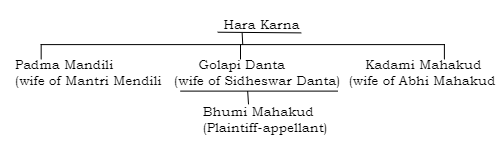
4. The case of the plaintiff, briefly stated, is that Hara Karna died in the year 1974 leaving behind her three daughters, Padma, Golapi and Kadami. Both Padma and Kadami died issueless. Therefore, Golapi being the sole surviving heir succeeded to the entire suit properties. The plaintiff is the daughter of Golapi and after death of her mother, she succeeded to the properties and continued to possess it having her residential house thereon. On the other hand,, defendant is the daughter of one Sambhu Mendili, who is of the brother of husband of Padma and as such not related to the family. Two to three years prior her death, Padma was not mentally sound and was often ailing from various deceases. She was an illiterate rustic lady not accustomed to public life. The plaintiff applied for mutation though the Tahasildar, Kantamal vide Mutation Case No. 190 of 2005. The defendant also filed Mutation Case No. 191 of 2005 before the Tahasildar, Kantamal for mutation of the land in her favour on the strength of a Willnama purportedly executed by Padma in her favour. Said mutation case was allowed in favour of the defendant on 19.08.2005. The plaintiff contends that said order of the Tahasildar was passed behind her back. Moreover, the Tahasildar erred in holding that there was a partition of suit land between Padma and Golapi whereby the suit land fell to the exclusive share of Padma. On such erroneous premises Padma had managed to record the suit land in the settlement operation of the year 1993. It is further alleged that the Willnama is a forged document obtained by the defendant by exercising undue influence, misrepresentation and fraud in connivance of her father. Even otherwise, Padma was not competent to bequeath the entire suit land under the Willnama as she has only 1/2 share thereon. Since the defendant, after obtaining the order of mutation tried to disposes the plaintiff on 25.09.2005, she was constrained filed the suit land.
5. The defendant contested the suit by filing written statement and also raised a counter claim over the suit land for declaration of title and possession with alternative prayer for recovery of possession in the event, she is found to have been dispossessed. According to the defendant, Hara Karna was also the owner in possession of another land measuring Ac.8.43 decimals out of Ac.16.87 decimals of land appertaining to Sabik Khata No.68 along with the suit land. She died leaving behind her three daughters one of whom Kadami also died issueless shortly thereafter. There was an amicable partition of the properties of Hara between her surviving daughters Padma and Golapi whereby the entire suit property fell to the share of Padma whereas the other property pertaining to Sabik Khata No.68 fell to the share of Golapi. As such, both sisters filed mutation cases being M.C. No. 594 of 1999 and M.C. No. 166 of 1990 before the Tahasildar, Kantamal. Both the
AI
A Will concerning ancestral property is invalid if the testator lacks the authority to bequeath the property and fails to prove prior partition among heirs.

The court recognizes the entitlement of female heirs to a share in ancestral property based on notional partition, counteracting historical biases that deprived them of their rightful claims.
Prior partition remains valid unless cogent evidence of reunion is established; absent such evidence, the ownership claims of plaintiffs over disputed properties are affirmed.


The presumption of joint family property necessitates proof of individual ownership; without such proof, a child has a right to claim share in ancestral property.

Joint family properties with tenancy rights must be equitably divided, and prior agreements should be recognized in claims of ownership.
A property owner cannot partition their exclusive assets among heirs who lack legal interest; valid sale deeds establish ownership rights.
In partition suits under the Hindu Succession Act, successors are entitled to equal shares regardless of prior unauthorized mutations in land records, affirming co-ownership rights.



An indispensable Tool for Legal Professionals, Endorsed by Various High Court and Judicial Officers
Please visit our Training & Support
Center or Contact Us for assistance

Scan Me!
India’s Legal research and Law Firm App, Download now!


For Daily Legal Updates, Join us on :



 Back to top


