
 Back
Back





IN THE HIGH COURT OF ORISSA AT CUTTACK
SASHIKANTA MISHRA, J.
Smt. Gouri Hansda - Appellant
Versus
Sri Dulla Majhi and Others - Respondents
RSA No. 180 of 2003
Decided On : 23-08-2024
| Table of Content |
|---|
| 1. appellant's standing in the case. (Para 1 , 2 , 3) |
| 2. factual narrative of property rights. (Para 4 , 5) |
| 3. issues determined by the trial court. (Para 6 , 7) |
| 4. appellate court's review of findings. (Para 8 , 9) |
| 5. proper presentation of appeal documentation. (Para 10 , 14) |
| 6. arguments against adverse possession findings. (Para 11 , 12) |
| 7. understanding of limitation periods. (Para 13 , 15) |
| 8. principles of notional partition. (Para 16 , 19) |
| 9. entitlement to ancestral property. (Para 20 , 21) |
| 10. final decision and decree. (Para 22) |
UDGMENT :
SASHIKANTA MISHRA, J.
The Plaintiff is the Appellant against the confirming judgment passed by learned Addl. District and Sessions Judge, (Fast Track Court), Baripada on 09.08.2002, followed by decree in Title Appeal No. 9/13 of 2002-01 whereby the judgment passed on 17.11.2000 followed by decree by the learned Civil Judge (Sr. Division), Udala in Title Suit No. 01 of 1999 was confirmed.
2. For convenience, the parties are referred to as per their respective status in the trial Court.
3. For better appreciation, the genealogy of the parties is given below.
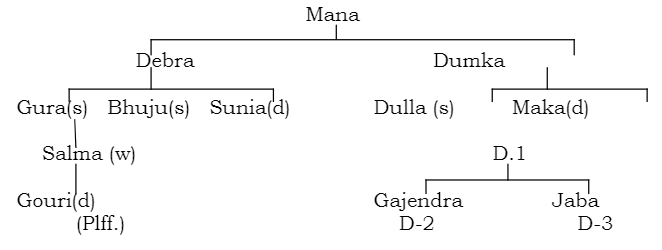
4. The case of the Plaintiff is that the common ancestor Mana had two sons Debra and Dumuka. Debra had two sons and a daughter, one of them being Gura. Gura died leaving behind his widow Salma and his only daughter Gouri the Plaintiff. On the other hand, Dumka had one son, namely, Dulla, the Defendant No.1 and a daughter, Maka. Defendant No.2 and Defendant No.3 are the son and daughter respectively of Dulla (Defendant No.1). The Plaintiff’s case is that their common ancestor had Ac.14.27 decimals of land under Sabik Khata No.44 in Mouza Sialamundali. Said property was divided between Gura (father of the Plaintiff) and Dulla, son of Dumka orally in the year 1970. Accordingly, Gura got Ac.7.14 decimals whereas Defendant No.1 got Ac.7.13 decimals. Gura died in the year 1971 and thereafter, the Plaintiff and her mother possessed and cultivated the suit land. It is the further case of the Plaintiff that after death of her mother Salma, She has been possessing the land along with her husband. It is alleged that in the Hal Settlement operation, the entire suit land was recorded in the name of the Defendants for which the Plaintiff filed Objection Case No.616 of 1986 before the Assistant Settlement Officer for recording of her name in respect of her father’s share. Said case was dismissed on 02.08.1986. She preferred an appeal, being Appeal No.272 of 1986, before the Settlement Officer but the same was also dismissed on 12.03.1987. During the time of consolidation operation, Defendant No.1 managed to get the entire suit land recorded in his name and the names of hisson and daughter (D-2 and D-3). It is further claimed that Defendant No.1 executed a sale deed on 24.06.1975 in favour of Suryanada Majhi of her village, in the recitals of which, it is clearly admitted that the ancestral properties had been divided between him and Gura. As such, Defendants have got no right, title and interest over the land falling to the share of the Plaintiff’s father Gura.
5. The Defendants contested the suit by filing written statement. Their plea was, Dumka and Debra were living jointly and after death of Dumka, Mana was managing the house-hold affairs. The second son Bhuju died unmarried followed by the death of Mana. As such, Dulla, (Defendant No.1) became the “Karta” of the family and managed the house-hold affairs. While living in joint family with Defendant No1, Gura died leaving behind his wife Salma and daughter, the Plaintiff. Salma thereafter married again to one Maha Majhi. The Plaintiff was therefore, raised by Defendant No.1 and given in marriage to one Masang Hembram. She however did not stay with her husband and remarried one Shyamsundar Hansda. She had filed a petition before the S.D.O. claiming her share, which was sent to the Sarpanch but her claim was turned down as being a daughter, she had no right in the joint family properties. Her f
AI
The court recognizes the entitlement of female heirs to a share in ancestral property based on notional partition, counteracting historical biases that deprived them of their rightful claims.

In a partition suit, registered documents act as constructive notice, initiating the limitation period. Prolonged exclusive possession of ancestral property by a co-owner establishes ouster. Addition....

Properties claimed as self-acquired were determined to be ancestral; the appeal for partition was dismissed due to lack of joint possession evidence and non-joinder of necessary parties, also barred ....
Prior partition remains valid unless cogent evidence of reunion is established; absent such evidence, the ownership claims of plaintiffs over disputed properties are affirmed.

In disputes regarding partition of joint Hindu family property, the burden of proof lies on the party asserting partition, and the presumption of jointness remains unless clear evidence to the contra....


The finalized partition under the Hindu Succession (Amendment) Act, 2005 cannot be reopened unless exceptions apply; claims barred by limitation and lack of necessary parties.

The presumption of joint family property necessitates proof of individual ownership; without such proof, a child has a right to claim share in ancestral property.

A co-sharer’s right to ancestral property is inherent and cannot be extinguished by absence from the parental home.



An indispensable Tool for Legal Professionals, Endorsed by Various High Court and Judicial Officers
Please visit our Training & Support
Center or Contact Us for assistance

Scan Me!
India’s Legal research and Law Firm App, Download now!


For Daily Legal Updates, Join us on :



 Back to top


