
 Back
Back





IN THE HIGH COURT OF ORISSA AT CUTTACK
A.C. Behera, J.
Mangal Majhi and Others - Appellants
Versus
Khela Majhi (dead) and others - Respondents
R.S.A. No.173 of 2003
Decided On : 22-01-2026
| Table of Content |
|---|
| 1. identification of parties and suit background. (Para 1 , 2 , 3) |
| 2. genealogy and inheritance rights. (Para 4 , 5 , 6 , 7 , 8 , 9 , 10) |
| 3. defendants' arguments against plaintiffs. (Para 11 , 12 , 13 , 14) |
| 4. dismissal of the first appeal. (Para 15 , 16 , 17) |
| 5. substantial questions of law framed. (Para 18 , 19 , 20 , 21 , 22 , 23) |
| 6. relevance of official records in establishing relationships. (Para 24 , 25 , 26 , 27) |
| 7. testimony of witnesses confirming relationships. (Para 28 , 29 , 30 , 31) |
| 8. legal standards for proving civil matters. (Para 32 , 33) |
| 9. concluding judgment on plaintiffs' claims. (Para 34) |
| 10. final dismissal of the appeal. (Para 35) |
JUDGMENT :
A.C. Behera, J.
This 2nd appeal has been preferred against the confirming judgment.
2. The appellants in this 2nd appeal were the defendant Nos.1 to 5 before the Trial Court in the suit, vide T.S. No.46 of 1996 and appellants before the 1st Appellate Court in the 1st Appeal vide T.A. No.52 of 1999.
The respondent Nos.1 & 2 in this 2nd appeal were the plaintiffs before the Trial Court in the suit vide T.S.46 of 1996 and respondent Nos.1 & 2 before the 1st Appellate Court in the 1st Appeal vide T.A. No.52 of 1999.
The respondent Nos.3 to 8 in this 2nd appeal were the defendant Nos.6 to 11 before the Trial Court in the suit vide T.S.46 of 1996 and respondent Nos.3 to 8 before the 1st Appellate Court in the 1st Appeal vide T.A. No.52 of 1999.
3. The suit of the plaintiffs (respondent Nos.1 & 2 in this 2nd appeal) before the Trial Court vide T.S.46 of 1996 was a suit for declaration, confirmation of possession, permanent injunction, for correction of names of the defendant Nos.1 to 5 from the R.o.R. and in alternative recovery of possession, if they (plaintiffs) are found to be dispossessed from the suit properties during the pendency of the suit.
4. The properties described in Schedule ‘A’ of the plaint are the suit properties.
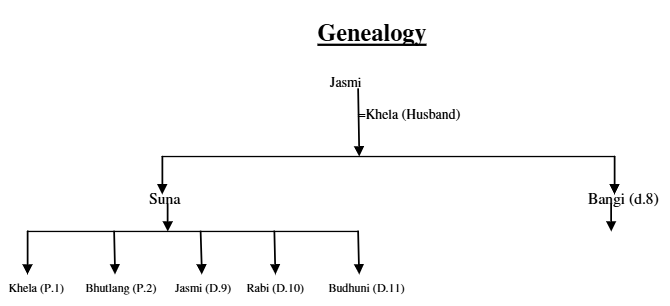
5. As per the case of the plaintiffs, one Jasmi Majhi was the common ancestor of the plaintiffs. The said Jasmi Majhi was the wife of Khela Majhi.
Jasmi Majhi died leaving behind her one daughter and one son i.e. Suna and Bangi (defendant No.8).
Suna died leaving behind his two sons and three daughters i.e. Khela (plaintiff No.1), Bhutlang (plaintiff No.2), Jasmi (defendant No.9), Rabi (defendant No.10) and Budhuni (defendant No.11).
6. In order to have a better appreciation, the family pedigree (genealogy) of the plaintiffs as given in the plaint is depicted hereunder for an instant reference:
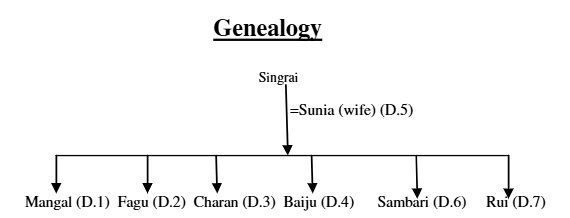
7. The husband of Jasmi i.e. Khela predeceased Jasmi. The plaintiffs and defendant Nos.9, 10 & 11 have born out of the wedlock of Jasmi and Khela. After the death of Khela, Jasmi had illicit relationship with one Singrai of the same village. Jasmi predeceased Singrai. Thereafter, Singrai married to one Sunia.
The defendant Nos.1 to 7 had born through Sunia (defendant No.5) and Singrai.
8. In order to have a better appreciation, the genealogy about the relationship between Sunia, Singrai and defendant Nos.1 to 4, 6 & 7 given in the plaint is also depicted hereunder:
9. The mother of the plaintiffs i.e. Jasmi Majhi was the owner of the suit properties i.e. the properties described in Schedule ‘A’ of the plaint and the said properties were recorded in her name exclusively in the previous settlements of the years 1913 & 1948 respectively.
After the death of Jasmi, the suit properties left by her (Jasmi) devolved upon her son Suna Majhi exclusively and Suna possessed the suit properties being the exclusive owner thereof. Because, Bangi being the daughter of Jasmi had no right of succession due to the bar of Section 2(2) of the Hindu Succession Act, 1956, as they belong to Scheduled Tribe Community.
10. It was the specific case of the plaintiffs that, they (plaintiffs) being Santals, they are guided under old Hindu Law. For which, for the purpose of inheritance and succession, The Hindu Succession Act, 1956 is not applicable to them. Therefore, daughters of Suna i.e. sis
AI
The court reaffirmed the principle that rightful ownership and possession of ancestral property can be determined based on historical records and applicable customary laws, which may exclude female h....

Co-owners of property cannot seek exclusive title or recovery of possession without partitioning the property, reaffirming shared ownership under Hindu law.

(1) Among Santals, succession law is Hindu Law and not Customary Law.(2) Suit for declaration of title and recovery of possession cannot be maintained in respect to joint and undivided property witho....
Genealogical claims in property disputes must be evidenced to be valid; mere assertion is insufficient, and suits for declaration require concurrent possession claims if plaintiffs lack possession.
A suit for declaration of title requires the plaintiff to be in possession of the property; otherwise, as per Section 34 of the Specific Relief Act, the suit is not maintainable.
The plaintiff was recognized as the adopted son of Parau Majhi, but the suit for exclusive ownership was dismissed due to established co-ownership.

Documentary evidence prevails over oral testimony when establishing legal relationships in property disputes.

Prior partition remains valid unless cogent evidence of reunion is established; absent such evidence, the ownership claims of plaintiffs over disputed properties are affirmed.



An indispensable Tool for Legal Professionals, Endorsed by Various High Court and Judicial Officers
Please visit our Training & Support
Center or Contact Us for assistance

Scan Me!
India’s Legal research and Law Firm App, Download now!


For Daily Legal Updates, Join us on :



 Back to top


