
 Back
Back





IN THE HIGH COURT OF ORISSA AT CUTTACK
A.C.BEHERA, J.
Dhanmati Muchu and others - Appellants
Versus
Narayan Muchu and others – Respondents
R.S.A. No.27 of 2008
Decided On : 17-03-2026
| Table of Content |
|---|
| 1. establishes case background and genealogy. (Para 1 , 2 , 3 , 4) |
| 2. dispute over property possession and ownership. (Para 6 , 7 , 8 , 9 , 10) |
| 3. defendant's counterarguments regarding genealogy. (Para 11 , 12) |
| 4. issues framed for trial. (Para 13 , 14 , 15) |
| 5. 1st appellate court's ruling on ownership. (Para 16 , 17) |
| 6. substantial questions of law in 2nd appeal. (Para 18 , 19 , 20 , 21) |
| 7. burden of proof regarding genealogy. (Para 22 , 23 , 24 , 25 , 26) |
| 8. admissions as best evidence. (Para 27 , 28 , 29) |
| 9. possession evidence and implications. (Para 30 , 31 , 32) |
| 10. dismissal grounds for plaintiffs' suit. (Para 33 , 34 , 35) |
| 11. conclusion of the 2nd appeal. (Para 36 , 37) |
JUDGMENT :
A.C. Behera, J.
The 2nd appeal has been preferred against the reversing judgment.
2. The appellants in this 2nd appeal were the plaintiffs before the learned trial court in the suit vide C.S. No.33 of 2002 and the respondent nos.1 to 6 before the learned 1st appellate court in the 1st appeal vide RFA No.05/18 of 2006.
The respondent no.1 in this 2nd appeal was the defendant no.1 before the learned 1st appellate court in the suit vide C.S. No.33 of 2002 and the appellant before the learned 1st appellate court in the 1st appeal vide RFA No.05/18 of 2006.
The respondent nos.2 to 4 in this 2nd appeal were the defendants nos.2 to 4 in the suit vide C.S. No.33 of 2002 and respondent nos.7 to 9 before the learned 1st appellate court in the 1st appeal vide RFA No.05/18 of 2006.
3. The suit of the plaintiffs(appellants in this 2nd appeal) vide C.S. No.33 of 2002 was a suit for declaration of title and confirmation of possession.
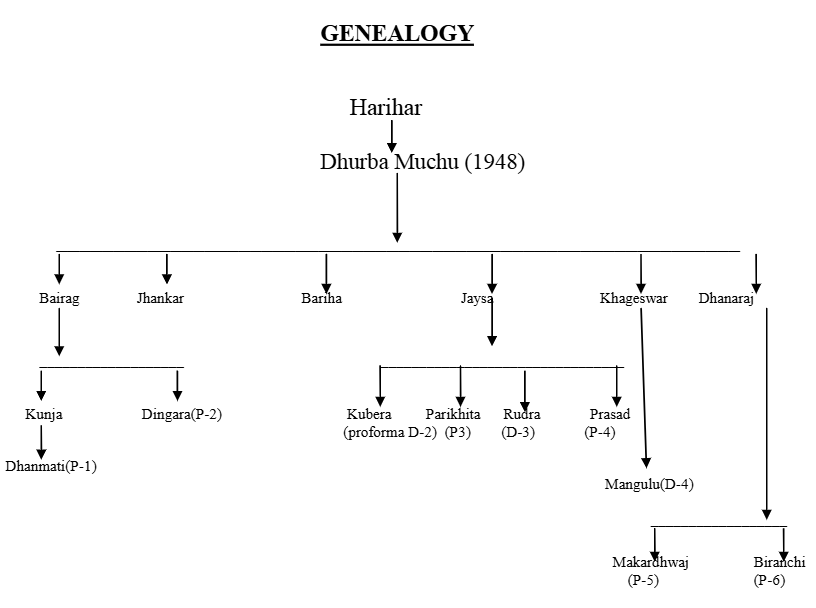
As per the case of the plaintiffs, they (plaintiffs) and proforma defendant nos.2 to 4 are the members of Schedule Tribe community and they belong to one family and their common ancestor was Dhruba Muchu. Dhurba Muchu died leaving behind his six sons, i.e., Bairag, Jhankar, Bariha, Jaysa, Khageswar and Dhanurja.
Bairag died leaving behind his two sons, i.e., Kunja and Dingara(plaintiff no.2).
Kunja died leaving behind his widow Dhanmati(plaintiff no.1).
The 2nd and 3rd son of Dhurba Muchu, i.e., Jhankar and Bariha died issueless.
The 4th son of Dhurba Muchu, i.e., Jaysa Muchu died leaving behind his four sons, i.e., Kubera(defendant no.2), Parikhita(plaintiff no.3), Rudra(defendant no.3) and Prasad(plaintiff no.4).
The 5th son of Dhurba Muchu, i.e., Khageswar Muchu died leaving behind his son Mangulu Muchu(defendant no.4)
The 6th son of Dhurba Muchu, i.e., Dhanarja Muchu died leaving behind his two sons, i.e., Makaradhwaja Muchu(plaintiff no.5) and Biranchi Muchu(plaintiff no.6).
4. In order to have a better appreciation and so also for an easy understanding about the family pedigree of the plaintiff and defendants, their genealogy as stated above, is depicted hereunder for an instant reference:-
5 According to the plaintiffs, defendant no.1 Narayan Samini @ Muchu son of Chandrasekhar Samini@Muchu is in no way related to the family of the plaintiffs and proforma defendant no.2 to 4. He (defendant no.1) is a stranger to their family.
The grand-father of the defendant no.1, i.e., Brusabha Samini had come to their village from an another village and he(Brusabha Samini) was working as a field servant under their common ancestor Dhurba Muchu.
Dhurba Muchu was the only son of his father Harihar Muchu. The said Dhurba Muchu was possessing A.18.10 decimals of land being the owner thereof and the RoR of the same was published in his name exclusively in the last Hamid Settlement.
Their common ancestor Dhurba Muchu died in or about 1948 leaving behind his widow and sons as described in the genealogy and after the death of their common ancestor Dhurba Muchu, his sons had mutated the properties to their names in the year 1949-50 paying rent to the Government.
6. The 1st son of Bairag Muchu sold some acres of land out of A.18.10 decimals properties to different persons executing different sale deeds as reflected in Para No.4 of the plaint.
7. In the la
AI
A suit for declaration of title requires the plaintiff to be in possession of the property; otherwise, as per Section 34 of the Specific Relief Act, the suit is not maintainable.
Genealogical claims in property disputes must be evidenced to be valid; mere assertion is insufficient, and suits for declaration require concurrent possession claims if plaintiffs lack possession.

A suit for declaration of title is maintainable even if there are erroneous entries in settlement records, as such entries do not create or extinguish title. The civil court has the authority to dete....

The court affirmed that concurrent findings of fact by lower courts cannot be interfered with in a second appeal unless shown to be perverse, thus upholding the judgment confirming possession of the ....
A claim of title through adverse possession is inadmissible when a claimant asserts title through inheritance over the same property, as these claims are mutually exclusive.
The court reaffirmed the principle that rightful ownership and possession of ancestral property can be determined based on historical records and applicable customary laws, which may exclude female h....
Possession must be adverse and hostile to establish adverse possession; mere long-term possession does not equate to legal title without evidentiary support.
The finalized Record of Rights (RoR) by consolidation authorities is binding, and civil courts cannot alter these determinations once established, reinforcing the plaintiff's title and possession.
The plaintiff was recognized as the adopted son of Parau Majhi, but the suit for exclusive ownership was dismissed due to established co-ownership.



An indispensable Tool for Legal Professionals, Endorsed by Various High Court and Judicial Officers
Please visit our Training & Support
Center or Contact Us for assistance

Scan Me!
India’s Legal research and Law Firm App, Download now!


For Daily Legal Updates, Join us on :



 Back to top


