
 Back
Back





PUNJAB AND HARYANA HIGH COURT AT CHANDIGARH
Pankaj Jain, J.
Prem Sagar – Appellant
Versus
Chaman Lal And Others – Respondent
RSA-1921-1994 (O&M) & IOIN-RSA-1921-1994
Decided on : 25-03-2025
| Table of Content |
|---|
| 1. claims of joint family relationships require rigorous proof. (Para 2 , 4 , 6) |
| 2. lack of evidence substantiating joint ownership leads to dismissal. (Para 12 , 21) |
| 3. evidence of separate dealings negates claims of joint family property. (Para 13 , 14 , 19) |
JUDGMENT :
Pankaj Jain, J. (Oral)
Plaintiff is in second appeal.
2. Plaintiff filed suit seeking partition by metes and bonds and separation of his 1/12th share in the properties claiming the same to be coparcenary and HUF properties.
3. Before adverting to the facts of the case, it will be apt to peruse the pedigree table demonstrating relationship between the parties:-
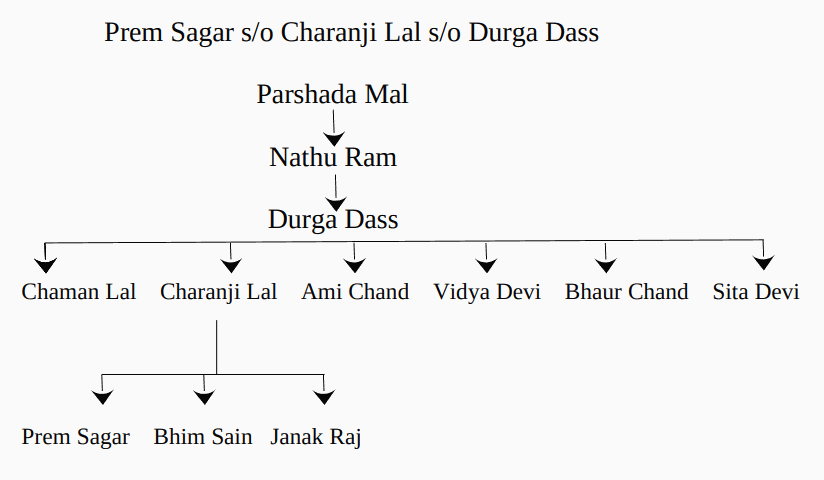
4. Durga Dass died in the year 1933. He had four sons, namely Chaman Lal, Charanji Lal, Ami Chand @ Amin Chand, Bhaur Chand and two daughters, namely Vidya Devi and Sita Devi. Ami Chand died in the year 1979. Janak Raj s/o Charanji Lal died in the year 1969. Plaintiff is son of Charanji Lal. He claims that properties at Sr. No.1 to 4 in schedule 'B' appended to the plaint, are coparcenary and joint hindu family properties of plaintiff and defendant No.1 to 23. They were inherited by the parties to the lis from Durga Dass. Properties mentioned in schedule 'C' attached to the plaint were purchased by joint hindu family constituted by sons, grand sons and great grand sons of Durga Dass with joint hindu family funds. Further case of the plaintiff is that the sons, grand sons and great grand sons of Durga Dass started a cooperative society in the name of Sherpur Bricks Workshop Cooperative Indl. Society Sherpur. Land mentioned in schedule 'D' attached to the plaint was purchased by the coparcenary in the name of the said cooperative society from joint hindu family funds. The same also thus, is a joint hindu family property. It has been further claimed that various firms as mentioned in the plaint being run by the descendants of Durga Dass, are all joint hindu family businesses, started with joint hindu family funds and are thus, joint hindu family concerns. Further case of the plaintiff is that some of the joint hindu family properties were alienated by different family members. The properties sold by them need to be set off while granting decree of partition. Plaintiff thus, claiming himself to be entitled to 1/12 share in the properties, sought partition by way of present suit.
5. Defendant No.10 to 12 admitted the claim of the plaintiff. Defendant No.1, 2, 5, 7, 8, 9, 13, 15, 14, 16, 17, 19, 21, 24, 27, 30 and 31 contested the suit. The main contest was amongst plaintiff, Bhaur Chand, legal heirs of Ami Chand and legal heirs of Chaman Lal. Apart from taking legal objections, the contesting defendants relied upon family settlement dated 17.08.1980. It is claimed that in view thereof, the plaintiff was precluded from filing the present suit. Defendant claims that during the life time of Lala Durga Dass, Chaman Lal-defendant No.1 was separated by Durga Dass. Properties described at Sr. No. 9 and 10 situated at Rampura Phool were given to defendant No.1 in an oral family settlement. Since then defendant No.1 has been residing at Rampura Phool with his family, having no concern with the other family. In the year 1938, Charanji Lal-father of the plaintiff shifted to Dhuri and started business in partnership with Ami Chand. Both of them purchased properties described at Sr. No. 13 and 14 at schedule 'C' in equal share with their own earnings. Bhaur Chand-defendant No.19 resided with the family at Sherpur. He along with Ami Chand and Charanji Lal, purchased property mentioned at Sr. No.23 of schedule 'C'. The joint family thus, disrupted in 1938 AD. Properties described in schedule 'C' are self acquired properties of Chaman Lal. 25 individuals including sons of descendants of Lala Durga Dass formed a cooperative society and purchased land with the funds of the society to start brick kiln. The land cannot be termed as joint hindu family property. Plaintiff alongwith his mother Shanti Devi got their share in
A party claiming joint ownership of property must establish the existence of a joint family and the pool of funds used for property acquisition.

The court affirmed the joint family status and the trial court's ruling on partition, rejecting claims of prior oral partition due to insufficient evidence.


The court clarified that properties must be inherited or acquired from a joint family nucleus to be classified as ancestral under Hindu law, rejecting claims based solely on joint acquisition.

The burden of proof lies on asserting self-acquisition when joint family property is claimed, as evidenced in the judgment affirming the trial court's findings on property character.

A partition among heirs was established, and the properties in question were determined to be self-acquired, nullifying the plaintiffs' claims of joint family property.

The court affirmed that partition of family properties had occurred prior to 1942, establishing individual ownership rights over properties acquired post-partition, thereby negating claims of joint f....
In a partition suit, the burden of proving that property standing in an individual's name is joint family property lies upon the party asserting it, requiring proof of a sufficient ancestral nucleus.....

Amendments to the Hindu Succession Act do not apply retroactively to previously partitioned properties, confirming the validity of prior partitions.

Daughters have equal rights as sons in ancestral property under the Hindu Succession Act, 2005, regardless of prior claims of partition.



An indispensable Tool for Legal Professionals, Endorsed by Various High Court and Judicial Officers
Please visit our Training & Support
Center or Contact Us for assistance

Scan Me!
India’s Legal research and Law Firm App, Download now!


For Daily Legal Updates, Join us on :



 Back to top


