
 Back
Back





IN THE HIGH COURT OF PUNJAB AND HARYANA AT CHANDIGARH
NIDHI GUPTA, J.
Kavita Rani - Appellant
Vs.
Parveen Kumari and others - Respondent
RSA-1027-2014 (O&M)
Decided On : 07-04-2026
| Table of Content |
|---|
| 1. factual history of property inheritance and trial procedural background. (Para 2 , 3 , 4 , 5 , 6 , 7 , 8 , 9 , 10) |
| 2. appellant's challenge regarding consent decree validity, registration requirements, and transfer competency. (Para 11 , 12 , 13 , 14 , 15 , 16 , 17 , 18 , 19 , 20 , 21 , 22 , 23 , 24 , 25 , 26) |
| 3. respondent's contentions on family settlement as pre-existing legal arrangements and absolute ownership. (Para 27 , 28 , 29 , 30 , 31) |
| 4. interpretation of pleadings and evidence confirming consent decree as part of family settlement. (Para 32 , 33 , 34 , 35 , 36 , 37 , 38) |
| 5. application of section 14(1) of hindu succession act regarding pre-existing right to maintenance and absolute ownership. (Para 39 , 40 , 41 , 42) |
| 6. final judicial affirmation of self-acquired property status and dismissal of the appeal. (Para 43 , 44 , 45 , 46 , 47 , 48) |
JUDGMENT :
NIDHI GUPTA, J.
Present Second Appeal has been filed by the plaintiff against the judgment of reversal; whereby suit filed by the appellant for possession and declaration, although decreed by the learned Trial Court, has been dismissed by the learned First Appellate Court.
2. Brief facts of the case are that the plaintiff had filed the present suit “……seeking possession and declaration to the effect that release deed bearing vasika no.2274 dated 27.7.2004 and mutation no.1756 dated 24.9.2004 sanctioned on the basis of said release deed are wrong, illegal, null, void, mere paper transaction just to deprive the plaintiff of her birth right in the suit property since the same is ancestral property in the hands of defendant no.2. As a consequential relief it was prayed that defendants be restrained from alienating the suit property in any manner.”
3. To better understand the dispute at hand, it will be helpful to look at the following Pedigree table of the parties: –
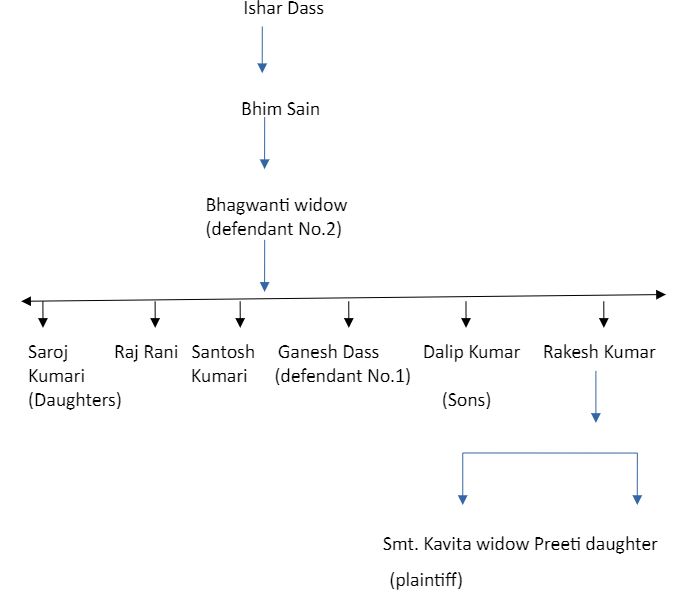
4. The pleaded case of the appellant in the plaint was that the suit land, total measuring 26K 9M, is ancestral property in the hands of Bhagwanti Devi/defendant No.2/paternal grandmother of the plaintiff, who had inherited the same from her husband, namely, Bhim Sain vide Mutation No. 1318 dated 14.10.1995. Defendant No.2 had executed a Release Deed No. 2274 dated 27.07.2004 in favour of her son/ defendant No.1; in pursuance to which Mutation No. 1756 dated 24.09.2004 had been sanctioned in his favour which is illegal, null and void. It was contended that as per Mutation No. 1318 dated 14.10.1995; defendant No.2 had power to transfer only 1/7th share in the suit property; whereas vide the impugned Release Deed, she had transferred the entire suit land in favour of defendant No.1. It was averred that father of the plaintiff, namely, Rakesh Kumar had died on 20.10.2003 and mutation of inheritance was sanctioned in favour of defendant No.2 being mother of Rakesh Kumar. Plaintiff had asked defendant No.2 several times to transfer the share in her favour and to set aside the Release Deed as well as the Mutation, but to no avail. Hence, present suit was filed on 01.06.2009.
5. Upon notice, defendants had resisted the suit by filing joint written statement and submitting that Shri Bhim Sain/husband of defendant no.2 was the owner in possession of agriculture land measuring 26 kanal 9 marla who had died on 22.5.1995; and after his death mutation no.1318 dated 14.10.1995 was sanctioned in the name of the defendants along with other children of Bhim Sain/brothers and sisters of defendant no.1 in equal shares of 1/7 share. Later on, defendant no.1 along with other successors of land had transferred their share of land to defendant no.2 vide civil suit no.1009/1995 decided on 25.11.1995. Hence, entire property in the hands of defendant no.2 was self acquired property of defendant no.2; and she has rightly executed the release deed in favour of defendant no.1. In the end, dismissal of the suit was prayed for.
6. No replication was filed.
7. On the basis of pleadings of the parties, following issues were framed by l
AI
A consent decree declaring pre-existing rights, such as maintenance, does not require registration. Furthermore, property acquired by a female Hindu in lieu of maintenance ripens into absolute owners....
Consent decrees based on family settlements cannot be challenged on incorrect facts unless fraud is proven; registration is not required for such decrees when they involve pre-existing rights.


An unregistered gift deed does not confer title to real property, necessitating proper registration and the inclusion of all necessary parties in a suit for declaration.


The court affirmed the validity of a Release Deed executed by a legal heir, emphasizing the burden of proof lies on the party disputing its execution.



An indispensable Tool for Legal Professionals, Endorsed by Various High Court and Judicial Officers
Please visit our Training & Support
Center or Contact Us for assistance

Scan Me!
India’s Legal research and Law Firm App, Download now!


For Daily Legal Updates, Join us on :



 Back to top


