
 Back
Back





IN THE HIGH COURT OF ALLAHABAD, LUCKNOW BENCH
ATTAU RAHMAN MASOODI, BRIJ RAJ SINGH, JJ.
Mahendra Pal and others - Appellants
Versus
State of U.P. and others - Respondents
Special Appeal Nos. 172, 174, 209, 210, 261, 262, 301, 302, 307, 318, 319, 320, 321 of 2023, Special Appeal Defective Nos. 204, 237, 243, 244, 245, 248, 251, 254, 255, 256, 257, 258, 259, 260, 262, 264, 265, 266, 267, 275, 281, 282, 283, 285, 287, 289, 290, 291, 292, 293, 294, 295, 296, 297, 298, 299, 301, 306, 310, 311, 312, 316, 318, 325, 326, 335, 336, 357, 366, 368, 372, 378, 380, 381, 384, 390, 392, 424, 425, 429, 438, 452, 464, 478, 480, 486, 489, 509, 534, 538, 598, 817, 875, 938 of 2023, 79, 85, 99 and 101 of 2024
Decided On : 13-08-2024
| Table of Content |
|---|
| 1. common questions of law regarding teacher recruitment. (Para 1 , 2 , 3 , 4) |
| 2. history and provisions regarding teacher recruitment and reservation. (Para 5 , 6 , 7) |
| 3. legal challenges and prior judicial decisions on recruitment rules. (Para 8 , 10 , 11 , 12) |
| 4. allegations of irregularities in candidate selection. (Para 13 , 14 , 15) |
| 5. arguments from appellants and respondents about selection policies. (Para 16 , 39 , 40) |
| 6. revised selection list preparation based on cumulative qualifications. (Para 38) |
| 7. court's reasoning on merit and reservation application. (Para 41 , 42 , 43 , 61) |
| 8. court orders for revising teacher recruitment process. (Para 62 , 63) |
JUDGMENT :
Attau Rahman Masoodi, J.
The bunch of appeals involve common questions of facts and law, therefore, they were heard together and are decided by a common judgement and order.
2. The aforementioned bunch of intra-Court appeals filed under Chapter VIII Rule 5 of the Rules of the Court is directed against the judgement and order dated 13.3.2023 passed by the learned Single Judge in Writ-A No. 17919 of 2021 and other connected writ petitions, whereby while disposing of all the writ petitions filed by the writ petitioners, learned Single Judge quashed the select list dated 1.6.2020 with certain directions.
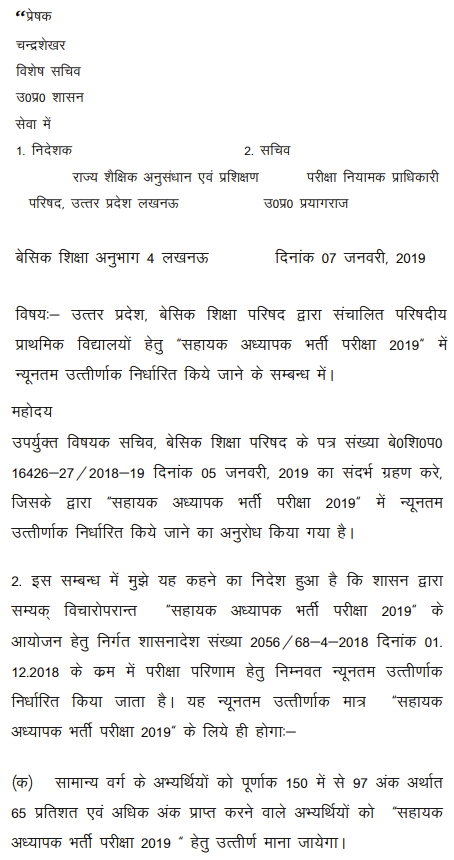
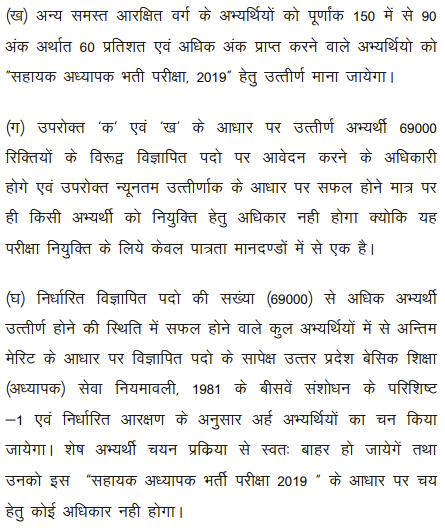
3. The bunch of appeals has raised an important question of law as to whether the marks obtained from the open competition on the result of Assistant Teachers Recruitment Examination (for short 'ATRE') based on 2019 examination alone or the marks derived on the basis of the entire process i.e. ATRE-2019 coupled with other criteria of educational and training record would be decisive to serve the real object of Section 3 (6) of the Uttar Pradesh Public Services (Reservation for Scheduled Castes, Scheduled Tribes and Other Backward Classes) Act, 1994 (for short ''Reservation Act, 1994'). The relevant provision for ready reference is extracted below :
''3. Reservation in favour of Scheduled Castes, Scheduled Tribes, and Other Backward Classes.-
................................
(6) If a person belonging to any of the categories mentioned in sub-section (1) gets selected on the basis of merit in an open competition with general candidates, he shall not be adjusted against the vacancies reserved for such category under sub-section (1)''
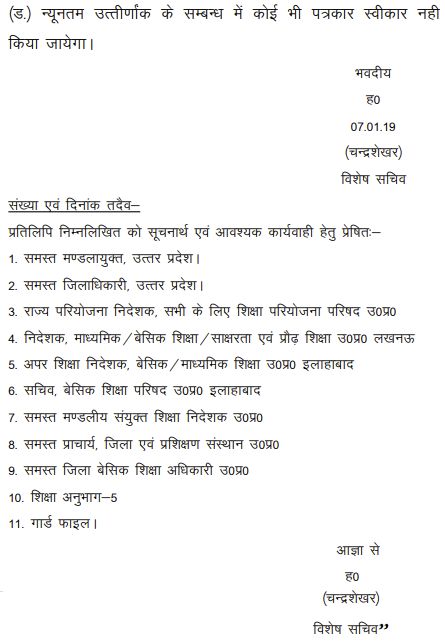
4. Learned Single Judge while deciding the bunch of writ petitions on the aforesaid issue, after considering the submissions and the position of law in its entity, has opined that the marks obtained in the open competition of ATRE-2019 has laid the just basis for implementing the Reservation Act, 1994 to compartmentalize the eligible candidates in their respective streams of vertical reservation and any further marks derived on the screening of other qualifications as per Rule 14 of the U.P. Basic Education (Teachers) Service Rules, 1981 (hereinafter referred as the ''Service Rules, 1981'') read with Appendix - I shall not alter the position for the purposes of migration from reserved category to an unreserved field, therefore, the vertical reservation once operated and implemented by the State at the stage of the result of the ATRE-2019, would bind all the eligible candidates in terms of the circular dated 7.1.2019. For the purposes of adjudication of the controversy at hand, we may take note of the facts, in brief, as under :
Facts:
5. The U.P. Basic Education Act, 1972 (hereinafter referred as the ''Basic Education Act, 1972'') was enacted to regulate and control the imparting of basic education in schools upto Class-VIII. Rule 19 of the Basic Education Act, 1972 empowers the State Government to make Rules for carrying out the purposes of the Act and Section 19(2)(a) and (c) of the Basic Education Act, 1972 empowers the State Government to make Rules relating to the recruitment and conditions of service of the persons appointed
AI
The court held that the reservation process must integrate all qualifying evaluations to ensure equitable treatment for candidates from reserved and unreserved categories, as mandated by law.

It is well-established that an authority cannot make any selection/appointment beyond the number of posts advertised, even if there were a larger number of posts available than those advertised.

(1) Reservation – Relaxation or concession in qualifying examination merely creates a level playing field where no concession or relaxation is granted in ultimate selection and same is solely made on....
Merit-based selection requires inclusion of qualified candidates from reserved categories in the unreserved list at the preliminary examination stage, ensuring compliance with equality and fairness p....

Reserved category candidates who received eligibility concessions cannot migrate to the unreserved category based on merit scores, as this would undermine educational standards.

Reserved category candidates who availed eligibility concessions cannot migrate to the unreserved category based on merit scores, as it undermines educational standards.
Reserved category candidates who score above the general category cut-off must be treated as general candidates, ensuring merit prevails in recruitment processes as mandated by the Constitution.

Reservation policies in public employment must prioritize merit; candidates from reserved categories who qualify for general positions based on merit are to be treated as general category candidates.

Candidates from reserved categories can claim horizontal reservations in open categories based on merit unless explicitly prohibited by law or policy.



An indispensable Tool for Legal Professionals, Endorsed by Various High Court and Judicial Officers
Please visit our Training & Support
Center or Contact Us for assistance

Scan Me!
India’s Legal research and Law Firm App, Download now!


For Daily Legal Updates, Join us on :



 Back to top


