
 Back
Back





IN THE HIGH COURT OF ALLAHABAD
SAURABH SHYAM SHAMSHERY, J.
Vyas Nath Tiwari and Others – Petitioners
Versus
A.D.C. Deoria and Others – Respondents
Writ (B) No. 3131 of 1979
Decided On : 04-01-2024
The legal judgment primarily addresses the issue of joint family status and property ownership within the context of land disputes and consolidation proceedings. The court emphasizes that the presumption of joint family status persists until it is explicitly rebutted by credible evidence. The burden of proof lies with the party asserting that the family has separated, and they must substantiate their claim with sufficient evidence.
The court found that the family remained joint until approximately 1928, despite a branch having separated about 100 years prior. Evidence such as mortgage deeds, family contributions to debts, and documents indicating joint dealings with property supported the conclusion that the family’s jointness persisted until that time. The authorities relied on previous legal findings and documentary proof to establish that the property was developed from a joint family nucleus, and that the joint family status continued until 1928.
Furthermore, the court clarified that the mere fact of family separation in one branch does not automatically imply that the entire family ceased to be joint. The presumption of jointness applies to the family as a whole, and the burden remains on the party claiming separation to prove otherwise. The court also noted that documents showing joint management of property and contributions to joint debts are significant indicators of joint family status.
In conclusion, the court upheld the findings of the lower authorities, confirming that the family remained joint until 1928 and that the property in dispute was acquired from joint family funds. The writ petition filed by the petitioners was dismissed, reinforcing the legal principle that the presumption of joint family status is strong and requires clear and convincing evidence to be overturned.
JUDGMENT :
SAURABH SHYAM SHAMSHERY, J.
1. This case is arising out of a consolidation proceedings. According to averment made in writ petition, original petitioners and original respondent Nos. 3 to 12 were descendants of a common ancestor namely, Madhu Nath. The pedigree which has not been in much dispute is part of writ petition being Annexure No. 1.
2. According to further averment, initially, land in dispute was recorded alone in the name of original petitioners and before settlement of 1324 fasli, name of Baldev alone was recorded in revenue records. Name of original respondents were never recorded before consolidation commenced.
3. There had been a prior litigation between the parties. A suit under section 229-B of U.P. Zamindari Abolition and Land Reforms Act, 1950 was filed by some of original respondents against original petitioners which was decree on 14.03.1967, therefore, names of respondents i.e. descendants of Beni Sevak and Rajmani were entered in revenue record, as co-tenure holders over Khatas in dispute.
4. The decree was challenged by way of filing an appeal at behest of original petitioners, which was allowed by an order dated 21.6.1968. A second appeal thereof, was filed by original contesting respondents before the Board of Revenue, and since consolidation proceedings commenced, therefore, second appeal was abated. It was further averred that name of respondents were recorded in pursuance of decree, which was later on set aside in appeal, therefore, their names were wrongly continued in revenue records. There is no dispute that land belongs to different Khatas situated in three different villages.
5. During consolidation proceedings, various objections were filed. The Consolidation Officer has consolidated all objections filed in respect of different khatas situated in three villages and by a common order dated 24.11.1972, held that original petitioners alone were tenure holders of land in dispute and it was directed that name of contesting respondents be expunged and be deleted from revenue records.
6. In aforesaid circumstances, the original contesting respondents filed an appeal. The Settlement Officer Consolidation, Deoria, Sadar by order dated 27.12.1973 held that whole family except, branch of Ramswarup which had separated earlier (about 100 years ago) was joint till the year 1928, whereas case of original petitioners was that when branch of Ramswarup got separated, entire family got separated and thereafter each branch of family have acquired property on its own, manage it and not from nucleus of joint family.
7. Sri H.N. Singh, learned Senior Counsel assisted by Sri Anup Kumar Srivastava, learned counsel for petitioners has submitted that reliance placed by Appellate Authority on a judgment passed by this Court in a case of Achuta Nand Tewari and others and others vs. Chandrabali Nath Tewari and others, AIR (33) 1946 Allahabad 142 between same parties, wherein it was held that family remained joint and since they have contributed in a sale deed which was subject matter of above referred judgment, therefore property was from nucleus of joint family was erroneous as issue of jointness of family was not an issue in that case. According to petitioners, entire family got separated many years ago and though they have acquired property not from any nucleus of joint family as alleged by respondents. He referred following paragraph of aforesaid judgment:
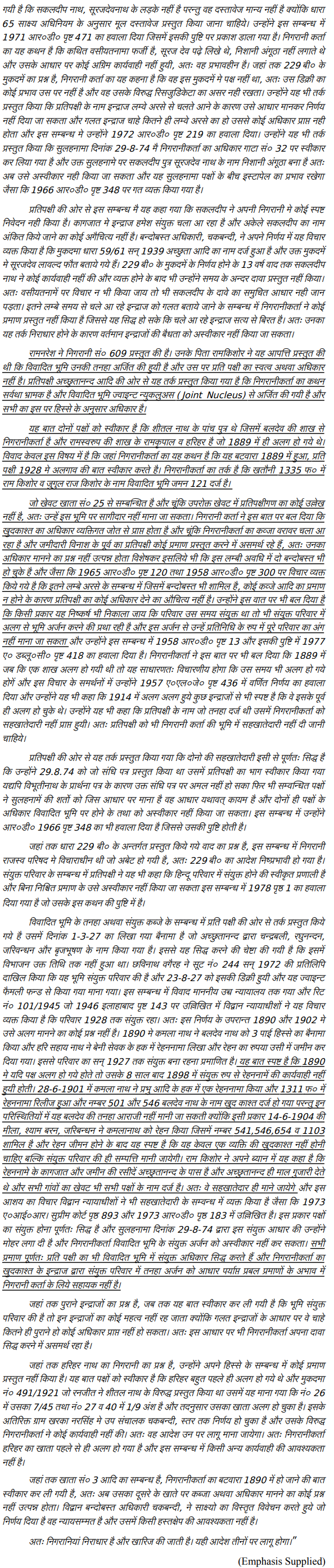
“Coming now to the two promissory notes executed on the 28th of February, 1927, by Jarbandhan and Ram Kishore, we find that they were discharged in the following manner. On the 26th of June, 1927, four promissory notes were executed by different members of this family in favour of different persons. The first was executed for a sum of Rs. 125 by Chandrabali in favour of Sumari Ahir, the second by Ram Kishore also for a sum of Rs. 125 in favour of Pranpati Hajjam, the third by Jarbandhan for a sum of Rs. 175 in favour of Budhu and the fourth by Raghunandan for a sum


AI
The presumption of joint family status persists until proven otherwise, with the burden of proof on the party asserting separation.
The presumption of joint family status persists until proven otherwise, with the burden of proof on the party asserting separation, supported by historical documentation.

The burden of proof lies on the party asserting property as Joint Hindu Family property, and mere assertions without evidence are insufficient to establish ownership.
Co-tenancy claims require demonstration of ancestral ties and continuity; mere presumption of joint heritage is insufficient for property claims.

The burden of proof rests on the claimants to establish joint ownership of property, which requires evidence of unbroken continuity of joint possession throughout generations, as mere assertions are ....
The presumption of joint family property does not arise solely from the existence of a joint family; the burden of proof lies on the claimant to establish that property was acquired from joint family....
The burden of proof lies on the party asserting that property is joint family property, and mere existence of a joint family does not create a presumption of joint ownership.



An indispensable Tool for Legal Professionals, Endorsed by Various High Court and Judicial Officers
Please visit our Training & Support
Center or Contact Us for assistance

Scan Me!
India’s Legal research and Law Firm App, Download now!


For Daily Legal Updates, Join us on :



 Back to top


