
 Back
Back





IN THE HIGH COURT OF ALLAHABAD
SAURABH SHYAM SHAMSHERY, J.
Shekhar And 3 Others – Appellant
Versus
State Of Up And 6 Others – Respondent
WRIT - B No. - 2412 of 2024
Decided on : 26-11-2024
| Table of Content |
|---|
| 1. factual background of the case proceeding. (Para 1 , 2 , 3 , 4 , 5) |
| 2. arguments regarding consent and misrepresentation. (Para 6 , 10 , 11 , 12 , 13 , 14) |
| 3. court's observations on appeals and consent decree. (Para 15 , 17 , 18) |
| 4. legal reasoning on challenging consent decree. (Para 19 , 20) |
| 5. conclusion on petitioners' remedy against consent decree. (Para 22) |
JUDGMENT :
Saurabh Shyam Shamshery,J.
1. Heard Sri Anil Bhushan, learned Senior Counsel assisted by Sri Pratik Chandra, learned counsel for the petitioners, Sri Chaudhary Subhash Kumar, learned counsel for the respondent no.5 and Sri P.S. Chauhan, learned Standing Counsel for State respondents.
2. This case is arising out of proceedings initiated by the respondent no.5 by way of filing a suit under Section 116 of Uttar Pradesh Revenue Code, 2006 (hereinafter called the ‘Code 2006’) for division of holding of plot in question claiming to be joint owners along with contesting defendants/respondents.
3. Present petitioners opposed it and filed a written statement.
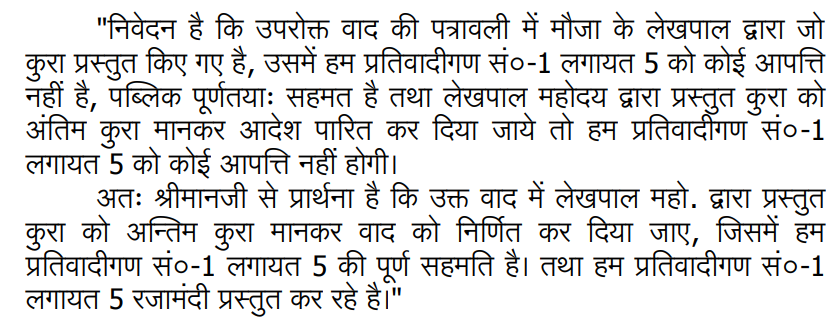
4. Learned Trial Court prepared a preliminary decree on basis of a report submitted by the Lekhpal on 12.6.2023 and accordingly Kurras were prepared on 16.8.2023. Objections were invited, however, present petitioners submitted an application on 20.9.2023 that they have no objection to the proposed Kurras. Said consent is being reproduced hereinafter:
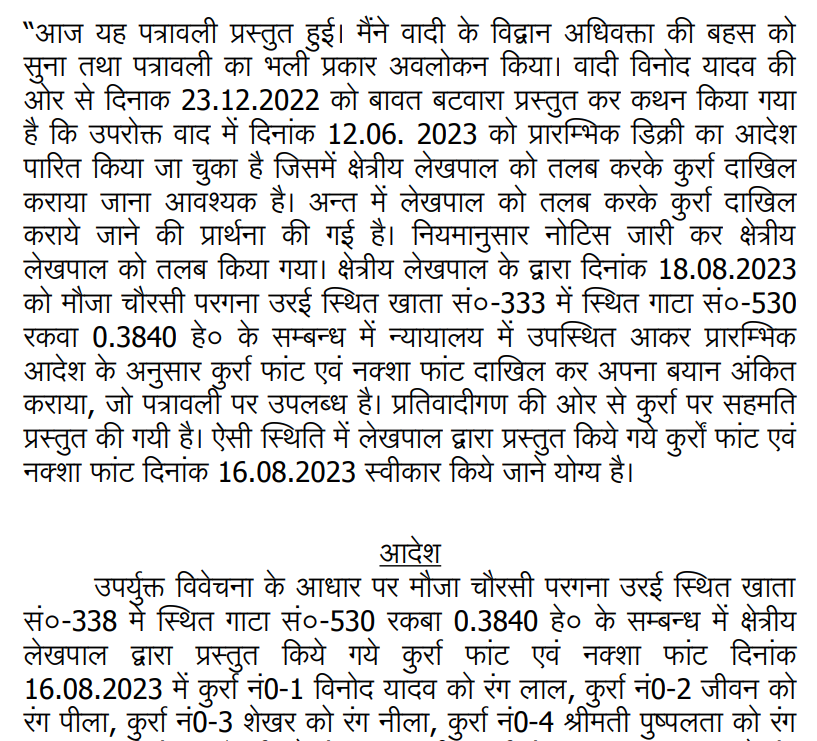
5. On the basis of above consent, learned Trial Court passed order dated 20.9.2023 and accordingly a final decree was passed on the basis of Kurras earlier proposed on 27.9.2023. For reference, same is reproduced hereinafter:


6. Petitioners before this Court filed an Appeal under Section 208 of Code, 2006 on 1.2.2024, along with an application for condonation delay. In the said appeal, a ground was taken that consent was procured on misrepresentation though the Kurras prepared were contrary to established procedure.
7. Above referred appeal was dismissed on ground being not- maintainable in view of Section 209 (g) of Code, 2006 which bars that a consent decree cannot be challenged by way of filing a first appeal. Relevant part thereof is mentioned hereinafter:
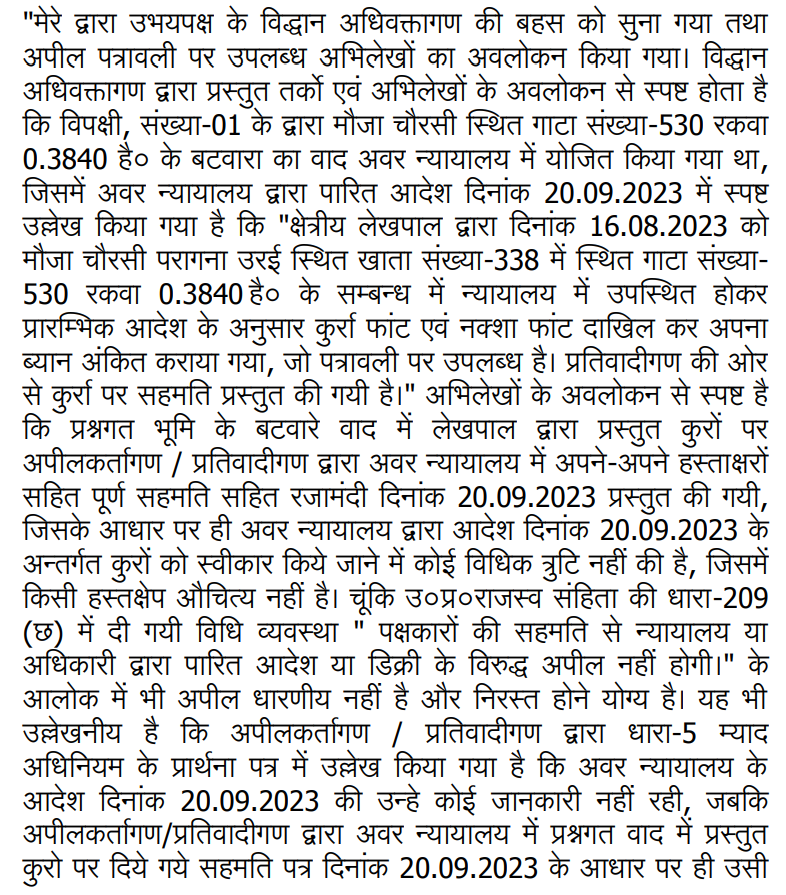
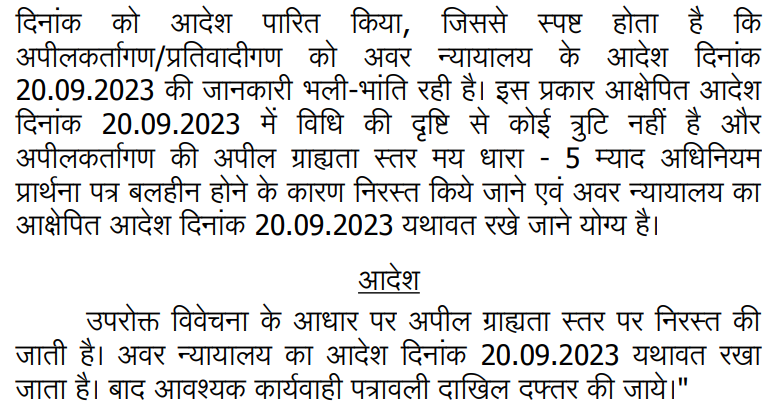
8. In the aforesaid circumstances, present petitioners filed a Second Appeal before the Board of Revenue, but same was also dismissed at the stage of admission on same ground that first appeal was not maintainable in view of Section 209 (g) of Code, 2006 . Relevant part thereof is mentioned hereinafter:
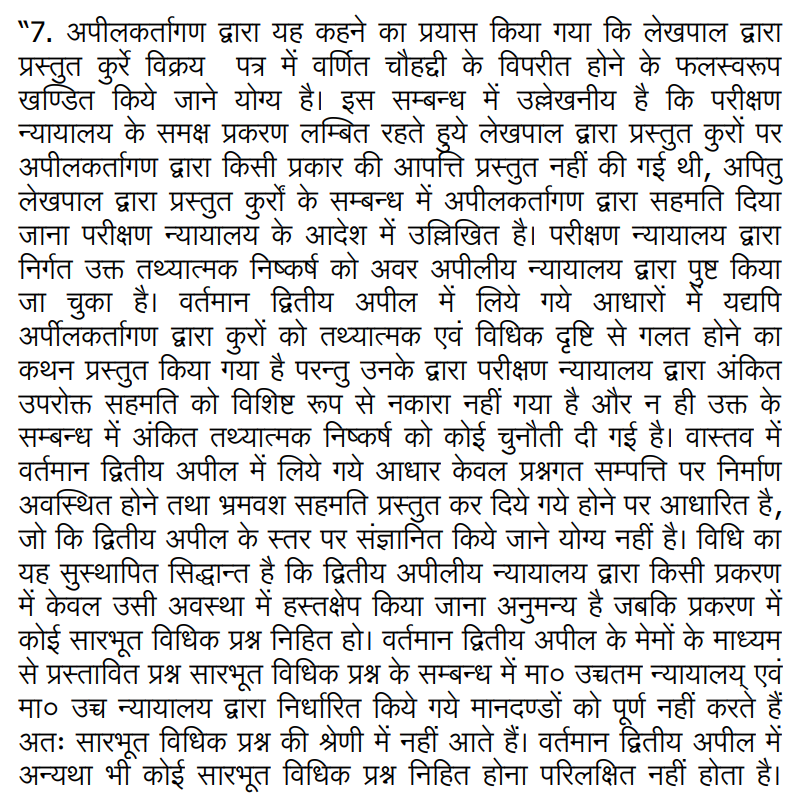
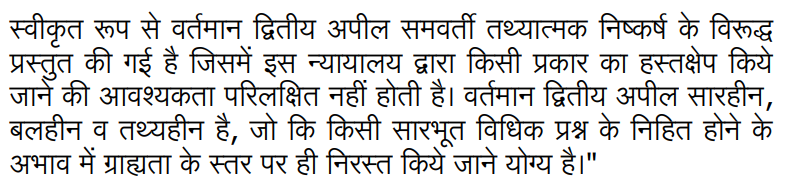
9. In aforesaid circumstances present writ petition has been filed.
10. Learned Senior Counsel appearing on behalf of petitioners has submitted that consent was obtained by misrepresentation since petitioners were assured that Kurras will be prepared on basis of possession without any prejudice. However, on spot Kurras were prepared contrary to it. Though it has not been specifically denied that application for consent was signed by the petitioners.
11. Learned Senior Counsel further submitted that Rule 109 of U.P. Revenue Code Rules, 2016 provides a mandatory procedure that on Kurras prepared by Lekhpal/Tehsildar, learned Trial Court shall invite objections, therefore, even if consent was given, mandatory requirement could not be skipped. He further submitted that bar as mentioned in Section 209 (g) of Code, 2006 does not bar a challenge to the consent decree if the consent was obtained on fraud as it is well established that fraud vitiates every solemn act.
12. Learned Senior Counsel placed reliance on judgments passed by Supreme Court in the case of Banwari Lal Vs. Chando Devi (through L.R.) and Ors, (1993) 1 SCC 581 ; A.V.Papayya Sastry & Ors. Vs. Government of A.P. & Ors, (2007) 4 SCC 221 ; Ved Pal (D) through, L.Rs & Ors. Vs. Prem Devi (D) through L.Rs & Ors, (2018) 9 SCC 496 ; Vipan Agarwal & Ors. Vs. Raman Gandotra & Ors (2023) 10 SCC 529 and Prasanta Kumar Sahoo & Ors. Vs. Charulata Sahu & Ors. (2023) 9 SCC 641 .
13. Per contra, learned counsel for the respondents has submitted that petitione
AI
A consent decree obtained by fraud must be challenged in the court that issued it; separate suits for challenge are not maintainable.


An appeal against a consent decree is barred under Section 96(3) of the CPC; aggrieved parties must contest the decree's validity in the same court that issued it.

An independent suit challenging a consent decree is barred under Order XXIII Rule 3A of the C.P.C. if the allegations of fraud are predominantly about breach/non-compliance of the consent terms/conse....

A consent decree obtained through fraud is challengeable by a third party, and such a challenge does not require an independent suit.

A consent decree obtained through fraud is void, and courts must investigate claims of fraud before accepting the decree as valid.


A party aggrieved by a compromise decree has a right to challenge the compromise decree by way of an appeal or to approach the same court which passed such decree by way of an appropriate application....
A consent decree obtained by fraud is a nullity and can be challenged in any court, reinforcing the principle that fraud vitiates all judicial acts.



An indispensable Tool for Legal Professionals, Endorsed by Various High Court and Judicial Officers
Please visit our Training & Support
Center or Contact Us for assistance

Scan Me!
India’s Legal research and Law Firm App, Download now!


For Daily Legal Updates, Join us on :



 Back to top


