
 Back
Back





HIGH COURT OF JUDICATURE FOR RAJASTHAN AT JODHPUR
KULDEEP MATHUR, J.
Seva Singh S/o Indra Singh – Appellant
Versus
The State of Rajasthan – Respondent
S.B. Civil Writ Petition No. 18416 of 2025
Decided On : 08-10-2025
ORDER :
1. The present writ petition has been filed under Article 226 of the Constitution of India by the petitioner being aggrieved by the order dated 10.09.2025 passed by the learned Board of Revenue, Ajmer in Appeal No.TA/1261/2019 whereby the order passed by the learned Revenue Appellate Authority (RAA) dated 15.03.2019 remanding the matter back to learned Assistant Collector, Tibbi has been maintained.
2. Learned counsel for the petitioner submitted that the present petitioner filed a suit for declaration of his tenancy rights before the learned Assistant Collector, Tibbi under Sections 88 and 53 of the Rajasthan Tenancy Act. Learned counsel submitted that during pendency of the revenue suit, both the parties had entered into a compromise. On the basis of the written compromise produced before the learned Assistant Collector, Tibbi, the suit was decreed vide order dated 13.02.2012.
3. Learned counsel submitted that the respondent No.3 against the compromise deed dated 13.02.2012 preferred an appeal before the learned RAA. The appeal was contested by the petitioner on the ground that appeal against the compromise decree passed by the learned Assistant Collector, Tibbi is not maintainable in view of the express bar contained in Section 96 (3) of CPC. However, the contention raised on behalf of the petitioner was not accepted by the learned RAA on ground that the compromise decree was obtained on the basis of blank signed papers of the respondent No.3 available with the petitioner. Further, the signatures of the respondent No.3 were not obtained on the order sheet before passing the compromise decree by the learned Assistant Collector, Tibbi. The judgment/order passed by the learned RAA has been further maintained by the learned Board of Revenue, Rajasthan Ajmer.
4. Learned counsel submitted that the respondent No.3 had also filed an FIR No.188/2012 under Sections 406 , 420, 417, 465, 466, 471 and 120-B of IPC against petitioner and other co- accused alleging inter alia that they have obtained a consent decree from the Court of Assistant Collector, Tibbi by using the blank papers containing his signatures and vakalatnama which was given to the petitioner for using the same in the ceiling proceedings before the learned Divisional Commissioner, Bikaner. Learned counsel contended that the police after making thorough investigation in the matter has filed a negative final report in relation to FIR No.188/2012 which was accepted by the competent criminal Court. According to the learned counsel, the civil and criminal proceedings have been initiated by the respondent No.3 in the present case after consent decree being passed by the Court of Assistant Collector, Tibbi only with a view to keep the dispute alive and pressurize the present petitioner to enter into re- settlement with the present petitioner. It was further urged that appeal against the compromise decree should not have been entertained being barred by Section 96 (3) of CPC. On these grounds, learned counsel for the petitioner prayed that impugned orders passed by the learned RAA and learned Board of Revenue, Ajmer may be quashed and set aside. He has placed reliance on the precedent set by the Hon’ble Supreme Court of India in the case of Pushpa Devi Bhagat (D) Th. Lr. Smt. vs. Rajinder Singh & Ors. (2006) 5 SCC 566 so also this Court in the case of Smt. Basanti Devi & Ors. vs. State, S.B. C.W.P. No. 2479/2006 decided on 22.11.2021.
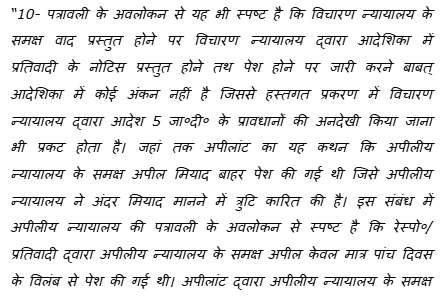
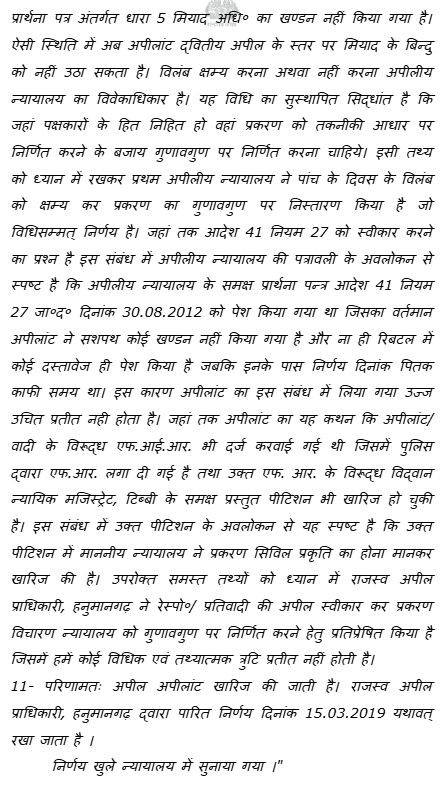
5. Per contra, learned counsel for the respondent submitted that a bare perusal of the impugned orders passed by the learned RAA and the learned Board of Revenue, Ajmer would clearly indicate that no compromise as alleged by the petitioner has been entered between the parties. The compromise degree was obtained by the petitioner by playing fraud with the Court and on the basis of his signatures on the papers which were handed over to the petitioner and his father at the time when the ceiling proceedings were being conducted jointly against
AI
A consent decree obtained through fraud is void, and courts must investigate claims of fraud before accepting the decree as valid.


An appeal against a consent decree is barred under Section 96(3) of the CPC; aggrieved parties must contest the decree's validity in the same court that issued it.

An appeal is not maintainable from a compromise decree under Section 96(3) of CPC, and the compromise decree confers only a right in personam and is not binding on parties who are not part of the com....

A party can appeal against a compromise decree to challenge its validity despite Section 96(3) CPC barring appeals against such decrees.

A consent decree obtained by fraud must be challenged in the court that issued it; separate suits for challenge are not maintainable.

(1) Compromise decree - A party that accepts compromise is bound by it and cannot appeal - A party that denies compromise must first raise that dispute before Trial Court - A fresh suit is no longer ....
(1) No suit shall lie to set aside a decree on the ground that compromise on which decree is based was not lawful.(2) Mere clever drafting would not permit plaintiff to make suit maintainable which o....

A consent decree obtained through fraud is challengeable by a third party, and such a challenge does not require an independent suit.

A suit challenging a compromise decree not challenged, but the compromise itself is called into question, would be barred by the provisions of Order XXIII Rule 3A of CPC. Additionally, a third party,....



An indispensable Tool for Legal Professionals, Endorsed by Various High Court and Judicial Officers
Please visit our Training & Support
Center or Contact Us for assistance

Scan Me!
India’s Legal research and Law Firm App, Download now!


For Daily Legal Updates, Join us on :



 Back to top


