
 Back
Back





IN THE HIGH COURT OF ALLAHABAD
Ajay Bhanot, Siddharth Khare, JJ.
Anil Kumar – Appellant
Versus
State of U.P. and Others – Respondents
Writ Appeal No. 930 of 2020
Decided On : 26-11-2024
| Table of Content |
|---|
| 1. petitioner denied appointment due to lower marks. (Para 1 , 2) |
| 2. petitioner's argument for higher marks in other districts. (Para 3 , 4) |
| 3. interpretation of directory nature in preference in recruitment. (Para 5 , 6) |
| 4. judicial precedents on preference in service appointments. (Para 7 , 8 , 9) |
| 5. entitlement established for consideration in other districts. (Para 10) |
| 6. writ petition allowed; claim processing directed. (Para 11 , 12) |
JUDGMENT :
Ajay Bhanot, J.
1. Heard Sri Siddharth Khare, learned counsel for the petitioner and Sri Ashok Kumar Yadav, learned counsel for respondent no.3 and learned Standing Counsel for the State.
2. By the impugned order dated 28.11.2019, the petitioner has been denied appointment as Assistant Teacher on the footing that he had obtained lower marks than last selected candidate in all the six districts for which he opted in the application form.
3. Sri Siddharth Khare, learned counsel for the petitioner contends that the petitioner has higher marks than other candidates in different districts and further, a number of vacancies are existing in different districts. The petitioner can be appointed against the said vacancies.
4. Shri K Shahi, learned counsel for the BSA submits that the petitioner cannot seek appointment beyond his options. The relevant rule pertaining to filling up the options is extracted hereunder:
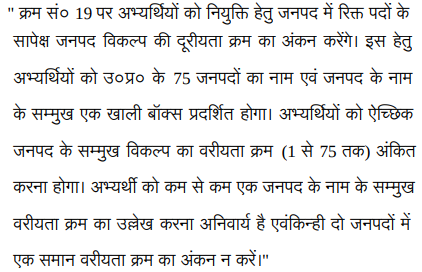
5. Perusal of the aforesaid Rule shows that the aforesaid requirement for filling up options in different is a directory in nature. At best the petitioner is required to fill up one option. The candidates cannot be non-suited for failing to fill 75 options pertaining to all the districts. The petitioner is entitled to be considered by the respondent even for appointment in other districts which he had not opted for in the application form.
6. The assertion of the petitioner that his marks obtained by him are higher than the cut-off merit for other districts has not been disputed by the respondents. The petitioner’s case is liable to be considered for appointment in other districts as per merit.
7. While determining the directory character of the preferences in recruitment process the Patna High Court in the case of Ram Bilash Ram vs. State of Bihar and others , 1986 SCC OnLine Pat 268 has been held as under:
"11. So, the ordinary meaning of "preference" is to give priority to one over another. It would mean that by giving preference to one the person shows his liking for it over the others. This does not mean that by giving preference or priority to one, he shows his dislike for others and opts against them. So, if the appellant gave preference to some services/posts, it cannot be said that he has withdrawn his candidature for the rest of the services/ posts. Any contrary inference drawn on the basis of preference list would be opposed to the principle of natural justice. If one says that he prefers a five-roomed house, it cannot be interpreted to mean that he would not accept a four-roomed house if no five- roomed house is made available to him. The term "preference" always indicates that the person has a choice to make. It cannot be interpreted to mean that if he is not offered the thing for which he has shown his preference, he will not accept the other things offered to him for which also he was otherwise eligible and for which also he was candidate from the very beginning. If the applicant had no choice left with him, as he was not found suitable for the services/posts for which he had shown preference, it cannot be said that he has abandoned his claim for the rest of the services, as it cannot be presumed that he would prefer to remain unemployed, if he did not get services/posts of his choice."
8. The aforesaid judgment was cited with approval by the Supreme Court in Union of India and Ors. vs. Probir Ghosh and Ors. (2022) 12 SCC 250 .
9. Similarly in the case of Union of India vs. M.V.V.S. Murthy , 1987 Supp SCC 371 , the Supreme Court has held as under:
"5. Indisputably t
AI
The directory nature of preference in recruitment allows candidates to be considered for unselected positions without abandoning their claims.

Recruitment processes must prioritize merit over district preferences, particularly when unfilled vacancies exist, ensuring compliance with constitutional guarantees of equality in public employment.

Candidates indicating preference for one service and failing to meet cut-off marks cannot claim selection in others, as upheld by the Supreme Court.

Preference based on district domicile in teacher selection cannot override merit; inclusion in the merit list does not confer an indefeasible right to appointment.
Preference in public service selection cannot override established merit, as legal precedent dictates that meritorious candidates must be prioritized irrespective of residency criteria.


The allocation of postings must be fair, transparent, and based on established merit principles, ensuring that no employee is arbitrarily deprived of their rightful position.
A candidate's inclusion in a select list does not confer an indefeasible right to appointment; the authorities have discretion in the selection process.



An indispensable Tool for Legal Professionals, Endorsed by Various High Court and Judicial Officers
Please visit our Training & Support
Center or Contact Us for assistance

Scan Me!
India’s Legal research and Law Firm App, Download now!


For Daily Legal Updates, Join us on :



 Back to top


