
 Back
Back





IN THE HIGH COURT OF JUDICATURE AT ALLAHABAD
ATUL SREEDHARAN, SIDDHARTH NANDAN, JJ.
Mala Devi – Appellant
Versus
State of U.P. and Others – Respondents
Writ (C) Nos. 7028, 7029, 7050, 7052 of 2026
Decided On : 20-03-2026
| Table of Content |
|---|
| 1. challenge to rejection of claim under benefits scheme. (Para 1 , 2) |
| 2. arguments regarding limitation period and delays in filing claims. (Para 3 , 4 , 5 , 6 , 17 , 18) |
| 3. analysis of reasonableness in limitation and public interest. (Para 7 , 8 , 9 , 10 , 11 , 12 , 13 , 14 , 15 , 16) |
| 4. condonation of delay and natural justice principles. (Para 26 , 29 , 30 , 31 , 32 , 33 , 34 , 35 , 36) |
| 5. directive for petitioner to file affidavit explaining delay. (Para 38 , 39) |
JUDGMENT :
SIDDHARTH NANDAN, J.
1. Heard Shri Ajeet Kumar Srivastav, Shri Amit Kumar Srivastava, Shri Kamal Kumar Singh, Shri Anil Kumar Yadav, Shri Prem Prakash Yadav learned counsel appearing on behalf of the parties. Sri Ansul Nigam, learned Standing Counsel for the State-respondents.
2. The present set of writ petitions have been filed challenging the orders by way of which the District Level Committee has rejected the claim of the petitioners, seeking the benefit of Mukhyamantri Krishak Durghatana Kalyan Yojana; and reasons assigned for the rejection of claim of all the petitioners are as follows:-

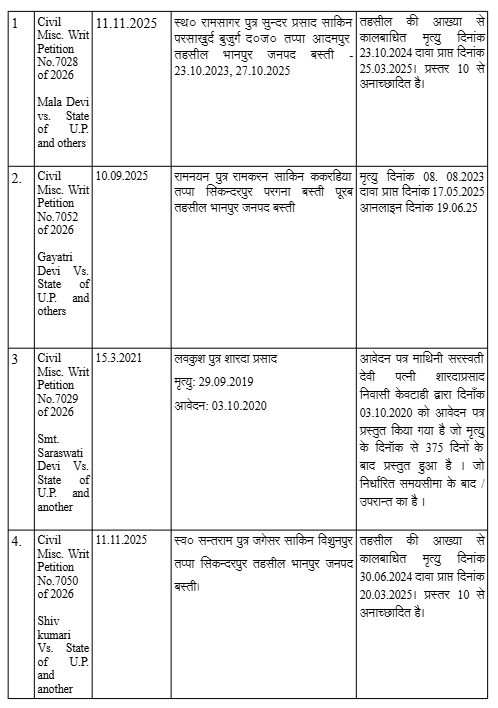
3. Counsel for the petitioner has attracted our attention to the Scheme, wherein under Clause-10 it has been provided, that the claim has to be registered within a period of 45 days before the concerned Tehsil Office and the authority shall have a leverage to extent the period by another one month but in "any case" the period may not be extended beyond a period of 75 days.
4. A coordinate Bench of this Court in the case of Gautam Yadav Vs. State of U.P. and others , 2020 (11) ADJ 321 has held that the period of limitation provided under the said scheme is unreasonable and arbitrary; and after discussing the provision of Limitation Act, 1963, had held that the period should be three years instead of 75 days.
5. Learned Standing Counsel has relied upon an interim order granted by the Apex Court in National Insurance Com. Ltd. Vs. Gautam Yadav and others , Special Leave to Appeal No. 7647 of 2021 to say that, the direction for all claims filed within a period of three years from the date of rejection should be treated as within limitation, has been stayed. For ready reference the said interim order is quoted herein below:-
"In compliance of this Court?s order dated 02.07.2021, the petitioner has paid the sum of Rs. 5 lakhs to the respondent no.1 and has filed proof of making such payment.
Issue notice, returnable in six weeks.
Though notice is being sent to respondent no.1, he need not to appear, as the payment has already been made to him.
In the meanwhile, the direction in the impugned order, that all claims filed within a period of three years from the date of rejection should be treated as within limitation, shall remain stayed.?"
6. Learned counsel for the petitioner has relied upon decisions of a coordinate Bench of this Court in Smt. Maya Devi Vs. The State of U.P. and others , Writ (C) No. 39605 of 2023 and Usha Devi Vs. State of U.P. and others , Writ (C) No. 7300 of 2026 to contend that the interim order of the Apex Court has been construed to stay the direction with regard to extension of limitation period of three years; but however it will have to be examined on the facts and the circumstances of each case, whether there was “sufficient cause” for the delay shown, in filing of the said claim.
7. Two things emerge from the aforesaid contentions, that:-
(1) firstly, as to what shall be the period of limitation for filing of a claim under the aforesaid scheme; and
(2) in case the claim has not been filed within a period of limitation, then whether claimant is entitled to give an explanation and hence, its consideration for the purposes of condonation of delay.
8. The concept of condonation of delay is distinct from enhancing the period of limitation-condoning delay does not extend the period of limitation but assess, as to whether the delay caused was beyond the control of the applicant; and this takes us to an issue, as to whether the applicant is entitled
AI
A claimant under the Mukhyamantri Krishak Durghatana Kalyan Yojana is entitled to explain delays in claim filing, with courts emphasizing principles of natural justice and reasonable interpretations ....

(1) Law of limitation is founded on public policy – Appeal which is preferred after expiry of limitation is liable to be dismissed.(2) Bar of limitation – Delay is not liable to be condoned merely be....

Inordinate delay of nearly two years not condoned due to lack of day-to-day explanation; natural disasters and administrative delays insufficient without proving diligence and bona fides, even for go....

The Court must balance the need for substantial justice against the necessity of adhering to procedural timelines, requiring satisfactory explanations for delays.

The law of limitation is strict and must be adhered to; bureaucratic delays are not sufficient grounds for condoning delays in filing appeals.
(1) Limitation – Condonation of delay – Phrase “within such period” signifies that period covered therein extends to not only original period within which, appeal or application, should have been fil....


The law of limitation applies equally to the State and private parties, with bureaucratic inefficiency not sufficient for condoning delay.



An indispensable Tool for Legal Professionals, Endorsed by Various High Court and Judicial Officers
Please visit our Training & Support
Center or Contact Us for assistance

Scan Me!
India’s Legal research and Law Firm App, Download now!


For Daily Legal Updates, Join us on :



 Back to top


